The Boy Who Rode a Peach
He floated into the world inside a giant peach — and grew up to march an army of animals straight into a demon's fortress. Was he ever really a peach at all?
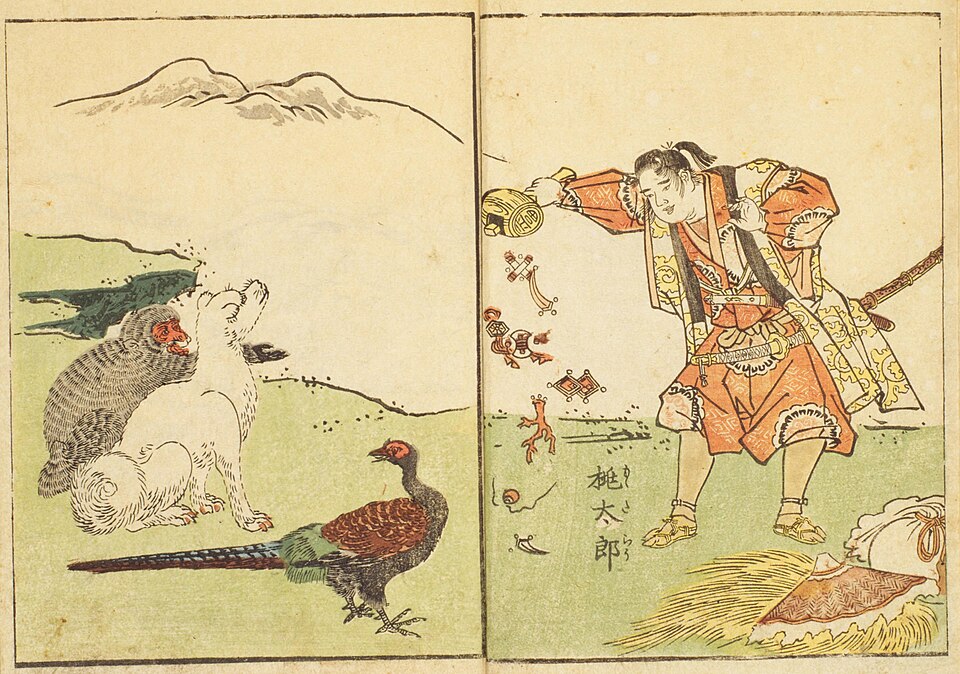
Long before Momotarō appeared in schoolbooks, he was already drifting through Japan's imagination in half-remembered, handwritten tales. An old, childless woman, washing clothes by a river, spots something enormous bobbing in the current: a peach far too large to be natural. She hauls it home, and when she and her husband try to cut it open to eat, a child bursts out. He tells them plainly that he has been sent by the gods to be their son. They name him Momotarō — momo for peach, tarō for eldest son — and by age five he is already strong enough to fell a great tree with nothing but an old knife.
As he grows into adolescence, Momotarō decides to leave the only parents he has known. Bands of Oni — demons or ogres — have been raiding the land, and he resolves to hunt them down at their source: a remote place called Onigashima, Demon Island. On the road there, he strikes up an unlikely alliance. A talking dog, a monkey, and a pheasant each agree to join his quest, paid in kibi dango, millet dumplings, from his own rations. Together, boy and beasts storm the demons' fortress, batter the Oni into surrender, and sail home with plundered treasure and the demon chief himself as a captive.
This is the version most people know today — the 'Standard Type' — and it became fixed in the popular mind largely because it was printed in Japanese school textbooks during the Meiji era. But that tidy, triumphant story is the endpoint of centuries of retelling, not the beginning.
The tale's oral roots may stretch back to the Muromachi period, between 1392 and 1573, but it wasn't committed to paper until the Edo period, sometime after 1603. The earliest known written texts date to the Genroku era, roughly 1688 to 1704, though the originals from that time have since been lost. What survives are later reprints, like the Saihan Momotarō mukashigatari from around 1777, believed to preserve the older tradition, and a tiny book from 1723 called simply Momotarō — now considered the oldest surviving copy of the story in any form.
These Edo-period texts tell a recognizably similar story but differ in curious details. Instead of kibi dango, the oldest versions give Momotarō tō dango and other treats to share with his companions. The old man in these earlier tellings goes out to cut grass rather than kindling. The dog, monkey, and pheasant all still appear, though their order varies — and in one striking variant, the dog gets only half a portion of food, the monkey comes willingly, and Momotarō has to threaten the pheasant into joining him.
More from Mythology

The Doctor Who Sang a Nation Into Being
A country doctor rode into the forests of Karelia armed with nothing but a notebook — and rode out with the soul of a nation.

The Boat That Carried the Sun
Every sunset, the ancient Egyptians believed, the sun climbed into a boat and sailed straight into the realm of the dead — only to fight a monstrous serpent before dawn could return.

The Wild Man of the Snows
At 21,000 feet, a colonel found tracks in the snow that he blamed on a wolf — but his guides knew better, and gave the world a name that would echo for a century.

The Knight Who Went Mad for Love: Orlando Furioso
A hero so devoted to duty he was Charlemagne's greatest paladin loses his mind—not to a sword wound, but to heartbreak. To cure him, a friend must ride a flying horse to the Moon.

The Book That Turned the World Into Myth
A poet condemned to exile spent his final years in Rome finishing a poem that would outlive empires—a poem about nothing standing still, not gods, not lovers, not even the shape of a man.

Paradise Lost: Milton's Rebel Angel
A blind poet, dictating verses in the dark, dared to explain the ways of God to men — and in doing so, made Hell's ruler unforgettable.