The Bronze Canopy Over a Saint's Bones
Sixty-six feet of gilded bronze, twisted like Solomon's own columns, rose over the tomb of a fisherman-turned-saint — and sparked a scandal about stolen Roman roofs.
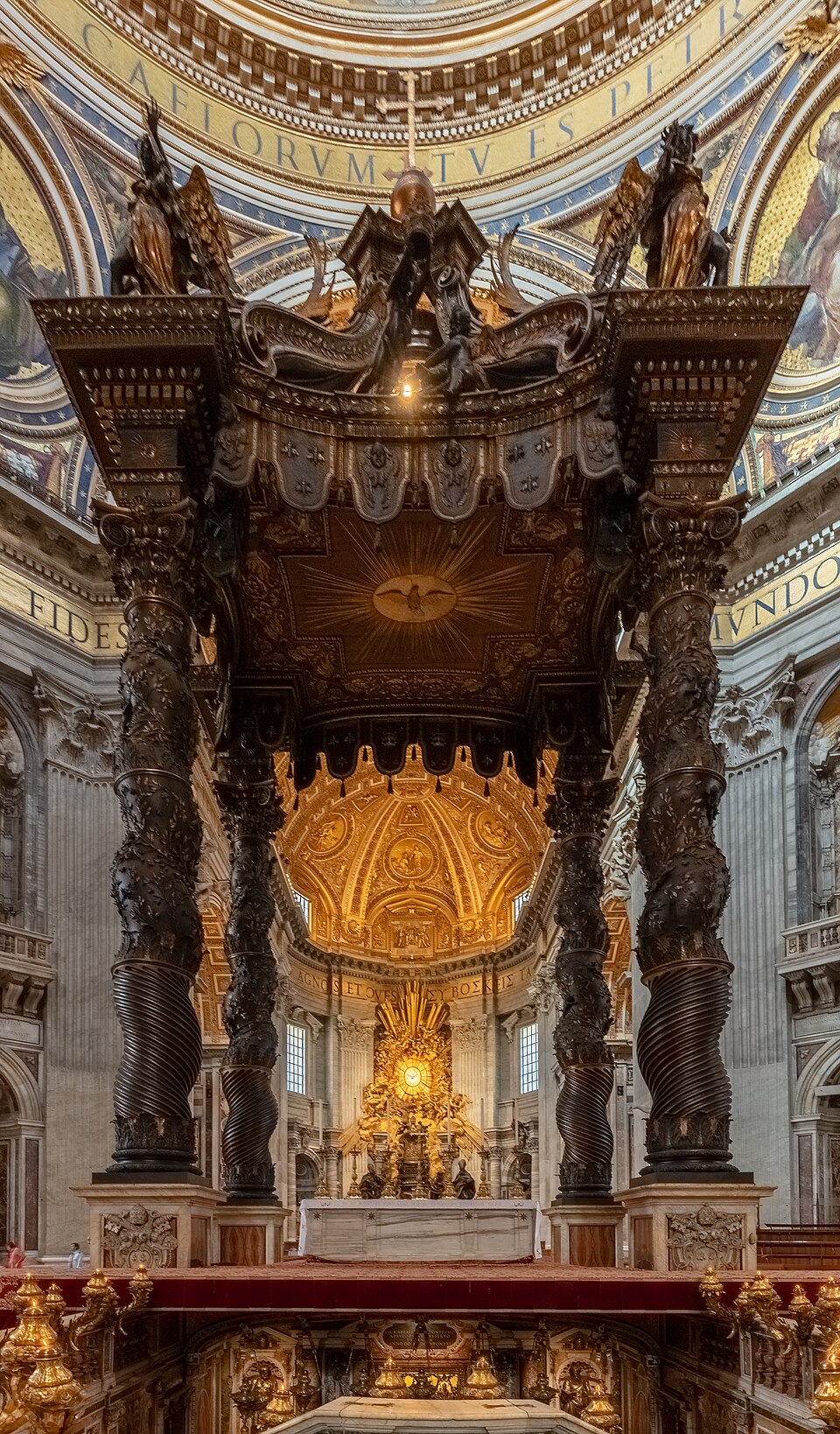
At the very center of St. Peter's Basilica, directly beneath Michelangelo's soaring dome, stands a structure so vast it could swallow a small palace, yet so finely wrought that it seems almost weightless. This is the baldachin, a bronze canopy marking the traditional site of Saint Peter's tomb, and it was the first work in which the young Gian Lorenzo Bernini fused sculpture and architecture into a single, breathing whole. Commissioned by Pope Urban VIII, work began in 1623 and continued for eleven years, finishing in 1634.
The idea of marking Peter's grave with a monumental canopy was not new. Old St. Peter's Basilica, like many major Roman churches, had once held its own ciborium, and Bernini's immediate predecessor, Carlo Maderno, had already drawn up a design featuring twisted Solomonic columns less than a decade earlier. The form itself echoed two older traditions: the funerary catafalque, fitting for a saint's grave, and the cloth baldacchino once carried above the pope's head on holy days, symbol of his role as Peter's successor.
Those twisted columns were not an aesthetic whim. The old basilica's altar screen had stood on ancient Solomonic columns, brought 'from Greece' by Constantine I and, by medieval belief, salvaged from the Temple of Jerusalem itself. Though genuinely Greek marble rather than biblical relics, they carried enormous sacred prestige, and eight of the original twelve still stand today, paired halfway up the piers flanking Bernini's baldachin.
Bernini's four columns rise twenty meters, or sixty-six feet, each cast in pieces — base and capital separately, the shaft in three sections. Atop the cornice, which curves gracefully inward on each side, four angels stand twice life-size, and above them four great volutes sweep upward to a smaller cornice crowned by a gilded cross resting on a globe, a symbol of the world redeemed. Bronze fringe, styled after the scalloped, tasselled border of a papal baldacchino, drapes from the cornice, while bees and laurel leaves — the heraldic emblems of the Barberini family, since Urban VIII was born Maffeo Barberini — decorate the whole structure. Beneath the canopy, directly above where the pope celebrates Mass, a radiant sun gleams, another Barberini emblem.
The bronze itself became a scandal. Rumor held that it had been stripped from the roof or portico ceiling of the ancient Pantheon, and a satirical lampoon pinned to the talking statue of Pasquino in Piazza Navona declared: Quod non fecerunt barbari, fecerunt Barberini — 'What the barbarians did not do, the Barberini did.' Urban's own accounts tell a more complicated story: roughly ninety percent of the Pantheon's bronze went instead into a cannon, while the baldachin's bronze actually came from Venice — still, the accusation stuck to the Barberini name.
More from Art

The Painting With No Foreground
A single robed figure stares out at an empty grey sea — and the emptiness itself became a scandal. When it was unveiled in Berlin in 1810, no one knew quite what to do with it.

The Painter Who Chased the Light
For a few purple minutes each evening, an American exile knelt in an English garden and raced the dying sun to paint two little girls lighting lanterns. It took him two years to finish.

When a President Became a God
Look straight up inside the U.S. Capitol dome and you will find George Washington enthroned among the clouds, surrounded by goddesses — the founding father transformed into myth.

Marble Brought Back to Life
A corpse asleep, a wing barely brushing her skin — and marble somehow learns to breathe. This is the moment Antonio Canova dared to carve.

The World Turned Upside Down
Look closely at a sixteenth-century Flemish village and you'll find a man biting a pillar, another carrying daylight in a basket, and a wife slipping a blue cloak over her husband's shoulders. Every gesture is a joke — if you know the language.

The Girl in the Glass Case
She stood two-thirds life size, dressed in a real tutu and human hair — and the critics who saw her in 1881 recoiled as if she were something obscene.