The Bronze Mermaid Who Kept Losing Her Head
She weighs less than an average man and stands barely taller than a child, yet for over a century she has been beheaded, blown off her rock, and dressed in a burqa. Copenhagen's tiniest icon has survived more violence than most monuments twice her size.
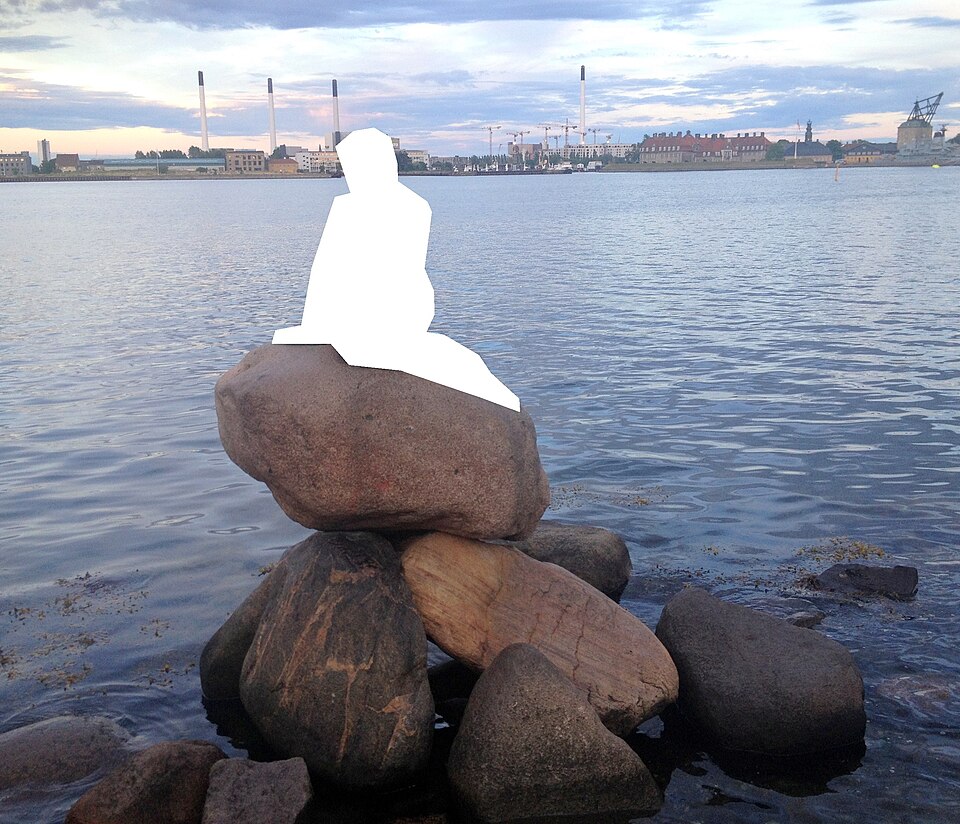
On a rock at the edge of the Langelinie promenade in Copenhagen sits a bronze figure just 1.25 metres tall, weighing 175 kilograms — smaller than most visitors expect when they first glimpse her. She is the Little Mermaid, and despite her modest size she has become one of the most recognizable statues in the world, standing alongside the likes of the Statue of Liberty, Christ the Redeemer, and Brussels' Manneken Pis as a symbol of her city.
Her story begins not with the sea but with the ballet. Carl Jacobsen, son of the Carlsberg brewery's founder, was so taken with a Royal Theatre ballet based on Hans Christian Andersen's 1837 fairy tale that he commissioned a statue in 1909. He asked the ballerina who danced the role, Ellen Price, to model for it. She agreed to lend her face — but refused to pose nude. So sculptor Edvard Eriksen turned to his own wife, Eline Eriksen, who modelled the entire body. A popular myth still insists the face was Price's too; it is false, though the legend has proven more durable than most of the statue's actual body parts.
The statue was unveiled on 23 August 1913, and quickly settled into her role as harbor-side curiosity and tourist magnet. For decades she sat quietly on her rock, watching ships pass. That peace ended in the 1960s, when the mermaid became, unexpectedly, a canvas for protest and vandalism, starting with a paint attack on 18 April 1963 and continuing with another paint incident on 17 July 1976.
The first major assault came on 24 April 1964, when Situationist artists — including Jørgen Nash — sawed off her head and stole it. It was never recovered; a new head was cast to replace it. Two decades later, on 22 July 1984, two young men severed her right arm, though it was returned the following day. In 1990, another attempt to decapitate her left an 18-centimetre gash in her neck without finishing the job.
The attacks kept coming. On 6 January 1998 she lost her head yet again; the culprits were never identified, but the head turned up anonymously at a nearby television station and was reattached on 4 February. White paint was poured over her on 1 June 2003, and just months later, on the night of 10 September 2003, explosives knocked her clean off her base and into the harbor, blasting holes in her wrist and knee. More paint attacks followed — red paint from Christiania residents on 15 May 2007, plus a March 2007 incident — and on 8 March 2006 a dildo was placed in her hand alongside green paint and the date written on it, apparently tied to International Women's Day.
More from Art

The Painting With No Foreground
A single robed figure stares out at an empty grey sea — and the emptiness itself became a scandal. When it was unveiled in Berlin in 1810, no one knew quite what to do with it.

The Painter Who Chased the Light
For a few purple minutes each evening, an American exile knelt in an English garden and raced the dying sun to paint two little girls lighting lanterns. It took him two years to finish.

When a President Became a God
Look straight up inside the U.S. Capitol dome and you will find George Washington enthroned among the clouds, surrounded by goddesses — the founding father transformed into myth.

Marble Brought Back to Life
A corpse asleep, a wing barely brushing her skin — and marble somehow learns to breathe. This is the moment Antonio Canova dared to carve.

The World Turned Upside Down
Look closely at a sixteenth-century Flemish village and you'll find a man biting a pillar, another carrying daylight in a basket, and a wife slipping a blue cloak over her husband's shoulders. Every gesture is a joke — if you know the language.

The Girl in the Glass Case
She stood two-thirds life size, dressed in a real tutu and human hair — and the critics who saw her in 1881 recoiled as if she were something obscene.