The Bronze That Dared to Bleed
On a spring day in 1554, a Florentine duke watched from a palace window to see whether his city would accept a monster's severed head cast in gleaming bronze — and whether the sculptor who made it would survive the verdict.
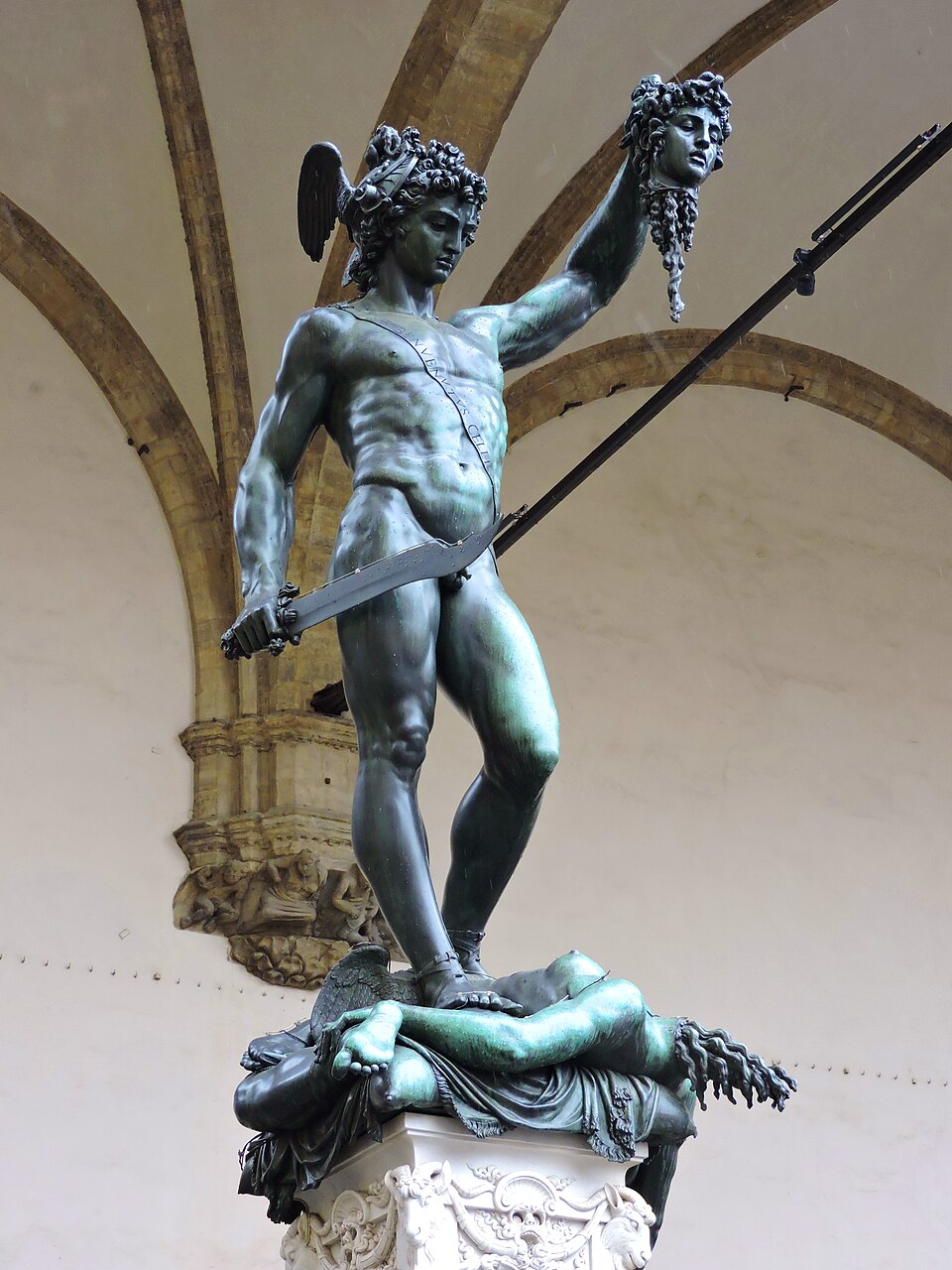
On 27 April 1554, in the Piazza della Signoria in Florence, a crowd gathered before a new bronze figure standing naked but for a sash and winged sandals. In his raised hand he held a woman's head crowned with writhing snakes, blood spilling from her severed neck at his feet. This was Perseus with the Head of Medusa, the work of goldsmith-turned-sculptor Benvenuto Cellini, made between 1545 and 1554 for Cosimo I de' Medici, second duke of Florence.
Cosimo had reason to be nervous. The piazza already held some of the most scrutinized sculpture in Italy: Michelangelo's David, Bandinelli's Hercules and Cacus, and Donatello's Judith and Holofernes. Hercules and Cacus, unveiled under the previous duke, Alessandro I, had been met with public scorn in 1534. Cosimo watched the crowd's reaction to Cellini's Perseus from a window of the Palazzo Vecchio — and this time, the public responded well.
The choice of subject was not incidental. Medusa's gaze turned men to stone, and Cellini's bronze figure now stood among three massive marble men — Hercules, David, and later Neptune — as if answering them directly. The sculpture rests on a square base decorated with bronze relief panels telling the story of Perseus and Andromeda, arranged like a predella beneath an altarpiece. Those panels carried political weight: Andromeda was read as an allegory for Florence, rescued by Perseus, who stood for the collective Medici, while the figure of Perseus on the pedestal itself was understood as symbolizing Duke Francesco de' Medici, whose Habsburg bride Giovanna was echoed in Andromeda.
Casting the piece in bronze was itself a bold statement. The medium had not been used for a monumental sculpture in nearly half a century, and Cellini saw it as an act of vivification — pouring molten metal into the mold like blood into a body. Donatello's Judith had been cast in bronze but in separate joined sections; Cellini wanted his Perseus poured whole, a far riskier technical feat, especially as he worked in the shadow of Michelangelo's marble David.
The casting itself nearly ended in disaster. According to Cellini's own account, his assistants let the molten metal begin to clot, and had he not intervened, the work would have been ruined. He remelted the bronze and pushed through, an episode later scholars have framed as Cellini not merely completing a sculpture but resurrecting it — invoking, in his own telling, an almost Christ-like act of restoring life to dead matter.
More from Art

The Painting With No Foreground
A single robed figure stares out at an empty grey sea — and the emptiness itself became a scandal. When it was unveiled in Berlin in 1810, no one knew quite what to do with it.

The Painter Who Chased the Light
For a few purple minutes each evening, an American exile knelt in an English garden and raced the dying sun to paint two little girls lighting lanterns. It took him two years to finish.

When a President Became a God
Look straight up inside the U.S. Capitol dome and you will find George Washington enthroned among the clouds, surrounded by goddesses — the founding father transformed into myth.

Marble Brought Back to Life
A corpse asleep, a wing barely brushing her skin — and marble somehow learns to breathe. This is the moment Antonio Canova dared to carve.

The World Turned Upside Down
Look closely at a sixteenth-century Flemish village and you'll find a man biting a pillar, another carrying daylight in a basket, and a wife slipping a blue cloak over her husband's shoulders. Every gesture is a joke — if you know the language.

The Girl in the Glass Case
She stood two-thirds life size, dressed in a real tutu and human hair — and the critics who saw her in 1881 recoiled as if she were something obscene.