The Bull, the Girl, and the Sea
A princess is flung backward on the flank of a swimming bull, her scarf whipping in the wind — and Titian dares his patrons to look closer at what they're really seeing.
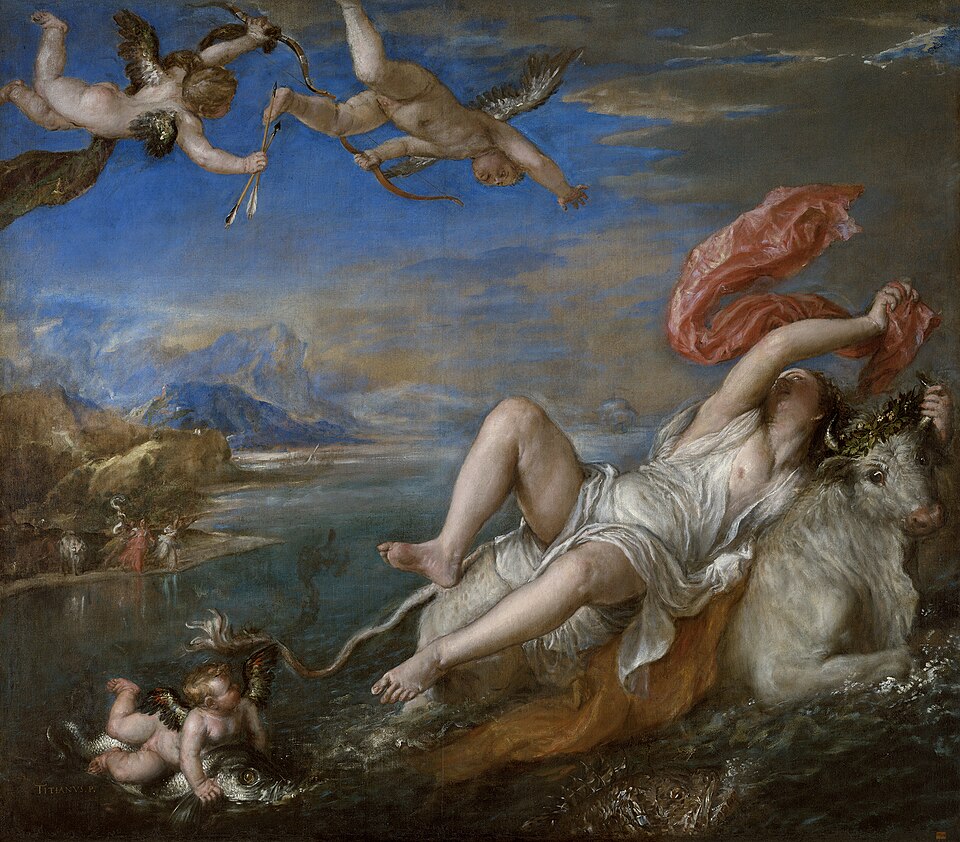
In the myth, Zeus takes the shape of a magnificent bull to lure Europa onto his back, then plunges into the sea and carries her to Crete, where he reveals himself and fathers three children with her before departing, leaving behind a necklace, a javelin, and a bronze guard. It is an old, often prettified story of divine seduction. Titian, painting around 1560 to 1562, refused to prettify it.
His canvas, now in the Isabella Stewart Gardner Museum in Boston, shows Europa sprawled helplessly on her back atop the bull, her clothes in disarray, her legs positioned as though she is precariously balanced or actively kicking to free herself. A red silk scarf whips from her hand. In the background, one of her attendants wears a pink garment that echoes the one Europa clutches. Two putti chase overhead, another rides a dolphin below, and a sea monster lurks in the foreground — all signals of danger rather than romance. This is, unmistakably, a scene of abduction.
Scholars trace Titian's inspiration partly to Ovid's Metamorphoses, which describes the bull's snow-white color and the muscles bulging around its neck, both echoed in the painting. But a more direct source may be Achilles Tatius's novel Leucippe and Clitophon, translated into Italian and printed in Venice in 1546, just years before Titian took up the brush. That text describes dolphins, Europa's scarf, a Cupid, her clothing, and — crucially — her position on the bull's back: not straddling it, but with her feet on the bull's right side and her left hand gripping its horn. Titian's composition mirrors these details closely.
The painting was part of a series of mythological works, called 'poesie', that Titian created for King Philip II of Spain. Alongside two companion pieces, Diana and Callisto and Diana and Actaeon, it eventually passed through royal hands: Philip V of Spain gave three of these Titian poesie to the French ambassador, the Duke of Gramont, who presented them to Philippe II, Duke of Orléans, then Regent of France.
For most of the eighteenth century, the painting resided in the Orleans Collection in Paris. It later crossed the Channel and appeared in the 1857 Manchester Art Treasures exhibition, one of the great Victorian showcases of European art. In 1896, the American art historian and dealer Bernard Berenson purchased it on behalf of the Boston collector Isabella Stewart Gardner, bringing it to the museum that still bears her name.
More from Art

The Painting With No Foreground
A single robed figure stares out at an empty grey sea — and the emptiness itself became a scandal. When it was unveiled in Berlin in 1810, no one knew quite what to do with it.

The Painter Who Chased the Light
For a few purple minutes each evening, an American exile knelt in an English garden and raced the dying sun to paint two little girls lighting lanterns. It took him two years to finish.

When a President Became a God
Look straight up inside the U.S. Capitol dome and you will find George Washington enthroned among the clouds, surrounded by goddesses — the founding father transformed into myth.

Marble Brought Back to Life
A corpse asleep, a wing barely brushing her skin — and marble somehow learns to breathe. This is the moment Antonio Canova dared to carve.

The World Turned Upside Down
Look closely at a sixteenth-century Flemish village and you'll find a man biting a pillar, another carrying daylight in a basket, and a wife slipping a blue cloak over her husband's shoulders. Every gesture is a joke — if you know the language.

The Girl in the Glass Case
She stood two-thirds life size, dressed in a real tutu and human hair — and the critics who saw her in 1881 recoiled as if she were something obscene.