The Cage, the Candle, and the Vacuum
A white cockatoo gasps for breath inside a glass globe while a room full of faces divides between horror and wonder — and the whole scene glows by candlelight, frozen forever on canvas in 1768.
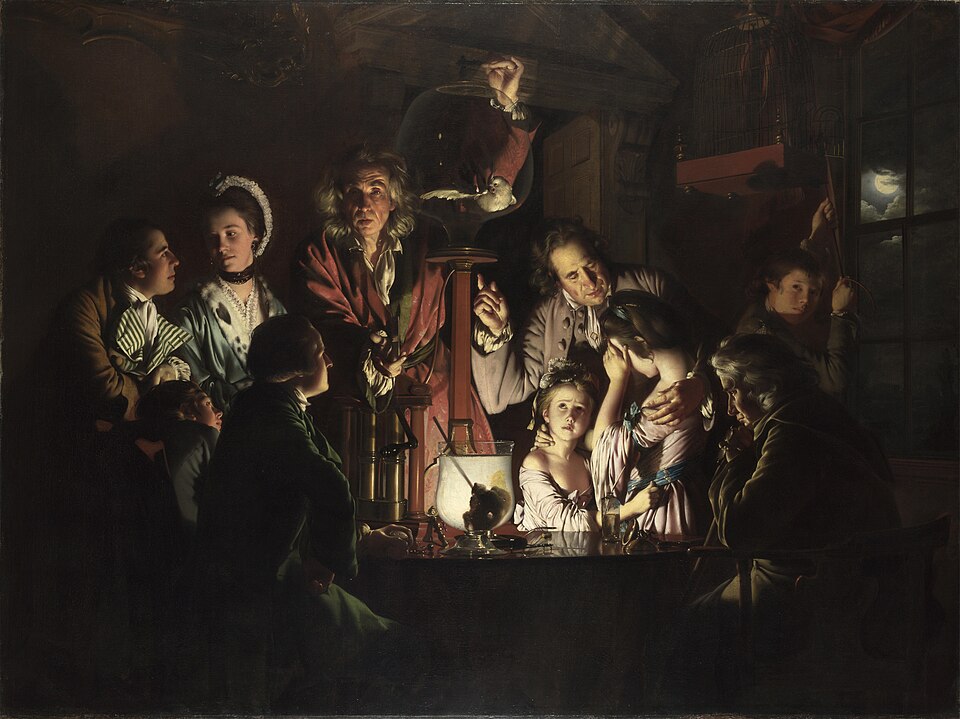
In a darkened room, a man in a red robe stands beside a glass vessel, one hand poised on a stopcock, the other lifted as if inviting the viewer to decide the bird's fate. This is the arresting center of An Experiment on a Bird in the Air Pump, painted in 1768 by Joseph Wright of Derby. Around the table, faces flicker in candlelight: two young girls recoil in distress, a boy lowers a cage as though preparing to bring in a replacement bird, an old man watches with grave contemplation, and a couple, absorbed in each other, seem indifferent to the drama. Wright gave a scientific demonstration the emotional intensity once reserved for religious or historical paintings — a radical choice for its time.
The scene draws on a real scientific lineage stretching back over a century. In 1659, Robert Boyle commissioned an air pump — a 'pneumatic engine' — building on the vacuum pump Otto von Guericke had invented in 1650. Boyle donated his first machine to the Royal Society and had two more built for himself. Such devices were rare and costly; besides Boyle's three, only a handful existed elsewhere in Europe by the 1660s, including one owned by Christiaan Huygens in The Hague. Boyle's pump was intricate and temperamental, largely designed to his specifications but built and often operated by Robert Hooke, whose technical skill and flair for demonstration made him indispensable.
Using the pump, Boyle carried out dozens of experiments on the properties of air, recorded in his New Experiments Physico-Mechanicall, Touching the Spring of the Air. Of the 43 experiments detailed in the book, two involved living creatures: one tested whether insects could fly in reduced air pressure, and another — Experiment 41 — examined how animals depended on air to survive. Boyle placed birds, mice, eels, snails, and flies into the vessel and observed their reactions as the air was withdrawn. He wrote in unflinching detail of an injured lark that convulsed violently and died as the air was pumped out, its neck twisted awry.
By the time Wright painted his picture a century later, air pumps had become common scientific instruments, no longer the rare privilege of a few virtuosi. Traveling lecturers in natural philosophy — often more showmen than scholars — toured town halls and private homes, performing the 'animal in the air pump' experiment as a dramatic centerpiece for paying audiences. One of the most respected of these itinerant lecturers was James Ferguson, a Scottish astronomer likely acquainted with Wright through their shared friend John Whitehurst. Ferguson noted that many demonstrators substituted a 'lungs-glass' — a bladder filled with air — for a live animal, since killing a creature onstage was, in his words, 'too shocking to every spectator who has the least degree of humanity.'.
Wright's painting captures the moment of genuine ethical tension this substitution was meant to avoid. The bird in his canvas appears to be a real cockatoo, and its suffering is rendered with an intensity that forces the viewer to feel the discomfort Ferguson described. Yet scientific curiosity dominates the room; only the children seem moved to protest, while the adults lean in, transfixed by the demonstration's outcome.
More from Art

The Painting With No Foreground
A single robed figure stares out at an empty grey sea — and the emptiness itself became a scandal. When it was unveiled in Berlin in 1810, no one knew quite what to do with it.

The Painter Who Chased the Light
For a few purple minutes each evening, an American exile knelt in an English garden and raced the dying sun to paint two little girls lighting lanterns. It took him two years to finish.

When a President Became a God
Look straight up inside the U.S. Capitol dome and you will find George Washington enthroned among the clouds, surrounded by goddesses — the founding father transformed into myth.

Marble Brought Back to Life
A corpse asleep, a wing barely brushing her skin — and marble somehow learns to breathe. This is the moment Antonio Canova dared to carve.

The World Turned Upside Down
Look closely at a sixteenth-century Flemish village and you'll find a man biting a pillar, another carrying daylight in a basket, and a wife slipping a blue cloak over her husband's shoulders. Every gesture is a joke — if you know the language.

The Girl in the Glass Case
She stood two-thirds life size, dressed in a real tutu and human hair — and the critics who saw her in 1881 recoiled as if she were something obscene.