The Canvas That Cost £49.5 Million
A painting catalogued for over a century as the work of a lesser hand turned out to be a lost Rubens — and its rediscovery would shatter auction records.
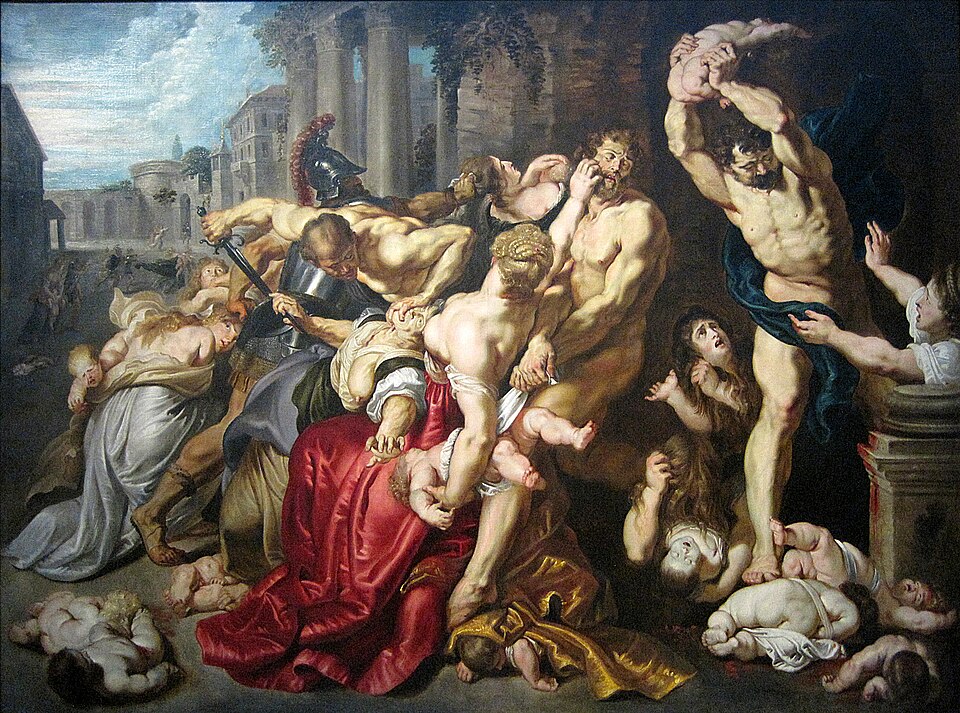
In 1611, back in Antwerp after eight years steeped in the light and violence of Italian painting, Peter Paul Rubens set brush to a canvas measuring 142 by 182 centimetres. The subject was the Massacre of the Innocents, the biblical episode from the Gospel of Matthew in which King Herod orders the killing of Bethlehem's infant boys. It was not an abstract choice of theme. Antwerp itself had known slaughter only a few years earlier: in a single year during the war between Spanish Catholic forces and Protestant rebels, more than 8,000 citizens had been killed. A truce signed in 1609 offered only a fragile pause.
Rubens was not alone in reaching for this subject. Some 160 kilometres north, in rebel-held Haarlem, Prince Maurits commissioned Cornelis van Haarlem to paint the same massacre for the town hall — propaganda meant to indict Spanish cruelty. Antwerp, by contrast, remained staunchly Catholic and became a centre of Counter-Reformation conviction. Rubens' painting, with its sheer drama, emotive dynamism, and rich colour, bore the unmistakable imprint of his years observing Italian Baroque masters like Caravaggio. He had studied écorché figures — skinless anatomical statues — to master the body's construction, and chiaroscuro to stage his violence in light and shadow.
By the end of the seventeenth century, the painting had entered the Liechtenstein Collection in Vienna, hanging alongside another Rubens masterpiece, Samson and Delilah. The Forchondt brothers had sold both works to Hans-Adam I, Prince of Liechtenstein, around 1700, and drawings from 1815 show them displayed side by side in the Garden Palace in Vienna. But attribution is a fickle thing. In 1767, cataloguer Vincenzio Fanti mistakenly listed the Massacre as a work by Franciscus de Neve II. By 1780, an anonymous inventory reassigned it again, this time to Rubens' assistant Jan van den Hoecke, working after Rubens.
Meanwhile, a separate copy of the same composition, produced by Rubens' workshop, had its own quiet journey: bought in 1902 by the Royal Museums of Fine Arts of Belgium as a work by Antoon Sallaert, sold to an Austrian family in 1920, and loaned in 1923 to the monastery of Stift Reichersberg in northern Austria.
The original Liechtenstein painting followed its own path after 1780, eventually surfacing far from public attention until 2001, when George Gordon, an expert in Flemish and Dutch painting at Sotheby's in London, examined it closely. Struck by its similarities to Samson and Delilah, painted around the same time, Gordon became convinced this was no assistant's work but Rubens' own hand.
More from Art

The Painting With No Foreground
A single robed figure stares out at an empty grey sea — and the emptiness itself became a scandal. When it was unveiled in Berlin in 1810, no one knew quite what to do with it.

The Painter Who Chased the Light
For a few purple minutes each evening, an American exile knelt in an English garden and raced the dying sun to paint two little girls lighting lanterns. It took him two years to finish.

When a President Became a God
Look straight up inside the U.S. Capitol dome and you will find George Washington enthroned among the clouds, surrounded by goddesses — the founding father transformed into myth.

Marble Brought Back to Life
A corpse asleep, a wing barely brushing her skin — and marble somehow learns to breathe. This is the moment Antonio Canova dared to carve.

The World Turned Upside Down
Look closely at a sixteenth-century Flemish village and you'll find a man biting a pillar, another carrying daylight in a basket, and a wife slipping a blue cloak over her husband's shoulders. Every gesture is a joke — if you know the language.

The Girl in the Glass Case
She stood two-thirds life size, dressed in a real tutu and human hair — and the critics who saw her in 1881 recoiled as if she were something obscene.