The Card Players: Cézanne's Silent Revolution
Two peasants bend over a table, cards in hand, saying nothing — and out of that silence Paul Cézanne built one of the most quietly radical images in modern art.
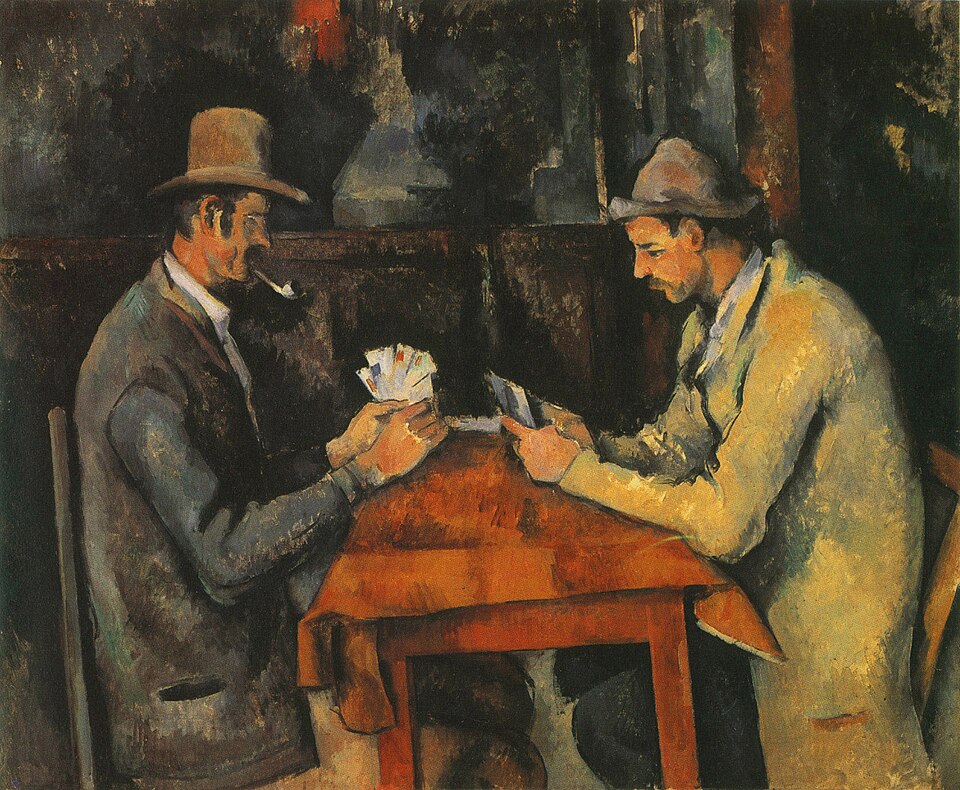
In the early 1890s, in the waning years of his life, Paul Cézanne turned his attention to a subject as old as tavern painting itself: men playing cards. But where centuries of Dutch and French genre painters had filled such scenes with drunken gamblers, spilled wine, and scattered coins, Cézanne stripped it all away. What remained were stone-faced Provençal tradesmen, pipes in hand, eyes cast down at their cards, locked in a stillness that had nothing to do with drama or narrative.
Cézanne painted five versions of The Card Players, varying in size, number of figures, and setting, along with numerous preparatory drawings and studies. The exact chronology of the paintings remains uncertain. For decades it was assumed he began with the largest, most populated canvases and pared them down over time, but recent research has cast doubt on that neat progression.
The models were not actors or professionals but local farmhands, some of whom worked on the Cézanne family estate, the Jas de Bouffan. There is something telling in that choice: these were men Cézanne knew, men whose quiet labor he had likely watched for years. In his paintings, they don't look at each other. They look only at their cards — as if the game itself were their sole form of communication outside of work.
One inspiration often cited is a painting by one of the Le Nain brothers, hung in a museum in Aix-en-Provence near Cézanne's home, which also depicted card players. But Cézanne's versions diverge sharply from that 17th-century tradition. Gone is the wine bottle passed hand to hand, gone the heightened tension of a winning or losing hand. What's left, as one critic put it, resembles a kind of 'human still life.' Another observer speculated that the players' intense focus on their game mirrored the painter's own absorption in his art.
The largest and most complex version, painted between 1890 and 1892, measures 134.6 by 180.3 centimeters and includes five figures: three players seated in a semi-circle, two spectators behind them, including a boy with downcast eyes and a standing man smoking a pipe. This canvas now hangs in the Barnes Foundation in Philadelphia. A slightly smaller version with four figures, long assumed to be the second in the series, resides in the Metropolitan Museum of Art in New York — though X-ray and infrared analysis of its underdrawing has suggested it may actually be a preliminary study for the larger works, with Cézanne struggling to merge individually studied figures onto one canvas.
More from Art

The Painting With No Foreground
A single robed figure stares out at an empty grey sea — and the emptiness itself became a scandal. When it was unveiled in Berlin in 1810, no one knew quite what to do with it.

The Painter Who Chased the Light
For a few purple minutes each evening, an American exile knelt in an English garden and raced the dying sun to paint two little girls lighting lanterns. It took him two years to finish.

When a President Became a God
Look straight up inside the U.S. Capitol dome and you will find George Washington enthroned among the clouds, surrounded by goddesses — the founding father transformed into myth.

Marble Brought Back to Life
A corpse asleep, a wing barely brushing her skin — and marble somehow learns to breathe. This is the moment Antonio Canova dared to carve.

The World Turned Upside Down
Look closely at a sixteenth-century Flemish village and you'll find a man biting a pillar, another carrying daylight in a basket, and a wife slipping a blue cloak over her husband's shoulders. Every gesture is a joke — if you know the language.

The Girl in the Glass Case
She stood two-thirds life size, dressed in a real tutu and human hair — and the critics who saw her in 1881 recoiled as if she were something obscene.