The Cart Nobody Sees Christ Riding Above
A wagon of hay rolls toward hell, dragged by demons, while a crowd of fools claws and scrambles for a fistful of straw — and not one of them looks up to notice Christ watching from the clouds.
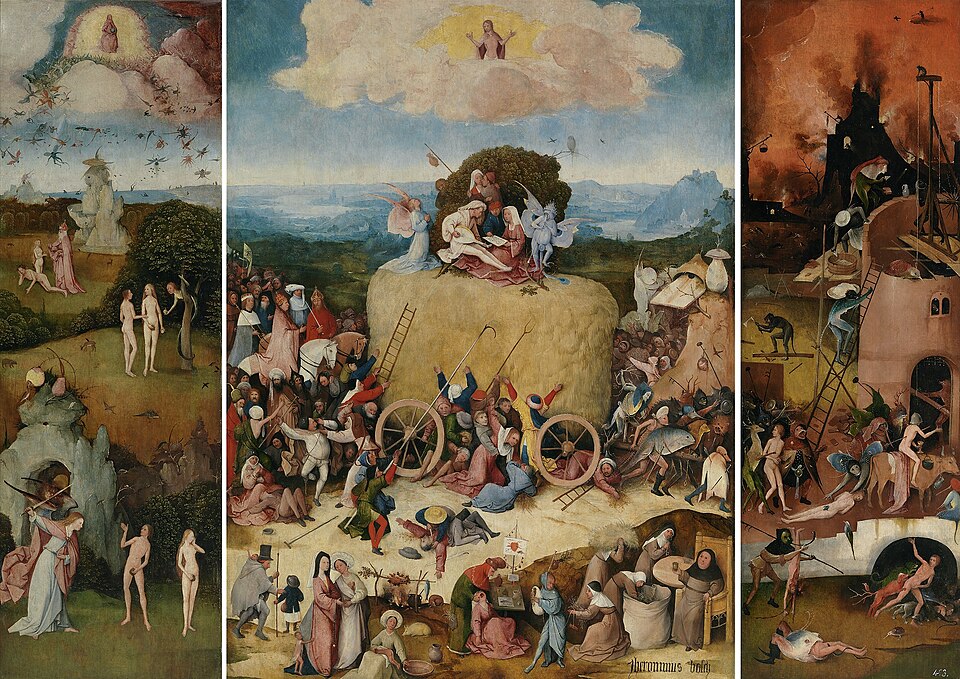
Sometime around 1516 — a date fixed not by any document but by the rings of the oak panels themselves, read through dendrochronology — Hieronymus Bosch signed his name, 'Jheronimus Bosch', across the central panel of a triptych that would outlive its own frame by centuries. That central scene, 135 by 200 centimeters, shows a great haywain, a cart piled with hay, trundling through a landscape crowded with fools. Around it people fight, steal, dance, and scramble for scraps of the load, oblivious to everything but their own small greeds. Above them, unnoticed by nearly every figure below, Christ appears in the sky. Only a single angel atop the wagon looks up and prays.
The wagon itself is drawn by grotesque, infernal beings, hauling the whole procession rightward across the panel toward its destined end. That rightward motion is not incidental — Bosch built the composition so that the viewer's eye is pulled along with the crowd, following the same slow bend toward catastrophe. On the left, some figures curve back into the middle ground, as if hesitating. On the right, the procession straightens out entirely, marching in an unbroken line into Hell, which fills the triptych's right-hand panel.
The left wing tells a different story, one that unfolds in stages rather than all at once. At the top, rebellious angels are cast out of Heaven, transforming into insects as they fall through the clouds while God looks on enthroned. Beneath that, God shapes Eve from Adam's rib. Below that scene, Adam and Eve encounter the serpent coiled in the tree, offering its apple. And at the bottom, an angel in a cope and alb drives the pair from Eden — Adam still speaking to the angel, Eve turned ahead with a melancholy look, already facing the world the haywain will fill.
When the wings are folded shut, they reveal something Bosch rarely gave his triptychs: full color instead of the grisaille typical of the period. Closed, the two panels form a single image of a wayfarer walking alone, a stick in hand to fend off a dog. Around him, tucked into the background like whispered warnings, are miniature scenes — a robbery of another traveler, a hanged man swinging from a gallows, two shepherds dancing, perhaps a hint of lust. Recent interpretations read the wayfarer as a man pressing on despite every temptation and every cruelty unfolding around him, refusing to be pulled off his road.
The painting's own journey was almost as eventful as its imagery. It was one of six Bosch works acquired by King Philip II of Spain in 1570, and four years later it was shipped to the monastery of El Escorial, where it remained for years. It was later sold to the Marquis of Salamanca and divided into three separate paintings. In 1848, Isabella II of Spain bought the central panel and brought it to Aranjuez; the right panel was returned to Escorial, and the left went to the Prado.
More from Art

The Painting With No Foreground
A single robed figure stares out at an empty grey sea — and the emptiness itself became a scandal. When it was unveiled in Berlin in 1810, no one knew quite what to do with it.

The Painter Who Chased the Light
For a few purple minutes each evening, an American exile knelt in an English garden and raced the dying sun to paint two little girls lighting lanterns. It took him two years to finish.

When a President Became a God
Look straight up inside the U.S. Capitol dome and you will find George Washington enthroned among the clouds, surrounded by goddesses — the founding father transformed into myth.

Marble Brought Back to Life
A corpse asleep, a wing barely brushing her skin — and marble somehow learns to breathe. This is the moment Antonio Canova dared to carve.

The World Turned Upside Down
Look closely at a sixteenth-century Flemish village and you'll find a man biting a pillar, another carrying daylight in a basket, and a wife slipping a blue cloak over her husband's shoulders. Every gesture is a joke — if you know the language.

The Girl in the Glass Case
She stood two-thirds life size, dressed in a real tutu and human hair — and the critics who saw her in 1881 recoiled as if she were something obscene.