The Ceiling That Burned: Klimt's Lost Faculty Paintings
Gustav Klimt spent seven years painting humanity's darkest truths onto a university ceiling — and the men who commissioned them recoiled in horror. What happened next would end his relationship with the state and, decades later, with fire, erase the paintings from the world entirely.
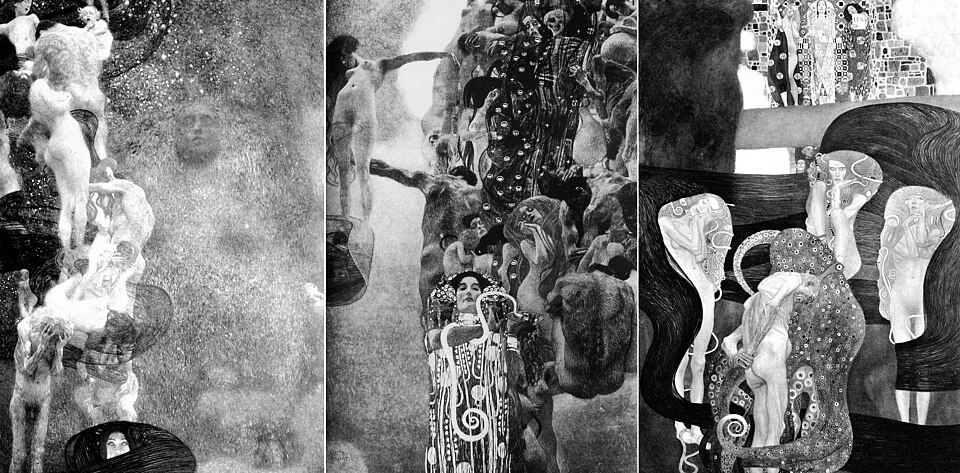
In 1894, Gustav Klimt was commissioned to paint the ceiling of the Great Hall at the University of Vienna. The assignment called for three allegorical panels representing Philosophy, Medicine, and Jurisprudence — grand, uplifting themes meant to celebrate the triumph of human knowledge. What Klimt delivered instead, painted between 1900 and 1907, was something far stranger and more unsettling: a vision of humanity adrift, entangled with death, anxiety, and ambiguity.
Philosophy came first, unveiled at the 1900 Vienna Secession exhibition. Klimt described it himself: on the left, a group of figures representing the beginning of life, fruition, and decay; on the right, the globe as mystery; below, a figure of light representing knowledge. The original brief had called for 'The Victory of Light over Darkness.' Instead, critics saw a dreamlike mass of drifting bodies, evoking neither optimism nor reason but what one observer called a 'viscous void.' The painting won a gold medal at the Paris World Exhibition, yet was savaged by critics back home.
Medicine followed, presented in March 1901 at the tenth Secession Exhibition. It showed a column of semi-nude figures — the river of life — beside a floating nude woman with a newborn at her feet, a skeleton within the river representing death. At the base stood Hygieia, the goddess of health, turned away from mankind, holding the cup of Lethe with the Aesculapian snake coiled on her arm. There was no celebration of medicine's power to heal — only an ambiguous unity of life and death. The Medizinische Wochenschrift complained bitterly that Klimt had ignored medicine's two great achievements: prevention and cure.
Jurisprudence, the third panel, was no gentler. It depicted a condemned man surrounded by three female furies and a sea monster, while the goddesses of Truth, Justice, and Law watched from the background as Eumenides, delivering punishment through an octopus's deadly embrace. Scholars have since described the painting's tension as distinctly psycho-sexual.
The backlash was fierce. Eighty-seven faculty members signed a protest. A public prosecutor was called in, and the controversy reached the Austrian Parliament — the first time a cultural debate had ever been raised there. Only the education minister defended Klimt. When Klimt was elected professor at the Academy of Fine Arts in 1901, the government refused to ratify it, and he was never offered another teaching post. Embittered, Klimt vowed never again to accept a state commission: 'I've had enough of censorship... I reject all state support, I don't want any of it.' His later painting Goldfish, showing a woman baring herself mockingly to the viewer, was his retort to critics — he had wanted to call it 'To My Critics' before friends talked him out of it.
More from Art

The Painting With No Foreground
A single robed figure stares out at an empty grey sea — and the emptiness itself became a scandal. When it was unveiled in Berlin in 1810, no one knew quite what to do with it.

The Painter Who Chased the Light
For a few purple minutes each evening, an American exile knelt in an English garden and raced the dying sun to paint two little girls lighting lanterns. It took him two years to finish.

When a President Became a God
Look straight up inside the U.S. Capitol dome and you will find George Washington enthroned among the clouds, surrounded by goddesses — the founding father transformed into myth.

Marble Brought Back to Life
A corpse asleep, a wing barely brushing her skin — and marble somehow learns to breathe. This is the moment Antonio Canova dared to carve.

The World Turned Upside Down
Look closely at a sixteenth-century Flemish village and you'll find a man biting a pillar, another carrying daylight in a basket, and a wife slipping a blue cloak over her husband's shoulders. Every gesture is a joke — if you know the language.

The Girl in the Glass Case
She stood two-thirds life size, dressed in a real tutu and human hair — and the critics who saw her in 1881 recoiled as if she were something obscene.