The Christ Who Fell from a Dream
Salvador Dalí saw the nucleus of the atom in his sleep — and painted the crucifixion without a single nail, drop of blood, or thorn.
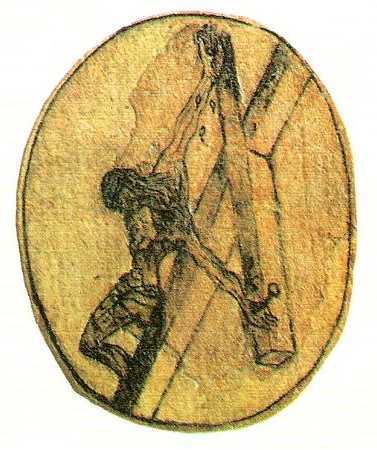
In 1950, Salvador Dalí had what he called a 'cosmic dream.' In it, he saw an image in vivid color that he understood, within the dream, to represent the nucleus of the atom. Waking, the image transformed in his mind into something larger: the very unity of the universe, embodied in the figure of Christ. From that vision came one of the most famous religious paintings of the twentieth century.
Dalí completed Christ of Saint John of the Cross in 1951. It shows Jesus on the cross, suspended in a darkened sky, floating above a body of water where a boat and fishermen go about their business below. The body of water is not invented — it is the bay of Portlligat in Catalonia, Spain, where Dalí lived at the time.
What makes the painting startling is what it leaves out. There are no nails, no blood, no crown of thorns. Dalí said he had been convinced by a dream that these traditional details would mar his depiction of Christ. Another dream, he claimed, revealed to him the importance of the painting's extreme downward angle, looking at Christ from above.
The title comes from a 16th-century drawing by the Spanish friar John of the Cross, on which Dalí based his composition. The figure of Christ is built from geometric forms: a triangle formed by his outstretched arms, and a circle formed by his head. Dalí saw the triangle as a reference to the Trinity and the circle as an echo of Platonic thought, representing unity.
To get the pose right, Dalí didn't simply imagine it. He had Hollywood stuntman Russell M. Saunders suspended from an overhead gantry, allowing Dalí to study exactly how gravity pulled at a human body from that specific, dizzying angle.
More from Art

The Painting With No Foreground
A single robed figure stares out at an empty grey sea — and the emptiness itself became a scandal. When it was unveiled in Berlin in 1810, no one knew quite what to do with it.

The Painter Who Chased the Light
For a few purple minutes each evening, an American exile knelt in an English garden and raced the dying sun to paint two little girls lighting lanterns. It took him two years to finish.

When a President Became a God
Look straight up inside the U.S. Capitol dome and you will find George Washington enthroned among the clouds, surrounded by goddesses — the founding father transformed into myth.

Marble Brought Back to Life
A corpse asleep, a wing barely brushing her skin — and marble somehow learns to breathe. This is the moment Antonio Canova dared to carve.

The World Turned Upside Down
Look closely at a sixteenth-century Flemish village and you'll find a man biting a pillar, another carrying daylight in a basket, and a wife slipping a blue cloak over her husband's shoulders. Every gesture is a joke — if you know the language.

The Girl in the Glass Case
She stood two-thirds life size, dressed in a real tutu and human hair — and the critics who saw her in 1881 recoiled as if she were something obscene.