The City the Ash Remembered
No bodies. No skeletons. Just a city frozen mid-breath beneath layers of volcanic ash — what happened to the people of Akrotiri, and how did they know to leave?
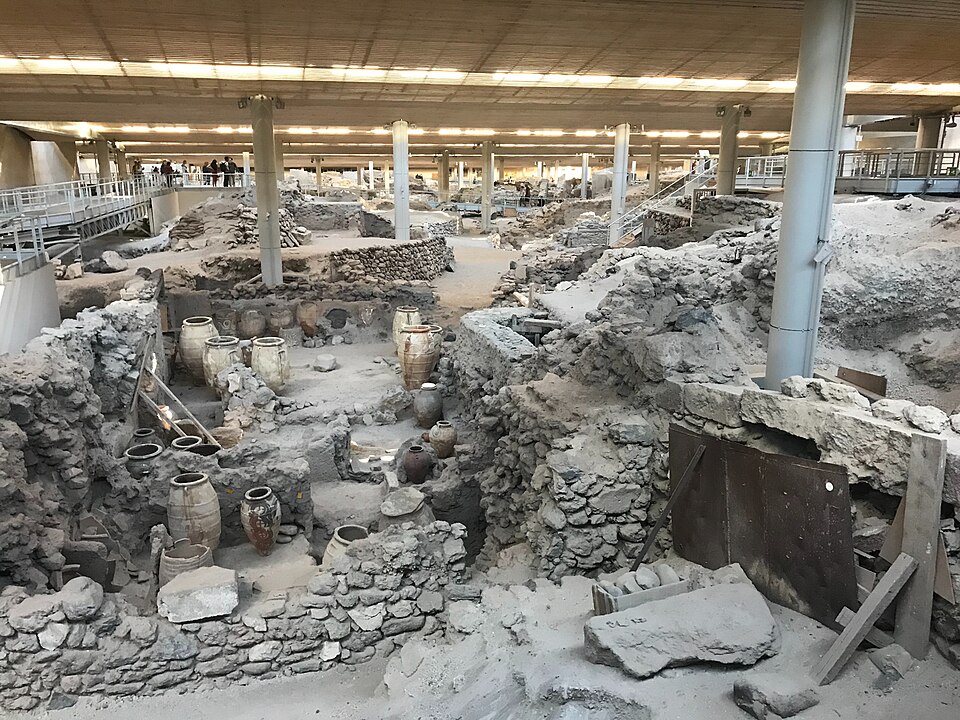
On the volcanic Greek island of Santorini, beneath the sun-bleached cliffs of the Cycladic sea, lies a settlement that time did not so much destroy as preserve. Akrotiri, named for the modern village nearby, was once a thriving Bronze Age town whose ancient name has been lost entirely. What survives instead is something rarer than a name: an almost complete freeze-frame of daily life, sealed beneath volcanic debris for more than three thousand years.
The story of Akrotiri begins far earlier than its dramatic end. Archaeological evidence traces habitation back to the fifth millennium BCE, when it was little more than a modest fishing and farming village. By the close of the third millennium BCE, however, Akrotiri had transformed into something far more significant. Its position on the sailing route between Cyprus and Minoan Crete made it a natural hub for trade, and fragments of foreign pottery found at the site attest to its far-reaching connections. The discovery of moulds and crucibles reveals that Akrotiri became an important centre for processing copper, a metal central to Bronze Age wealth and warfare alike.
Prosperity followed for roughly five centuries. Paved streets, an advanced drainage system, and finely made pottery point to a settlement of real sophistication — one capable of specialized craftsmanship and organized urban planning. Then, sometime in the 16th century BCE, catastrophe arrived in the form of the Theran eruption, one of the most powerful volcanic events of the ancient world. Radiocarbon dating places the eruption most likely between 1620 and 1530 BCE, a range broadly consistent with comparisons to material culture elsewhere in the Aegean, which suggests a date between 1570 and 1500 BCE. Tree-ring evidence from 1597, 1560, 1546, and 1544 BCE shows growth disruptions consistent with a major volcanic event, with the latter three years considered strong candidates, partly because they align with Egyptian New Kingdom records thought to reference the eruption.
The eruption buried Akrotiri in ash and pumice, and in doing so, preserved it with a completeness that invites inevitable comparison to Pompeii. Frescoes, pottery, furniture, sophisticated drainage systems, and buildings standing three storeys tall have all been recovered from beneath the debris. Though Akrotiri was a Cycladic settlement, its inscriptions in Linear A and close stylistic parallels in artifacts and frescoes tie it firmly to Minoan civilization.
The modern rediscovery of the site has its own layered history. French geologist F. Fouque conducted the earliest excavations on Santorini in 1867, after locals stumbled upon ancient artifacts in a quarry. Decades later, between 1895 and 1900, German archaeologist Baron Friedrich Hiller von Gaertringen uncovered the ruins of ancient Thera at Mesa Vouno — though these dated from the archaic period, long after the Minoan eruption. Not long after, R. Zahn excavated nearby at Potamos under the German Archaeological Institute at Athens.
More from Archaeology

The Bronze Disc That Rewrote the Sky
Two looters with a metal detector dug up something illegal, invisible in value, and older than Stonehenge's final stones — a map of the heavens buried for over three thousand years.

The Faceless Women of the Ice Age
Long before writing, before cities, before the wheel, someone carved a woman's body into stone and ivory — and left no name, no face, no explanation.

The Pebble That Might Be Human
A palm-sized stone found on a Moroccan riverbank may be humanity's oldest attempt to see itself — or simply a trick of erosion.

The Crown That Vanished: Deshret and the Red Land
A crown worn by kings for three thousand years has never once been found in a tomb — not one. So where did it go?

The Face That Traveled Between Empires
A farm worker's shovel struck stone in 1897 and unearthed a face so striking it would be sold to France, seized as war booty, and finally traded back for a Velázquez.

The Boy in the Dark Tunnel
A schoolboy fell into black water inside an ancient tunnel and surfaced with his fingers brushing letters no one had noticed for 2,600 years.