The Clay Legion Guarding an Emperor's Eternity
Six well-diggers struck something hard beneath the dry soil of Shaanxi in 1974 — and unearthed an army that had waited underground for over two thousand years.
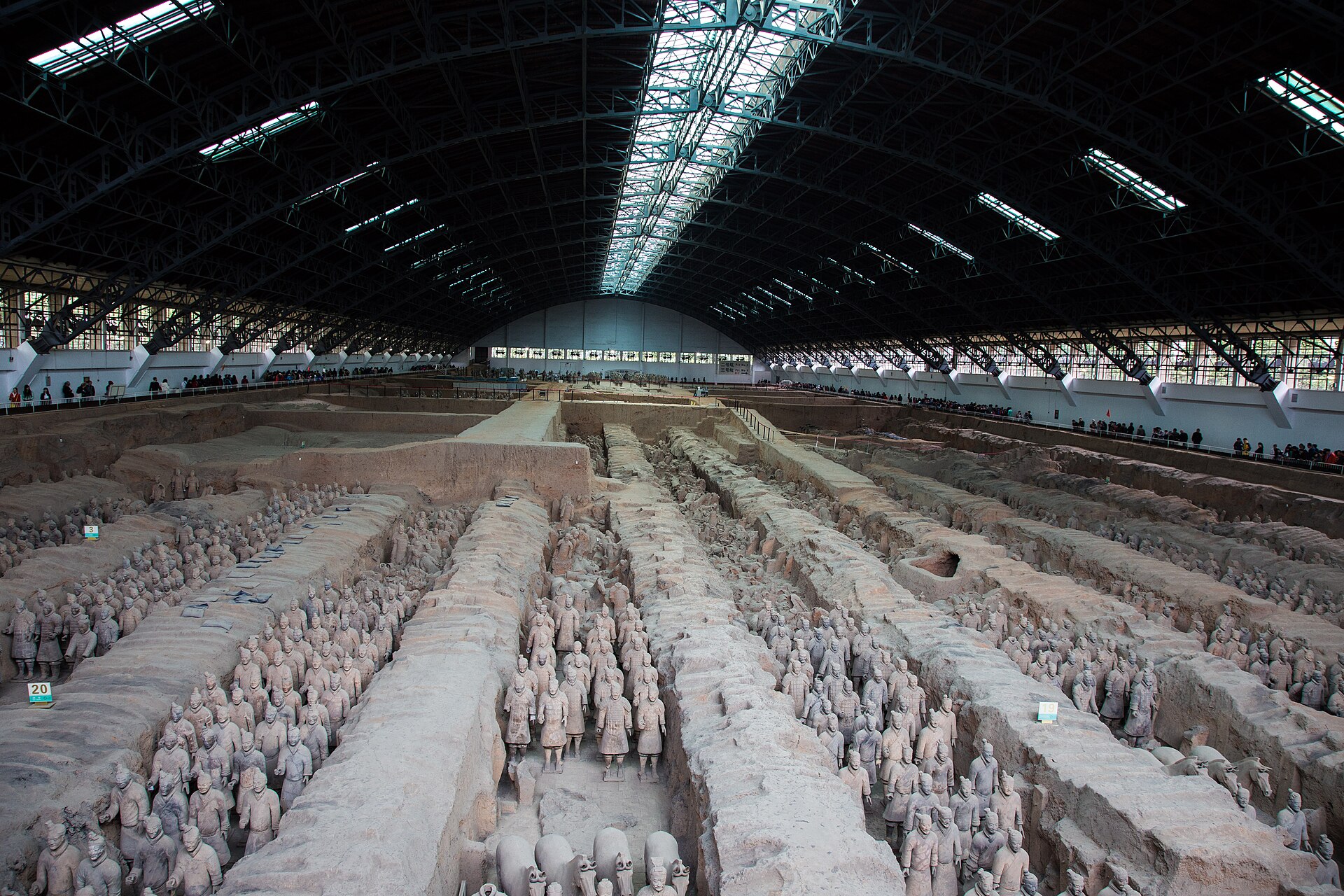
In March 1974, a group of farmers led by Yang Zhifa, his five brothers, and their neighbour Wang Puzhi were digging a well near Mount Li, outside Xi'an. Instead of water, their shovels hit fragments of a face — the first pieces of what would prove to be one of the most staggering archaeological discoveries of the twentieth century: the buried army of Qin Shi Huang, the first emperor of a unified China.
The figures had lain there since roughly 210–209 BCE, sealed into the ground as funerary art meant to protect the emperor in the afterlife. According to the historian Sima Qian, writing a century after the mausoleum's completion, construction began in 246 BCE when the future emperor was just thirteen years old and had recently succeeded his father as King of Qin. Sima Qian claimed the project eventually conscripted 700,000 laborers — a staggering figure for any age.
The scale uncovered since 1974 backs up the ambition of that account. Estimates from 2007 suggest the three excavated pits contain more than 8,000 soldiers, 130 chariots with 520 horses, and 150 cavalry horses, the majority of which remain in situ, still buried. Later digs revealed that the army was not alone — pits nearby held terracotta officials, acrobats, strongmen, and musicians, suggesting the underground world built for the emperor was meant to mirror the whole of his court, not just his military.
The figures themselves vary in height by rank, with the tallest reserved for generals — a detail that hints at how meticulously the sculptors mirrored the hierarchy of the living Qin army. Each soldier stands guard facing east, toward the very states the emperor had conquered to unify China, as though still braced against enemies from his lifetime.
The army is only part of a much larger necropolis, measured by ground-penetrating radar and core sampling at roughly 98 square kilometers. The complex was built as a microcosm of the emperor's own palace, complete with offices, halls, stables, and an imperial park surrounding the pyramidal earthen tomb mound at the foot of Mount Li, itself enclosed by rammed-earth walls.
More from Art

The Painting With No Foreground
A single robed figure stares out at an empty grey sea — and the emptiness itself became a scandal. When it was unveiled in Berlin in 1810, no one knew quite what to do with it.

The Painter Who Chased the Light
For a few purple minutes each evening, an American exile knelt in an English garden and raced the dying sun to paint two little girls lighting lanterns. It took him two years to finish.

When a President Became a God
Look straight up inside the U.S. Capitol dome and you will find George Washington enthroned among the clouds, surrounded by goddesses — the founding father transformed into myth.

Marble Brought Back to Life
A corpse asleep, a wing barely brushing her skin — and marble somehow learns to breathe. This is the moment Antonio Canova dared to carve.

The World Turned Upside Down
Look closely at a sixteenth-century Flemish village and you'll find a man biting a pillar, another carrying daylight in a basket, and a wife slipping a blue cloak over her husband's shoulders. Every gesture is a joke — if you know the language.

The Girl in the Glass Case
She stood two-thirds life size, dressed in a real tutu and human hair — and the critics who saw her in 1881 recoiled as if she were something obscene.