The Cliffs That Held Two Gods
For over a thousand years, two colossal Buddhas gazed out over an Afghan valley on the Silk Road — until a single order erased them in seconds.
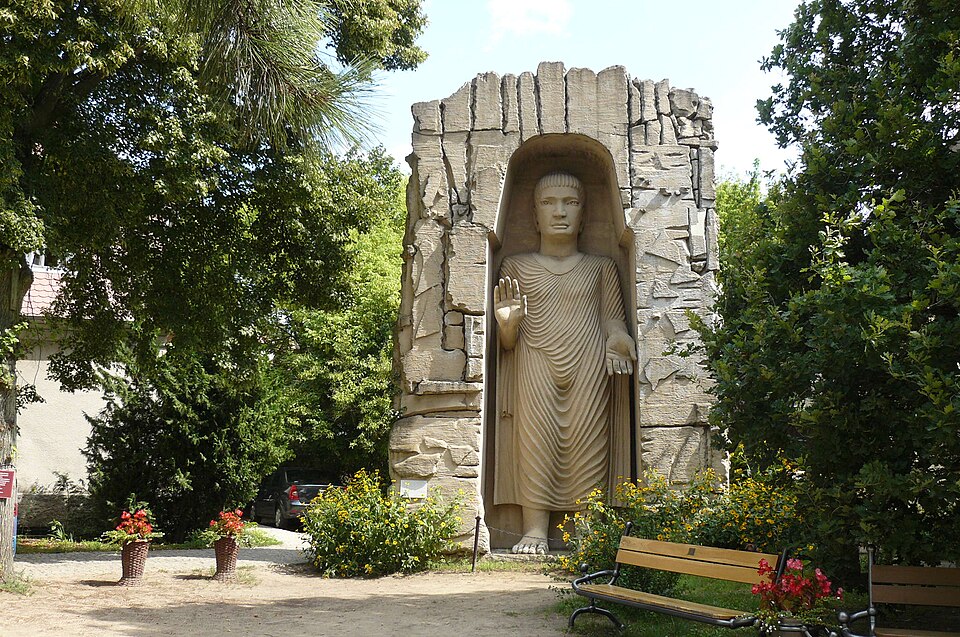
High in the Hindu Kush, at 2,500 metres above sea level and 130 kilometres northwest of Kabul, the Bamiyan Valley once held two of the most extraordinary sculptures ever carved into rock. Cut directly from sandstone cliffs, the smaller 'Eastern Buddha' rose 38 metres, and the larger 'Western Buddha' towered 55 metres — the biggest standing Buddha carvings on Earth. Carbon dating of organic material found after their destruction placed the smaller figure's construction around 570 CE and the larger around 618 CE, both raised during the rule of the Hephthalites in the region of Tokharistan. The Hephthalites did not always follow the Buddhist faith themselves, yet it was under their rule that these monuments to another religion rose from the cliffs.
The statues were technically reliefs, their backs fused into the cliff wall. Their main forms were hewn from sandstone, but finer details — faces, hands, the folds of robes — were built up from mud mixed with straw and finished in stucco, most of which wore away over the centuries. The larger figure, known as 'Salsal', meaning 'the light shines through the universe', was regarded as male and was painted carmine red. The smaller figure, 'Shah Mama' or 'Queen Mother', considered female though not with certainty, was painted in multiple colours. Researchers believe the upper parts of their faces were once covered by huge wooden masks, and their lower arms were built on wooden armatures.
Bamiyan sat on the Silk Road, the great caravan route linking Chinese and Western markets, and for centuries it thrived as a Buddhist religious centre. Since the 2nd century CE, under the Kushans, monks lived as hermits in caves cut into the cliffs surrounding the Buddhas, decorating their walls with elaborate frescoes painted between the 6th and 8th centuries CE. These paintings blended Gandharan Buddhist art with Gupta influences from India, and touches from the Sasanian and Byzantine empires.
The valley's religious identity shifted with conquest. Buddhism persisted until the Islamic conquest of 770 CE under the Abbasid Caliphate, then the valley became Buddhist again from 870 CE, before finally coming under Turkic Ghaznavid rule beginning in 977 CE. Archaeological evidence suggests the cave paintings stopped after the Muslim conquests, closing a chapter of centuries-long artistic devotion at the site.
Despite the region's turbulent history, the Buddhas endured remarkably long. In 1221, Genghis Khan's forces besieged the Bamiyan Valley and devastated its population during the Siege of Bamyan, yet the statues themselves were left untouched. Centuries later, in the 17th century, Mughal emperor Aurangzeb ordered artillery fire against the carvings, causing some damage — but the Buddhas survived largely intact, weathering both nature and empire for well over a millennium.
More from Art

The Painting With No Foreground
A single robed figure stares out at an empty grey sea — and the emptiness itself became a scandal. When it was unveiled in Berlin in 1810, no one knew quite what to do with it.

The Painter Who Chased the Light
For a few purple minutes each evening, an American exile knelt in an English garden and raced the dying sun to paint two little girls lighting lanterns. It took him two years to finish.

When a President Became a God
Look straight up inside the U.S. Capitol dome and you will find George Washington enthroned among the clouds, surrounded by goddesses — the founding father transformed into myth.

Marble Brought Back to Life
A corpse asleep, a wing barely brushing her skin — and marble somehow learns to breathe. This is the moment Antonio Canova dared to carve.

The World Turned Upside Down
Look closely at a sixteenth-century Flemish village and you'll find a man biting a pillar, another carrying daylight in a basket, and a wife slipping a blue cloak over her husband's shoulders. Every gesture is a joke — if you know the language.

The Girl in the Glass Case
She stood two-thirds life size, dressed in a real tutu and human hair — and the critics who saw her in 1881 recoiled as if she were something obscene.