The Cross That Unfolded Into the Fourth Dimension
A body floats free of nails and thorns, suspended above a chessboard sea — crucified not on wood, but on the unfolded skeleton of a shape no human eye can fully see.
By the early 1950s, Salvador Dalí had grown bored of melting clocks and dream logic. The atomic bomb had rearranged his imagination; he later said the atom had become his favorite food for thought. In 1951 he wrote a manifesto declaring a new obsession he called 'nuclear mysticism' — an attempt to fuse Catholicism, mathematics, science, and his native Catalan culture into a single classical vision. He toured the United States lecturing on this 'return to spiritual classicism,' and before he ever touched brush to canvas, he announced he intended to paint an exploding Christ using both rigorous classical technique and the geometry of the cube. He called it, with characteristic grandeur, the great metaphysical work of his summer.
The result, painted in oil in 1954, is Corpus Hypercubus — a canvas 194.3 by 123.8 centimeters, now hanging in the Metropolitan Museum of Art in New York. At first glance it seems to honor tradition: the drapery falls in classical folds, and light rakes across Christ's suspended body in a manner borrowed from Caravaggio. But nothing else about it is traditional. There is no crown of thorns, no nails piercing hands or feet. Christ's face is turned entirely away from the viewer, unseeable. Dalí had done the same in his earlier Christ of Saint John of the Cross, stripping away the wounds so that only what he called the metaphysical beauty of Christ-God remained.
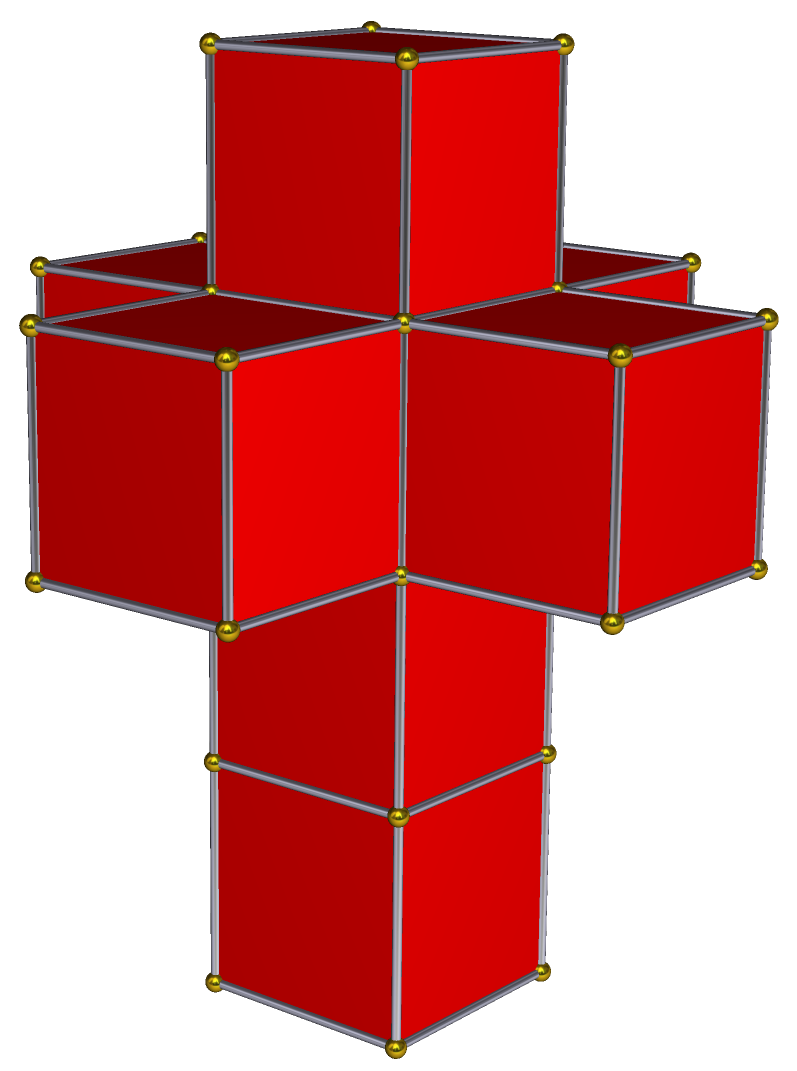
The most radical transformation is the cross itself. Instead of the familiar timber beams, Dalí paints an unfolded net of a tesseract — a four-dimensional hypercube flattened into eight connected cubes, the way the six faces of an ordinary cube can be unfolded into a flat cross-shaped pattern. He had been reading Juan de Herrera's Treatise on Cubic Forms, and the idea took hold of him: just as a hypercube exists in a dimension the human mind cannot directly picture, God exists in a realm beyond ordinary comprehension. The unfolded net becomes a bridge between the incomprehensible and the visible, just as Christ himself is understood as the human form through which the divine becomes accessible.
Dalí chose to set the scene at the bay of Port Lligat, his hometown in Catalonia — the same coastline that appears in several of his other religious paintings, including The Madonna of Port Lligat and The Sacrament of the Last Supper. Christ hovers above this familiar shoreline, levitating over a giant chessboard whose black and white squares echo the cube motif running throughout the painting. Even the title plays on this doubling of meaning: 'corpus' refers both to the body of Christ and to geometric solids, binding flesh and mathematics into a single word.
Look closer at Christ's knees and the painting reveals a strange trick of hyperrealist detail. Embedded in his right knee are five different images of Dalí's wife Gala; in his left knee, five images of Dalí himself, including his signature upswept mustache. These hidden portraits are nearly invisible in reproductions but unmistakable before the original canvas — a private signature folded into the sacred body, much as the tesseract folds hidden dimensions into visible form.
More from Art

The Painting With No Foreground
A single robed figure stares out at an empty grey sea — and the emptiness itself became a scandal. When it was unveiled in Berlin in 1810, no one knew quite what to do with it.

The Painter Who Chased the Light
For a few purple minutes each evening, an American exile knelt in an English garden and raced the dying sun to paint two little girls lighting lanterns. It took him two years to finish.

When a President Became a God
Look straight up inside the U.S. Capitol dome and you will find George Washington enthroned among the clouds, surrounded by goddesses — the founding father transformed into myth.

Marble Brought Back to Life
A corpse asleep, a wing barely brushing her skin — and marble somehow learns to breathe. This is the moment Antonio Canova dared to carve.

The World Turned Upside Down
Look closely at a sixteenth-century Flemish village and you'll find a man biting a pillar, another carrying daylight in a basket, and a wife slipping a blue cloak over her husband's shoulders. Every gesture is a joke — if you know the language.

The Girl in the Glass Case
She stood two-thirds life size, dressed in a real tutu and human hair — and the critics who saw her in 1881 recoiled as if she were something obscene.