The Cup He Chose to Drink
A condemned man reaches for poison with the calm of a teacher mid-lecture — and a French painter turns his last hour into a lesson for the ages.
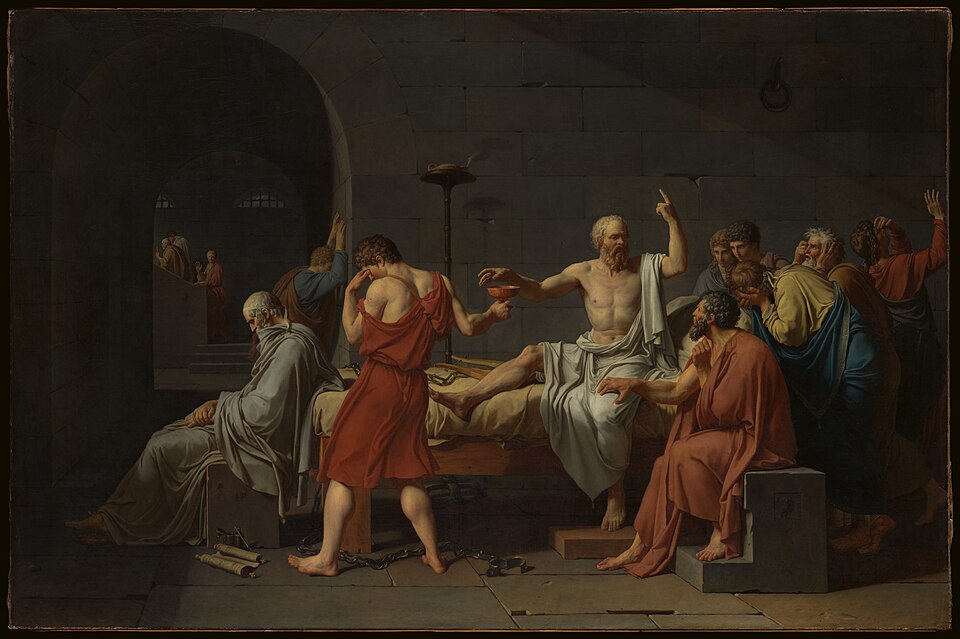
In 1787, Jacques-Louis David unveiled a canvas that froze one of philosophy's most famous moments: the instant before Socrates drank the hemlock that would kill him. The scene comes from Plato's Phaedo, which is Plato's fourth and last dialogue to detail the philosopher's final days — a story also told in Euthyphro, Apology, and Crito. Socrates had been convicted by Athens of corrupting the city's youth and introducing strange gods, and sentenced to die by poison. Rather than flee when given the chance, he chose to use his death itself as a final lesson.
David's painting shows an elderly Socrates in a white robe, sitting upright on his bed, one hand reaching toward the cup, the other still raised in the air — teaching even now. Around him his friends dissolve into grief, their faces twisted with emotion he does not share. The young man extending the cup toward him looks away, burying his face in his free hand, unable to watch. Crito grips his teacher's knee, listening intently. At the foot of the bed sits an old man, slumped and staring into his lap: Plato. Through an archway in the background, more mourners are visible, and on a distant stairway, Socrates' wife Xanthippe — dismissed earlier by her husband — casts one last wistful glance at the scene she is not permitted to witness.
Color does much of the emotional work here. David muted his reds at the edges of the canvas, letting them intensify toward the center, culminating in the dark red robe of the man offering the cup. Socrates and Plato, the only two figures untouched by visible anguish, wear a contrasting bluish-white — serenity rendered in cool tones against a room boiling with feeling. Some have read this restrained palette as David's answer to critics who had called the colors of his earlier Oath of the Horatii too garish.
David took liberties with history to sharpen the drama. He stripped away many of the characters Plato's dialogues actually describe, simplifying the crowded death scene into something more legible. He also aged his figures freely: Plato, in reality a young man when Socrates died, appears here as an old man collapsed at the bed's foot — perhaps because David intended the scene to be Plato's own memory, conjured decades later as he wrote. Socrates himself is idealized, more handsome and vigorous than a real seventy-year-old of his era, his face softened far beyond the well-known classical bust used as his likeness.
The artist left his signature twice, and each placement carried meaning. His full signature appears beneath Crito, the young man clutching Socrates' thigh — the figure David seems to have identified with most closely, a man holding fast to the values Socrates embodied. His initials appear beneath Plato, a quiet acknowledgment that the story itself belonged to him, the philosopher who first told it.
More from Art

The Painting With No Foreground
A single robed figure stares out at an empty grey sea — and the emptiness itself became a scandal. When it was unveiled in Berlin in 1810, no one knew quite what to do with it.

The Painter Who Chased the Light
For a few purple minutes each evening, an American exile knelt in an English garden and raced the dying sun to paint two little girls lighting lanterns. It took him two years to finish.

When a President Became a God
Look straight up inside the U.S. Capitol dome and you will find George Washington enthroned among the clouds, surrounded by goddesses — the founding father transformed into myth.

Marble Brought Back to Life
A corpse asleep, a wing barely brushing her skin — and marble somehow learns to breathe. This is the moment Antonio Canova dared to carve.

The World Turned Upside Down
Look closely at a sixteenth-century Flemish village and you'll find a man biting a pillar, another carrying daylight in a basket, and a wife slipping a blue cloak over her husband's shoulders. Every gesture is a joke — if you know the language.

The Girl in the Glass Case
She stood two-thirds life size, dressed in a real tutu and human hair — and the critics who saw her in 1881 recoiled as if she were something obscene.