The Deathbed He Painted for Forty Years
A grieving man returned to the same bedside six times across four decades, trying to paint his way out of guilt. He never quite managed it.
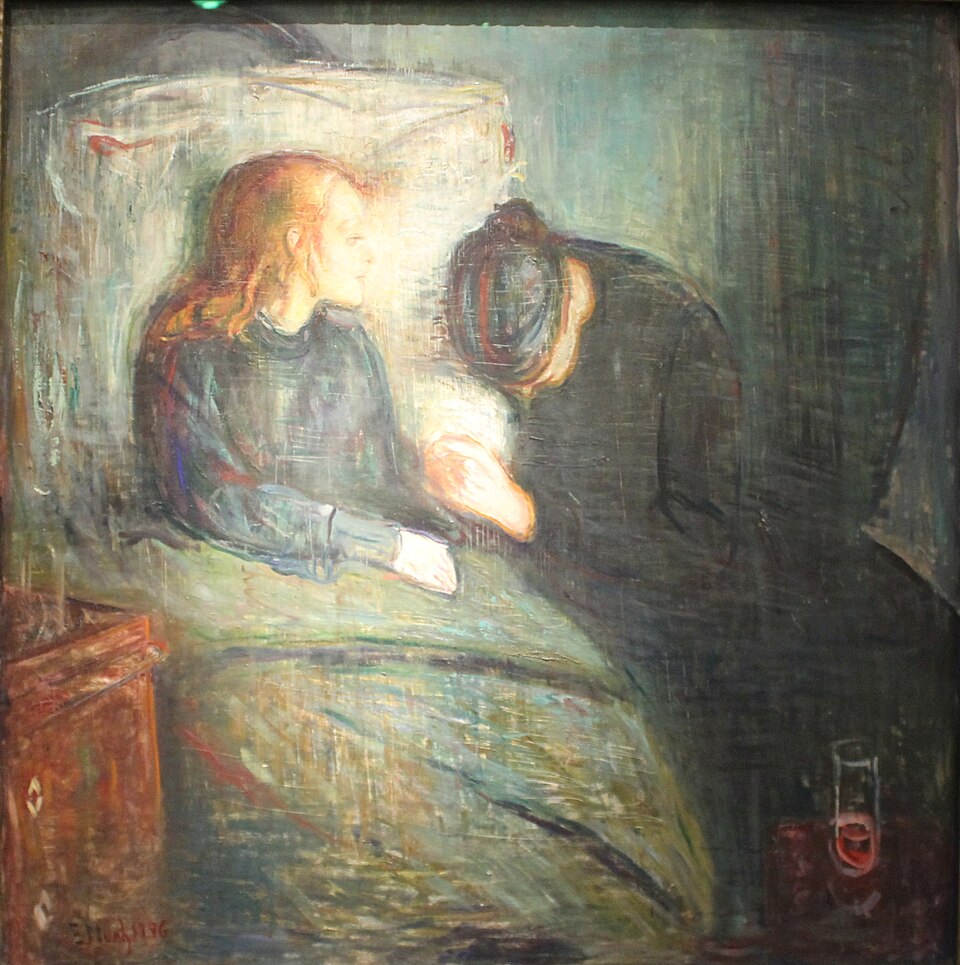
When Edvard Munch was twenty-six, he set himself an impossible task: to paint the moment before his sister died. His older sister, Johanne Sophie Munch, had succumbed to tuberculosis in 1877 at just fifteen years old, and Munch, who had nearly died of the same disease as a child, carried the memory of her final hours for the rest of his life. He began work on the first canvas in 1885, and it took him more than a year of painting, scrubbing out, and repainting before he was satisfied. So unsure was he of the result that he gave it the tentative title Study rather than claim it as a finished statement.
The image he eventually settled on became a template he would return to again and again. Sophie is shown in profile on her deathbed, propped up by a large white pillow that half-conceals a circular mirror on the wall behind her. Her red hair and pallid, frail face give her a haunted, vacant look as she gazes toward a dark, full-length curtain to her left — a detail many art historians read as a symbol of death itself. A heavy dark blanket covers her body, and her breathing is evidently laboured, a mark of tuberculosis in its final stages.
Beside her sits an older, dark-haired woman in black, almost certainly meant to be Sophie's aunt Karen. The two figures' clasped hands are placed at the exact centre of every version of the painting, a visual anchor for the emotional weight of the scene. The woman's head is bowed so low that her face is never shown — only the crown of her head is visible, as though she cannot bear to look the dying girl in the eye. Critic Patricia Donahue observed that the composition almost inverts expectation: it is the child who seems to be comforting the exhausted adult, rather than the reverse.
Munch worked in an intensely Expressionist, impressionistic style, building the paint up in thick impasto with heavy, broad vertical brushstrokes. The verticals give the canvases a hazy, blurred quality, which critic Michelle Facos likened to a scene 'experienced at close range but hazily, as if viewed through tears or the veil of memory.' It is a fitting description for a work born entirely out of remembered trauma rather than direct observation.
Colour shifted from version to version as Munch's relationship to the memory evolved. The earliest 1885–86 painting leans on whites, greys and greens, evoking a kind of oblivion. Later versions bring in richer greens and yellows to suggest sickness, and eventually red enters the palette — a reference to the coughing of blood that marks tuberculosis's most brutal late stage. This is not decorative variation; it is Munch reprocessing the same grief through different emotional registers over time.
More from Art

The Painting With No Foreground
A single robed figure stares out at an empty grey sea — and the emptiness itself became a scandal. When it was unveiled in Berlin in 1810, no one knew quite what to do with it.

The Painter Who Chased the Light
For a few purple minutes each evening, an American exile knelt in an English garden and raced the dying sun to paint two little girls lighting lanterns. It took him two years to finish.

When a President Became a God
Look straight up inside the U.S. Capitol dome and you will find George Washington enthroned among the clouds, surrounded by goddesses — the founding father transformed into myth.

Marble Brought Back to Life
A corpse asleep, a wing barely brushing her skin — and marble somehow learns to breathe. This is the moment Antonio Canova dared to carve.

The World Turned Upside Down
Look closely at a sixteenth-century Flemish village and you'll find a man biting a pillar, another carrying daylight in a basket, and a wife slipping a blue cloak over her husband's shoulders. Every gesture is a joke — if you know the language.

The Girl in the Glass Case
She stood two-thirds life size, dressed in a real tutu and human hair — and the critics who saw her in 1881 recoiled as if she were something obscene.