The Dream Picture That Haunted a Century
A small boat glides toward a wall of dark rock, carrying a coffin no one commissioned—until a grieving widow asked for one. What began as a quiet Florentine study became one of the most reproduced, imitated, and politically fraught images of the modern age.
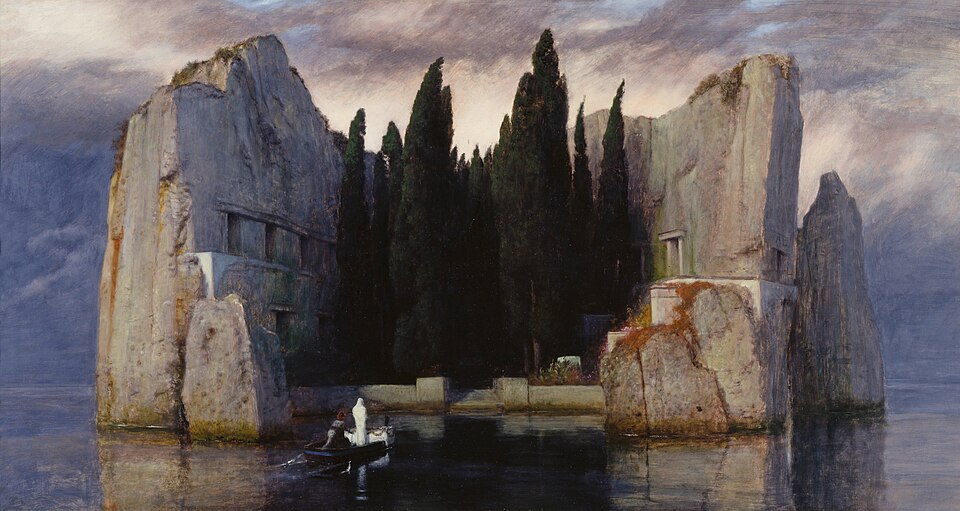
In a studio near Florence's English Cemetery, Swiss painter Arnold Böcklin worked through the spring of 1880 on a canvas of a rocky islet rising from still, dark water. A dense grove of cypress trees—long tied to mourning—choked its center, hemmed in by sheer cliffs pocked with what looked like tomb doorways. A rowing boat approached a seawall gate. It was, in Böcklin's own words, 'a dream picture: it must produce such a stillness that one would be awed by a knock on the door.' He completed this first version in May 1880 for his patron Alexander Günther, though he ended up keeping it for himself.
The cemetery was no random backdrop. It stood close to Böcklin's studio, and it was where his infant daughter Maria had been buried—one of eight of his fourteen children he lost. The rocky islet itself may have been modeled on Pontikonisi, a cypress-covered island near Corfu crowned with a small chapel, or perhaps on the jagged islet of Strombolicchio near Sicily's Stromboli volcano; the island of Ponza in the Tyrrhenian Sea has also been proposed, though the connection there is considered less likely.
In April 1880, while that first canvas still sat half-finished on his easel, Marie Berna—widow of financier Georg von Berna, who had died of diphtheria years earlier, and soon to remarry into the Oriola family—visited the studio and was struck by the image. Böcklin painted her a smaller version on wood. At her request, he added a white-festooned coffin and a standing figure clad entirely in white, in memory of her late husband. He then folded these same additions back into the original canvas. He called both paintings Die Gräberinsel—'Tomb Island.'
The title everyone knows today, Isle of the Dead, wasn't Böcklin's choice at all. Art dealer Fritz Gurlitt named it in 1883, borrowing a phrase from a letter Böcklin had written to Günther, the patron who had originally commissioned the first version. Without knowing this backstory, generations of viewers assumed the boatman was Charon, ferrying a soul across the Styx or Acheron to the underworld—a reading the painting invites but never confirms.
Between 1880 and 1886, Böcklin produced five versions. The Basel and New York paintings came first, followed in 1883 by a third—commissioned by Gurlitt—which introduced a new detail: the initials 'A.B.' carved into one of the rock-face tomb chambers. A fourth version, painted in 1884 on copper for entrepreneur Baron Heinrich Thyssen, hung in a Berlin bank until it was destroyed by wartime bombing, surviving only in a black-and-white photograph. A fifth, commissioned in 1886 by the Museum of Fine Arts in Leipzig, remains there today.
More from Art

The Painting With No Foreground
A single robed figure stares out at an empty grey sea — and the emptiness itself became a scandal. When it was unveiled in Berlin in 1810, no one knew quite what to do with it.

The Painter Who Chased the Light
For a few purple minutes each evening, an American exile knelt in an English garden and raced the dying sun to paint two little girls lighting lanterns. It took him two years to finish.

When a President Became a God
Look straight up inside the U.S. Capitol dome and you will find George Washington enthroned among the clouds, surrounded by goddesses — the founding father transformed into myth.

Marble Brought Back to Life
A corpse asleep, a wing barely brushing her skin — and marble somehow learns to breathe. This is the moment Antonio Canova dared to carve.

The World Turned Upside Down
Look closely at a sixteenth-century Flemish village and you'll find a man biting a pillar, another carrying daylight in a basket, and a wife slipping a blue cloak over her husband's shoulders. Every gesture is a joke — if you know the language.

The Girl in the Glass Case
She stood two-thirds life size, dressed in a real tutu and human hair — and the critics who saw her in 1881 recoiled as if she were something obscene.