The Duchess Who Refused to Fade
She holds out a flower meant for a bride, wearing a headdress a century out of style — and for five hundred years, no one has been able to look away.
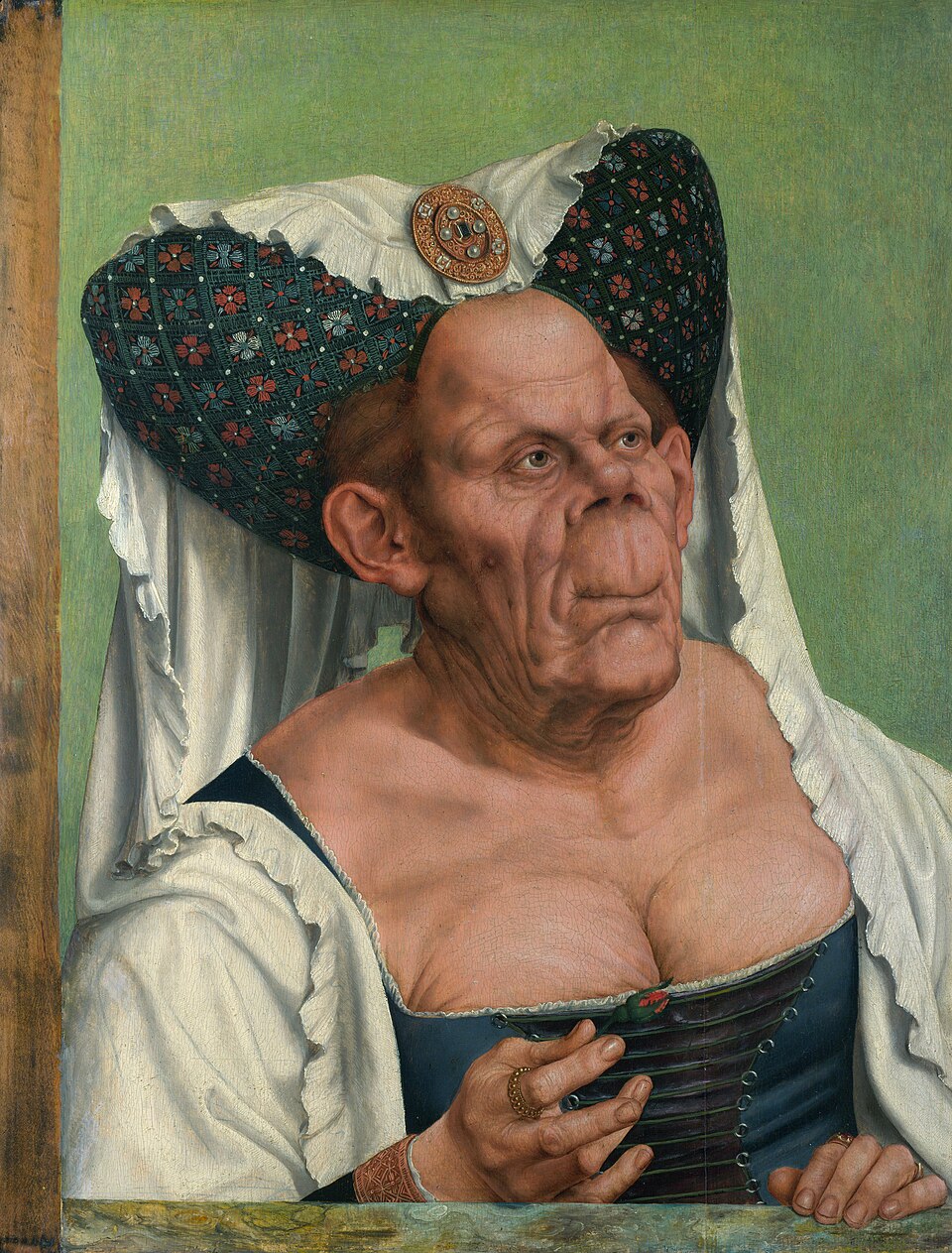
In an oil painting on oak measuring just 62.4 by 45.5 centimeters, a woman stares out with a face that seems almost impossible: a short, upturned nose, a stretched philtrum, thin pinched lips, cheeks and jaw sagging with loose, pocked skin, and a wart marking one side of her face. This is The Ugly Duchess, painted around 1513 by the Flemish artist Quinten Matsys, and it remains his most famous work — a small, strange portrait that has unsettled and fascinated viewers for five centuries.
What makes the painting so unnerving is not just the woman's exaggerated ugliness, but the contrast Matsys builds around it. She is dressed in the height of fashion — but fashion from a century earlier, the Burgundian style popular between 1400 and 1500, long out of date by 1513. Her escoffion, the aristocratic horned headdress, frames thinning hair swept behind protruding ears. A white veil decorated with roses falls from it, fastened with a gold and pearl brooch. Her corseted dress pushes her wrinkled breasts upward, well beyond what propriety of the era allowed. In her right hand she holds a red flower, then a widely understood symbol of engagement or courtship — a bud, as it has been described, that will likely never blossom.
Matsys's brushwork rewards close looking. Working wet-in-wet, he dragged and feathered his paint to soften transitions, and used sgraffito — scratching through wet paint to reveal the layer beneath — to render the hair near her ear and the embroidery on her cuff. Her uneven flesh was built from layered pink paint dotted with red and white in sporadic dashes. The brooch alone contains at least five shades of brown, orange, pink and yellow to achieve its golden hue. Infrared analysis reveals that Matsys treated her face with special care: he drew the eyes twice, shifting them slightly, then reworked the chin, neck and right ear from an earlier underdrawing, and also repositioned the right shoulder and both hands. The clothing, by contrast, was painted more loosely and freely — perhaps, scholars suggest, with help from assistants, given the inconsistent techniques used on the two horns of her headdress.
For a long time, the painting was believed to descend from a lost work by Leonardo da Vinci, based on its resemblance to two caricature drawings long attributed to him. That theory has since reversed: it now appears more likely that Leonardo's caricatures were influenced by Matsys, who is known to have exchanged drawings with the Italian master.
Scholars have also pointed to a possible literary source: Erasmus's 1511 essay In Praise of Folly, which mocked older women who 'still play the coquette', who 'cannot tear themselves away from their mirrors', and who 'do not hesitate to exhibit their repulsive withered breasts'. The woman in the painting has sometimes been identified as Margaret, Countess of Tyrol, whose enemies called her ugly — but she had died 150 years before Matsys picked up his brush, making the identification almost certainly symbolic rather than literal.
More from Art

The Painting With No Foreground
A single robed figure stares out at an empty grey sea — and the emptiness itself became a scandal. When it was unveiled in Berlin in 1810, no one knew quite what to do with it.

The Painter Who Chased the Light
For a few purple minutes each evening, an American exile knelt in an English garden and raced the dying sun to paint two little girls lighting lanterns. It took him two years to finish.

When a President Became a God
Look straight up inside the U.S. Capitol dome and you will find George Washington enthroned among the clouds, surrounded by goddesses — the founding father transformed into myth.

Marble Brought Back to Life
A corpse asleep, a wing barely brushing her skin — and marble somehow learns to breathe. This is the moment Antonio Canova dared to carve.

The World Turned Upside Down
Look closely at a sixteenth-century Flemish village and you'll find a man biting a pillar, another carrying daylight in a basket, and a wife slipping a blue cloak over her husband's shoulders. Every gesture is a joke — if you know the language.

The Girl in the Glass Case
She stood two-thirds life size, dressed in a real tutu and human hair — and the critics who saw her in 1881 recoiled as if she were something obscene.