The Emperor's Buried Army
Digging a well in 1974, farmers struck something no shovel had touched in over two thousand years — the silent face of an ancient soldier.
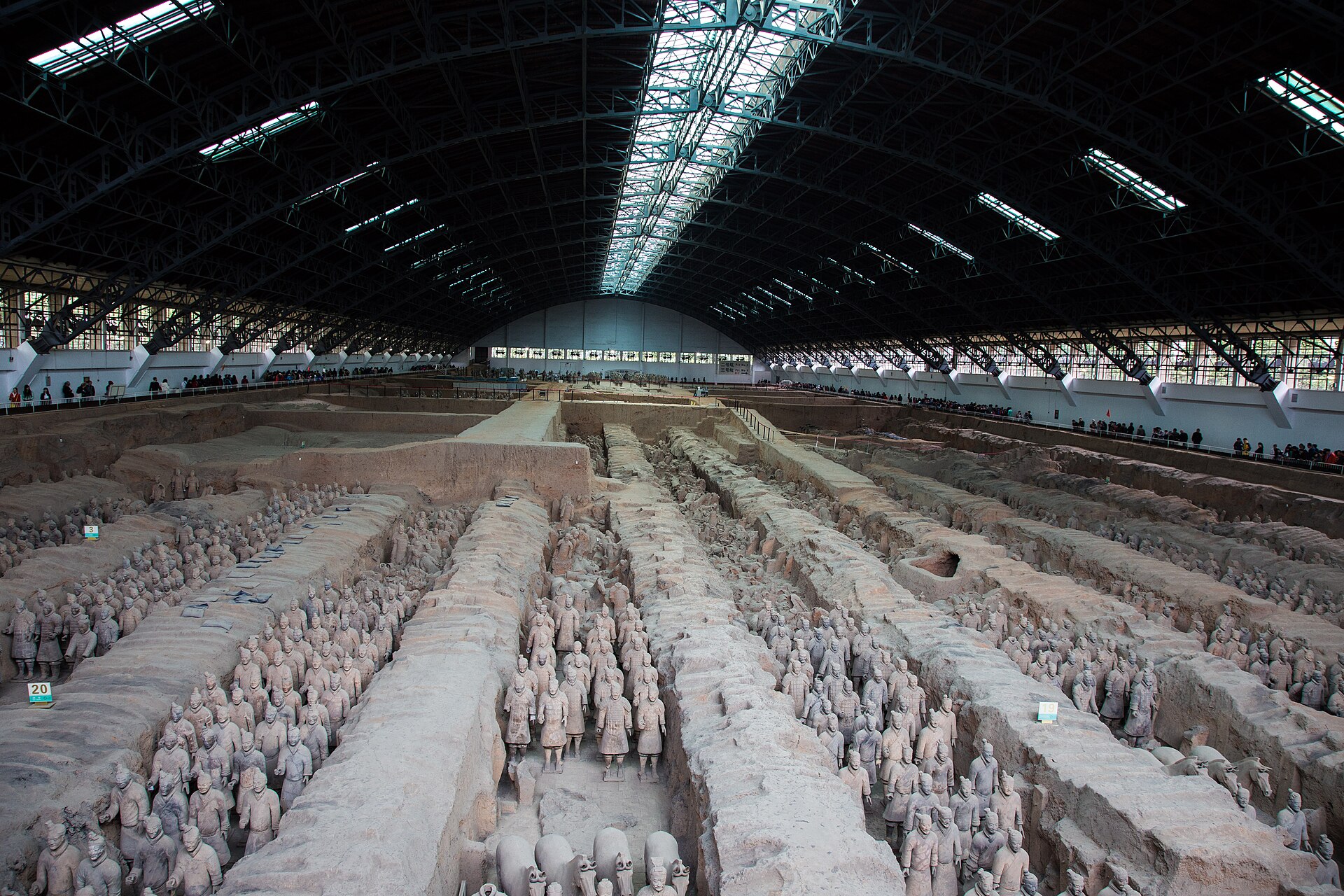
In March 1974, Yang Zhifa, his five brothers, and their neighbor Wang Puzhi were digging a well east of a mound near Mount Li, outside Xi'an in Shaanxi, China. Instead of water, their shovels struck fragments of clay figures buried some seven meters below the surface. What they had stumbled upon was not a curiosity but the edge of one of the largest funerary discoveries in human history: the Terracotta Army of Qin Shi Huang, the first emperor of a unified China.
Qin Shi Huang began building his mausoleum in 246 BCE, when he was just thirteen years old and had recently inherited the throne of the state of Qin. According to the historian Sima Qian, writing a century later in the Records of the Grand Historian, the project eventually conscripted 700,000 laborers. The tomb complex was built at the foot of Mount Li, a site favored, according to geographer Li Daoyuan, for its auspicious geology — rich in gold to the north and fine jade to the south.
Sima Qian described a tomb filled with palaces, towers, officials, and wondrous objects, with 100 flowing rivers simulated using mercury beneath a ceiling painted with heavenly bodies. Modern soil testing near the tomb mound has found unusually high mercury levels, lending some credibility to this ancient account — though Sima Qian's writing never actually mentions the terracotta soldiers themselves.
The army was buried roughly 1.5 kilometers east of the tomb mound, positioned as if to guard the emperor from the direction of the states he had conquered. Archaeologists eventually uncovered four main pits, each about seven meters deep. Pit 1 alone stretches 230 meters long and 62 meters wide, holding more than 3,000 of the army's estimated 8,000-plus soldiers. Alongside the warriors stood 130 chariots, 520 chariot horses, and 150 cavalry horses — a force whose scale still stuns anyone who walks its rows today.
The figures were not identical. Their height varied by rank, ranging from about 183 to 195 centimeters, with generals standing tallest among the ranks. Later excavations revealed non-military figures too — officials, acrobats, strongmen, and musicians — suggesting the underground world built for the emperor mirrored the full complexity of his court, not just his military might.
More from Archaeology

The Bronze Disc That Rewrote the Sky
Two looters with a metal detector dug up something illegal, invisible in value, and older than Stonehenge's final stones — a map of the heavens buried for over three thousand years.

The Faceless Women of the Ice Age
Long before writing, before cities, before the wheel, someone carved a woman's body into stone and ivory — and left no name, no face, no explanation.

The Pebble That Might Be Human
A palm-sized stone found on a Moroccan riverbank may be humanity's oldest attempt to see itself — or simply a trick of erosion.

The Crown That Vanished: Deshret and the Red Land
A crown worn by kings for three thousand years has never once been found in a tomb — not one. So where did it go?

The Face That Traveled Between Empires
A farm worker's shovel struck stone in 1897 and unearthed a face so striking it would be sold to France, seized as war booty, and finally traded back for a Velázquez.

The Boy in the Dark Tunnel
A schoolboy fell into black water inside an ancient tunnel and surfaced with his fingers brushing letters no one had noticed for 2,600 years.