The Engraver Who Invented the Seven Wonders
Everyone has heard of the Seven Wonders of the Ancient World — but for centuries, no two ancient writers could agree on what they actually were. It took a Flemish printmaker, a well-traveled painter, and a humanist poet to finally fix the list in stone.
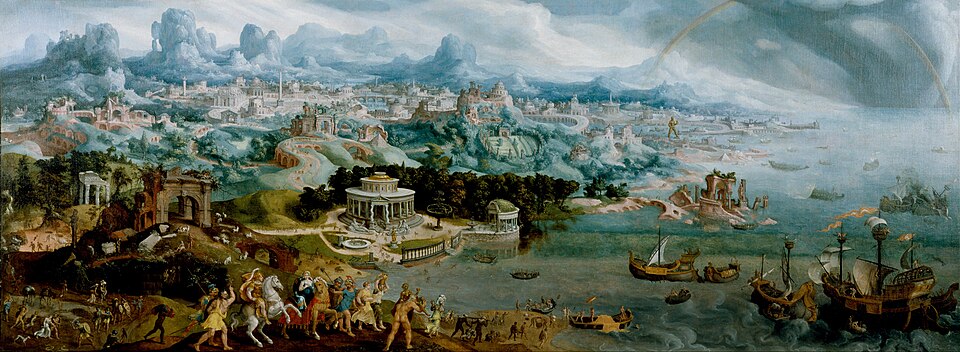
In 1572, in the workshop of Antwerp engraver Philips Galle, a set of eight prints emerged that would quietly reshape how the Western world imagined its own antiquity. Titled Octo Mundi Miracula — Eight Wonders of the World — the series was based on drawings by the Dutch painter Maarten van Heemskerck, with Latin elegiac couplets composed by the humanist poet Hadrianus Junius. Together, the three men produced something that had never existed before: a single, consistent, fully illustrated canon of the Seven Wonders of the Ancient World.
The project's necessity came from a real problem. Classical sources on the Seven Wonders never agreed with each other. Heemskerck's chief guide was Pedro Mexía's 1540 Silva de varia lección, a Spanish miscellany that laid out the confusion plainly: ancient historians, orators, and poets all mentioned the Wonders, but disagreed on the seventh entry and on the order in which they should be listed. Mexía noted that six of the seven were broadly agreed upon, but writers diverged over whether the final spot belonged to the Hanging Gardens, the Lighthouse of Pharos, or even the Obelisk of Semiramis, as the scholar Ludovico Celio had once argued.
Heemskerck brought more than bookish research to the project. Between 1532 and 1536 or 1537, he had traveled to Rome, where he studied its ruins and monuments firsthand, sketching classical architecture with the eye of a man who had walked among its stones. That direct experience shaped the entire series, giving the drawings a sense of physical presence even when depicting structures, like the Hanging Gardens or the Colossus of Rhodes, that no living person had ever seen.
Each of the eight engravings follows a consistent visual formula: the wonder itself dominates the center of the composition, framed by scenes of its mythical or historical context — rulers commissioning the work, laborers building it, gods presiding over its creation. Junius's accompanying Latin verses added another layer, referencing builders like Queen Artemisia II and Semiramis, and even technical legends, such as the use of charcoal beneath the foundations of the Temple of Artemis.
What makes the series most curious is its title: Eight Wonders, not seven. Alongside the traditional monuments, Heemskerck included the Colosseum in Rome — a building none of the classical sources ever counted among the Seven Wonders. This was clearly personal. Heemskerck had already featured the Colosseum in his own 1553 Self-Portrait with the Colosseum, and it appears in the 1572 series as the only monument shown in its true, ruined state rather than in idealized ancient splendor. It was also the only wonder his contemporary audience could actually go and visit.
More from Art

The Painting With No Foreground
A single robed figure stares out at an empty grey sea — and the emptiness itself became a scandal. When it was unveiled in Berlin in 1810, no one knew quite what to do with it.

The Painter Who Chased the Light
For a few purple minutes each evening, an American exile knelt in an English garden and raced the dying sun to paint two little girls lighting lanterns. It took him two years to finish.

When a President Became a God
Look straight up inside the U.S. Capitol dome and you will find George Washington enthroned among the clouds, surrounded by goddesses — the founding father transformed into myth.

Marble Brought Back to Life
A corpse asleep, a wing barely brushing her skin — and marble somehow learns to breathe. This is the moment Antonio Canova dared to carve.

The World Turned Upside Down
Look closely at a sixteenth-century Flemish village and you'll find a man biting a pillar, another carrying daylight in a basket, and a wife slipping a blue cloak over her husband's shoulders. Every gesture is a joke — if you know the language.

The Girl in the Glass Case
She stood two-thirds life size, dressed in a real tutu and human hair — and the critics who saw her in 1881 recoiled as if she were something obscene.