The Eye That Watches: Bosch's Wheel of Sin and Judgment
A drunkard, a vain woman, a lazy dreamer by the fire — ordinary people caught in the act, arranged in a circle around the pupil of God's own eye. Beware, beware, the Lord sees.
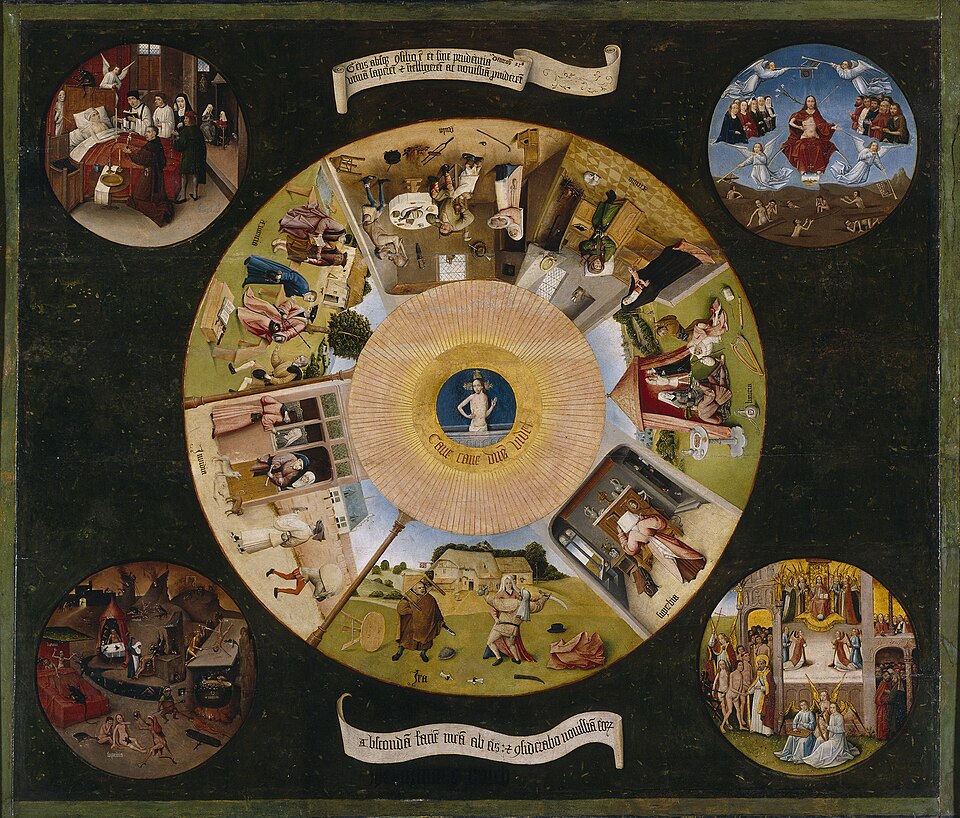
Sometime around 1500, or perhaps a little later, a painter working in the tradition of Hieronymus Bosch set out to show sin not as an abstract vice but as everyday behavior caught in the act. The result is a panel now known as The Seven Deadly Sins and the Four Last Things, oil on wood, composed as a series of circular images rather than a single continuous scene.
At the heart of the composition sits a large circle said to represent the eye of God. Within its pupil, Christ is shown emerging from his tomb. Beneath this image runs a Latin inscription: Cave cave d[omi]n[u]s videt — Beware, beware, the Lord sees. Around the central eye, arranged clockwise, are seven small scenes depicting the seven deadly sins, not through allegory but through vignettes of ordinary life.
Starting at the bottom is wrath, where a woman tries to break up a fight between two drunken peasants. Moving clockwise comes envy, in which a couple in a doorway cast jealous glances at a wealthy man with a hawk on his wrist and a servant carrying his load, while their daughter flirts with a man outside her window. Greed follows, then gluttony — a drunkard swigging from a bottle, a fat man eating greedily while ignoring his equally obese son, and his wife grudgingly bringing in a turkey.
Sloth shows a lazy man dozing before the fireplace while Faith, disguised as a nun, appears to him in a dream to remind him to pray. Continuing clockwise came extravagance, the sin later replaced in the scheme by lust: two couples picnicking in a pink tent, entertained by two clowns. Pride closes the circle — a woman, her back to the viewer, admiring her reflection in a mirror held up by a demon.
Surrounding this central wheel are four smaller circles depicting the Four Last Things: Death, Judgment, Heaven, and Hell. Above and below the whole composition run Latin inscriptions drawn from Deuteronomy 32:28–29 — lines lamenting a nation void of counsel and understanding, and wishing that people were wise enough to consider their latter end.
More from Art

The Painting With No Foreground
A single robed figure stares out at an empty grey sea — and the emptiness itself became a scandal. When it was unveiled in Berlin in 1810, no one knew quite what to do with it.

The Painter Who Chased the Light
For a few purple minutes each evening, an American exile knelt in an English garden and raced the dying sun to paint two little girls lighting lanterns. It took him two years to finish.

When a President Became a God
Look straight up inside the U.S. Capitol dome and you will find George Washington enthroned among the clouds, surrounded by goddesses — the founding father transformed into myth.

Marble Brought Back to Life
A corpse asleep, a wing barely brushing her skin — and marble somehow learns to breathe. This is the moment Antonio Canova dared to carve.

The World Turned Upside Down
Look closely at a sixteenth-century Flemish village and you'll find a man biting a pillar, another carrying daylight in a basket, and a wife slipping a blue cloak over her husband's shoulders. Every gesture is a joke — if you know the language.

The Girl in the Glass Case
She stood two-thirds life size, dressed in a real tutu and human hair — and the critics who saw her in 1881 recoiled as if she were something obscene.