The Face in the Mirror: Vincent van Gogh's Self-Portraits
He painted himself dozens of times, always reversed by the mirror's trick — and one of those faces was hiding, unseen, for over a century.
On July 14, 2022, a conservator named Lesley Stevenson was running an X-ray over a painting called Head of a Peasant Woman at the Scottish National Gallery of Modern Art. Beneath the surface, something emerged: a bearded man in a brimmed hat, a neckerchief knotted at his throat, his left ear plainly visible. It was, almost certainly, a self-portrait of Vincent van Gogh, hidden under layers of cardboard and glue for well over a hundred years. Experts believe it dates to 1885, painted around the time van Gogh arrived in France and began absorbing the lessons of the impressionists — an encounter that would transform his palette from muddy earth tones into the vivid color the world now reveres him for. Because he was frequently short of money, van Gogh often reused canvases or painted on their reverse sides, and this discovery was simply one more secret sealed away by necessity.
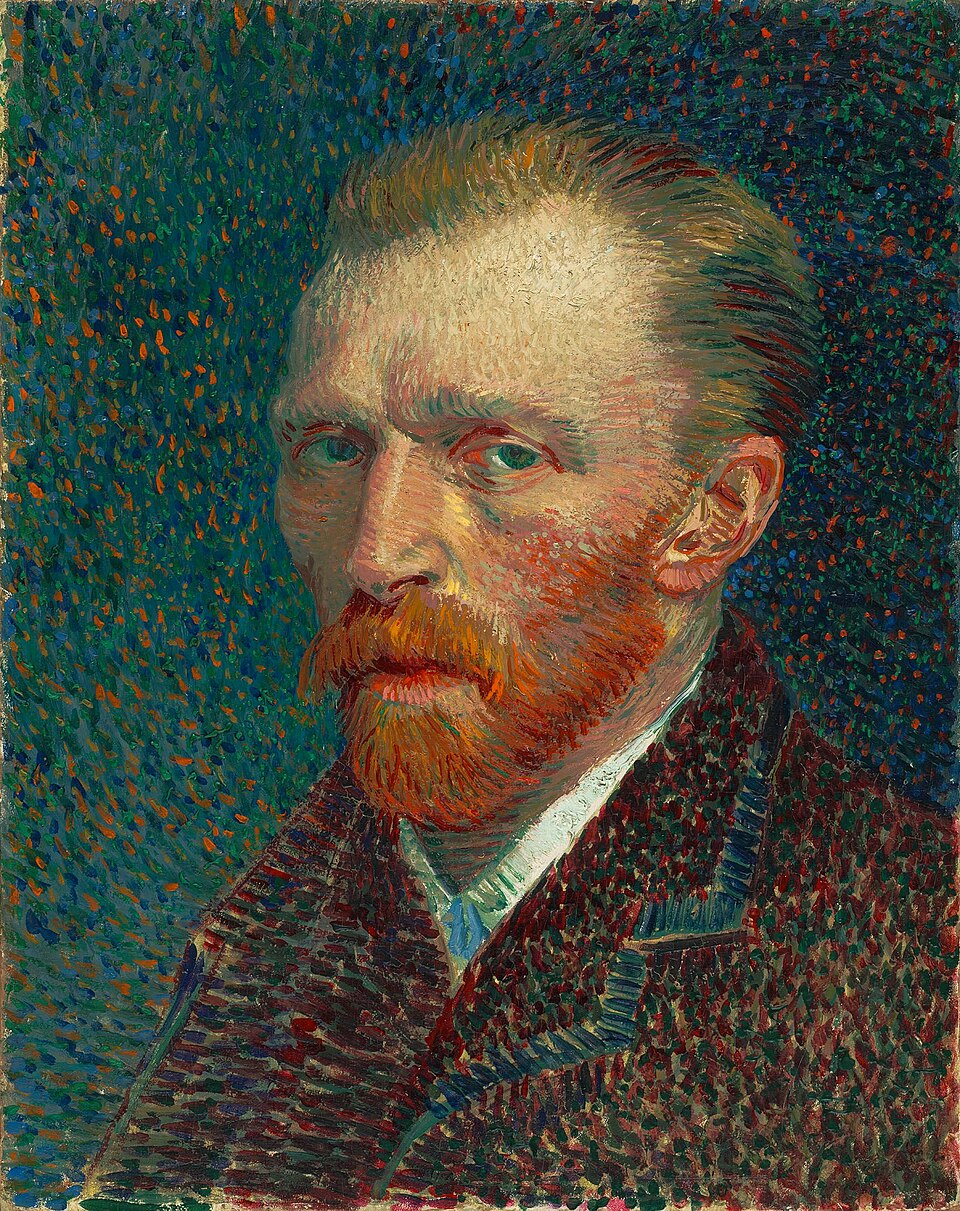
The earliest self-portrait of his that has survived openly dates to 1886, painted in Paris. It marks the beginning of a habit that would define much of his artistic output: turning the mirror on himself again and again, not out of vanity but largely out of necessity. Models were expensive, and his own face was always available, unpaid and patient.
One especially debated early work is known by its catalogue number, F208a: Self-Portrait with Dark Felt Hat. It surfaced late within the family collection and was never exhibited until 1945. Scholars have long argued over exactly when and where it was made — some placing it in Antwerp before 1886, others in Paris that same year, and still others in the autumn of 1886, based on stylistic ties to van Gogh's growing interest in Neo-impressionism. An X-ray revealed a nude figure study underneath, and since students in Antwerp did not work from nude models, this detail points to Paris, where van Gogh had enrolled in Fernand Cormon's atelier. His biographer Marc Edo Tralbaut prized the painting highly, choosing it for the dust jacket of his book and describing it as a moment when van Gogh had 'laid himself bare.' Tralbaut noted that van Gogh, in poor health with his teeth falling out, grew a moustache to hide the damage, and dressed in city clothes to project a respectable, middle-class image as he tried to launch a conventional art career.
As van Gogh moved through Arles and later Saint-Rémy, his self-portraits shifted in a quietly telling way. Every self-portrait made in Saint-Rémy shows his head turned to the left — displaying the ear that remained intact after he mutilated the other. It is a detail easy to miss, yet it silently records the aftermath of one of the most infamous episodes of his life.
Two portraits stand out as candidates for his very last self-portrait. One, catalogued as F627, was a gift to his brother Theo. The other, F525, was given to his mother as a birthday present. This second painting, made just after van Gogh had shaved off his beard, is linked by scholar Jan Hulsker to his hospitalization in Arles following the ear mutilation — a period documented in the so-called 'bandaged ear' portraits, F527 and F529, where he also appears beardless. The birthday portrait for his mother can even be glimpsed within the third, smaller version of his famous Bedroom in Arles, now at the Musée d'Orsay. Decades later, this same self-portrait became one of the most expensive paintings ever sold, fetching $71.5 million in New York in 1998.
More from Art

The Painting With No Foreground
A single robed figure stares out at an empty grey sea — and the emptiness itself became a scandal. When it was unveiled in Berlin in 1810, no one knew quite what to do with it.

The Painter Who Chased the Light
For a few purple minutes each evening, an American exile knelt in an English garden and raced the dying sun to paint two little girls lighting lanterns. It took him two years to finish.

When a President Became a God
Look straight up inside the U.S. Capitol dome and you will find George Washington enthroned among the clouds, surrounded by goddesses — the founding father transformed into myth.

Marble Brought Back to Life
A corpse asleep, a wing barely brushing her skin — and marble somehow learns to breathe. This is the moment Antonio Canova dared to carve.

The World Turned Upside Down
Look closely at a sixteenth-century Flemish village and you'll find a man biting a pillar, another carrying daylight in a basket, and a wife slipping a blue cloak over her husband's shoulders. Every gesture is a joke — if you know the language.

The Girl in the Glass Case
She stood two-thirds life size, dressed in a real tutu and human hair — and the critics who saw her in 1881 recoiled as if she were something obscene.