The Face on the Shield
He painted his own severed head frozen in its last scream — and mounted it on a shield fit for a Medici.
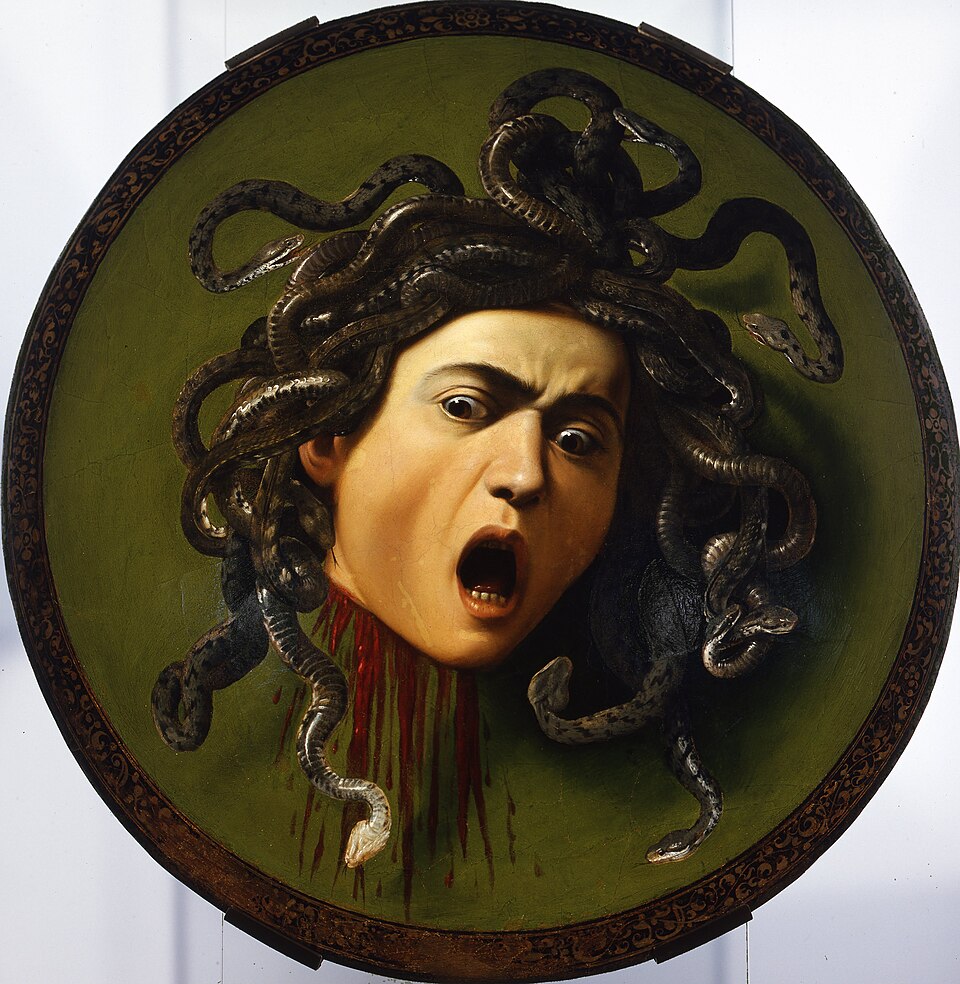
In the summer of 1597, while Caravaggio was being pulled into police interrogations over a missing cloak and a small dagger, he was also completing one of the strangest self-portraits in Western art: his own face, decapitated, mouth open, eyes wide with the shock of death, painted onto a convex wooden shield. He called it Medusa, and there were, in fact, two versions.
The first, painted in 1596, is small — just 48 by 55 centimeters — and signed Michel A F, an abbreviation of the Latin Michel Angelo Fecit, 'Michelangelo made this.' It became known as Murtula, named for the poet Gaspare Murtola, who wrote of the Gorgon that if your eyes were petrified in amazement, she would turn you to stone. That painting remains in private hands. The second version, slightly larger at 60 by 55 centimeters, is unsigned and undated, though scholars place it around 1597. It now hangs in the Uffizi Gallery in Florence.
Both paintings were commissioned by Francesco Maria del Monte, the Italian diplomat and cardinal in whose household Caravaggio lived and worked. Del Monte intended the shield as a gift for Ferdinando I de' Medici, meant to enter the storied Medici collection — a token of political and artistic ambition disguised as myth.
The myth itself is grim: Medusa, once a mortal woman, was cursed by Athena after being raped by Poseidon in one of the goddess's own temples. Her hair became serpents, her gaze a weapon that turned onlookers to stone. Perseus, son of Zeus, beheaded her using gifts from the gods. Caravaggio chose to paint not the triumph but the instant after — the head still seeming conscious, brows creased, blood pouring from the severed neck, as though the shock of death hadn't yet caught up with the flesh.
And the face is his own. By replacing Medusa's features with a self-portrait, Caravaggio positioned himself as the one figure immune to her fatal stare — the painter who could look at horror and survive it, even reproduce it in oil. The choice fits a man whose life, at that very moment, was tangled in violence and suspicion: witnesses describing him in the courts as a disheveled figure in black, arrested for carrying swords, defending himself by invoking his patron's name.
More from Art

The Painting With No Foreground
A single robed figure stares out at an empty grey sea — and the emptiness itself became a scandal. When it was unveiled in Berlin in 1810, no one knew quite what to do with it.

The Painter Who Chased the Light
For a few purple minutes each evening, an American exile knelt in an English garden and raced the dying sun to paint two little girls lighting lanterns. It took him two years to finish.

When a President Became a God
Look straight up inside the U.S. Capitol dome and you will find George Washington enthroned among the clouds, surrounded by goddesses — the founding father transformed into myth.

Marble Brought Back to Life
A corpse asleep, a wing barely brushing her skin — and marble somehow learns to breathe. This is the moment Antonio Canova dared to carve.

The World Turned Upside Down
Look closely at a sixteenth-century Flemish village and you'll find a man biting a pillar, another carrying daylight in a basket, and a wife slipping a blue cloak over her husband's shoulders. Every gesture is a joke — if you know the language.

The Girl in the Glass Case
She stood two-thirds life size, dressed in a real tutu and human hair — and the critics who saw her in 1881 recoiled as if she were something obscene.