The Face That Became a Dragon
Buried in a ship, crushed under a hill of earth, and pieced back together from hundreds of rusted shards — this helmet still stares back at us fourteen centuries later.
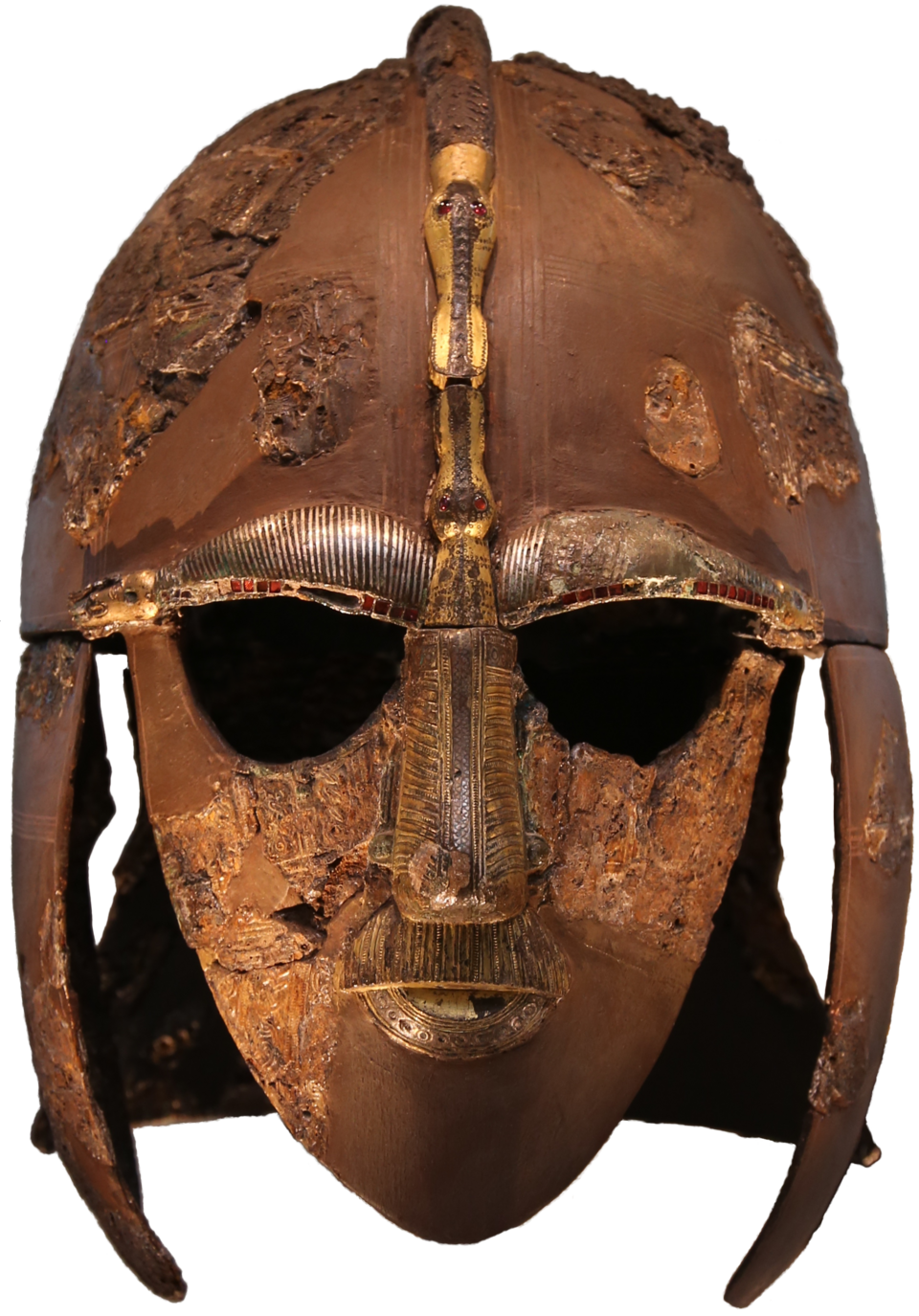
In 1939, on a low hill above the River Deben in Suffolk, archaeologists opened a mound and found the remains of a ship-burial. Among the treasures lifted from the soil was a corroded mass of iron fragments, so shattered it seemed at first like little more than rust and ruin. It would take decades and two separate reconstructions before the world understood what they had actually found: one of the most iconic objects to survive from Anglo-Saxon England, a helmet that has been compared to the treasures of Tutankhamen for the shock it delivered to archaeology.
The burial itself was an act of enormous labor and intention. A wooden ship had been hauled up from the river and lowered into a prepared trench on the hilltop, then loaded with regalia and instruments of power. The helmet was wrapped in cloth and placed to the left of the head of the person it was buried with. An oval mound was raised over the whole ship. Long after the burial, the roof of the chamber inside collapsed under the weight of that earth, crushing the ship's contents into a thin seam of soil — and shattering the helmet into the pieces that would puzzle its eventual finders.
Paradoxically, that violent collapse is part of why the helmet survives in recognizable form today. Had it been crushed earlier, while the iron was still pliant and had not yet fully oxidized, it would likely have been squashed flat and distorted, more like the related helmets found at Vendel and Valsgärde in Sweden. Instead, it shattered into hundreds of fragments that, however painstaking to reassemble, preserved something closer to its true original shape.
That reassembly happened in two stages. An initial reconstruction was displayed in 1945–46, not long after the fragments were pulled from the ground. But it wasn't until a second, more careful reconstruction in 1970–71 that the helmet took the form now familiar to millions of visitors to the British Museum. The face that emerged is startling: eyebrows, a nose, and a moustache combine with a dragon's head to transform the wearer's visage into the image of a soaring dragon with outstretched wings — a helmet that was both battlefield armor and a piece of symbolic, perhaps even royal, metalwork.
Who wore it remains a question without a certain answer, though one name dominates the speculation: Rædwald, King of East Anglia. His seat of power is believed to have been at Rendlesham, some 4+1⁄4 miles — about six kilometres — upriver from Sutton Hoo. The case for Rædwald rests on the estimated dating of the burial to around 620–625 AD, the sheer wealth and regal character of the grave goods, and a detail that fits Rædwald unusually well — the presence of both Christian and pagan influences in a burial, echoing a king who, according to the historian Bede, kept a temple with two altars, one for each faith.
More from Archaeology

The Bronze Disc That Rewrote the Sky
Two looters with a metal detector dug up something illegal, invisible in value, and older than Stonehenge's final stones — a map of the heavens buried for over three thousand years.

The Faceless Women of the Ice Age
Long before writing, before cities, before the wheel, someone carved a woman's body into stone and ivory — and left no name, no face, no explanation.

The Pebble That Might Be Human
A palm-sized stone found on a Moroccan riverbank may be humanity's oldest attempt to see itself — or simply a trick of erosion.

The Crown That Vanished: Deshret and the Red Land
A crown worn by kings for three thousand years has never once been found in a tomb — not one. So where did it go?

The Face That Traveled Between Empires
A farm worker's shovel struck stone in 1897 and unearthed a face so striking it would be sold to France, seized as war booty, and finally traded back for a Velázquez.

The Boy in the Dark Tunnel
A schoolboy fell into black water inside an ancient tunnel and surfaced with his fingers brushing letters no one had noticed for 2,600 years.