The Faces That Almost Broke Norman Rockwell
To paint the simplest of America's promised freedoms, Norman Rockwell tore up his own canvas — and rebuilt his faith in the work from his neighbors' rosary and fez.
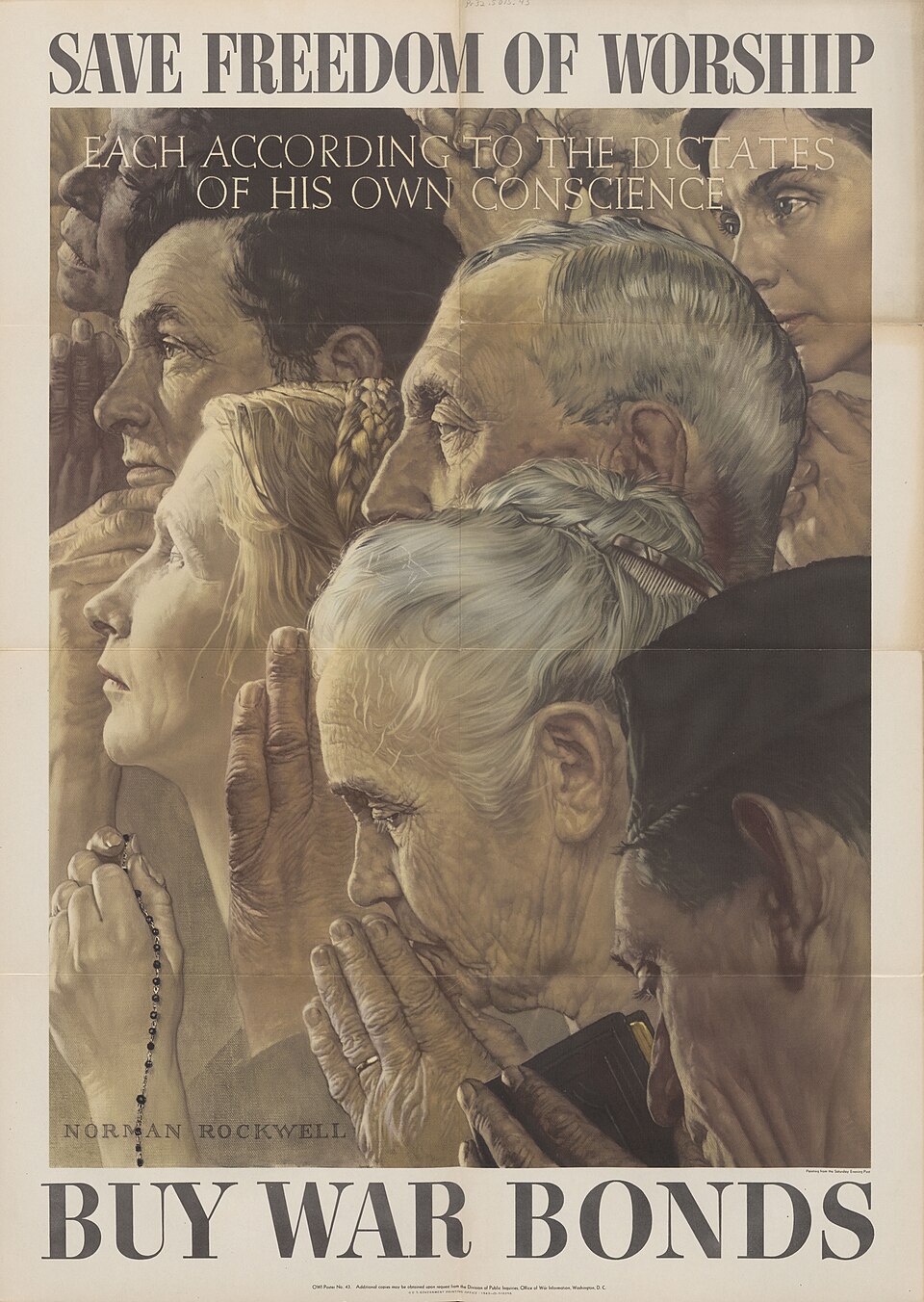
In October 1942, Norman Rockwell sat in his Arlington, Vermont studio, staring at a painting he had already abandoned once. He was two months into a deadline given to him by Ben Hibbs, editor of The Saturday Evening Post, to complete Freedom of Worship — the second in a series of four paintings inspired by President Franklin D. Roosevelt's 1941 State of the Union Address, in which Roosevelt had named four freedoms he believed all people deserved: of speech, of worship, from want, and from fear.
Rockwell's first attempt had been set in a barbershop, with patrons of different religions and races lined up for the barber's chair — a Jewish man being served by a Protestant barber, a Black man and a Roman Catholic priest waiting nearby. It was meant to depict tolerance as the basis of a democracy's religious diversity. But Rockwell found that rendering each figure recognizably by faith or race pushed him toward crude caricature: an overly Semitic Jewish man, a preppy white customer, a Black man reduced to agrarian workman's clothes. He felt it failed the very idea it was meant to honor, and he scrapped it.
His second approach abandoned literal scene-setting altogether. Instead, Rockwell composed eight heads in profile, packed closely in a modest space, each figure caught in a moment of quiet prayer. Along the bottom row, from right to left, sit three carefully chosen figures: a man with his head covered, holding a religious book, understood as Jewish; an older woman, understood as Protestant; and a younger woman with a softly lit face, holding rosary beads, understood as Catholic. Dark-skinned worshippers were placed at the edges of the composition — a Black woman near the top, painted, in Rockwell's own words, 'furtively,' and a man wearing a fez at the bottom, whose foreignness, Rockwell felt, was too obvious to give offense.
His models were his own Arlington neighbors. Rose Hoyt, three months pregnant, her hair braided up, posed as the Catholic woman with the rosary — though she was actually an Episcopalian Protestant. Others included a Mrs. Harrington, his own carpenter Walter Squires, Squires' wife Clara at the composition's right edge, Winfield Secoy, and Jim Martin at the center. The finished painting leaned on such quiet visual clues — a rosary, a religious book — rather than exaggerated features, to signal faith without caricature.
Rockwell placed enormous weight on the hands in the painting. He later said that hands were, to him, second only to heads in conveying a story, and that in Freedom of Worship he depended on hands alone to carry about half the message he wanted to express. He described religion as an extremely delicate subject, one so easy to wound people over, and his months of labor reflected that caution. The finished canvas favored a muted palette of soft greys, beiges and browns, the paint applied thinly enough that the weave of the canvas itself shows through — a texture reproductions often darken or enhance.
More from Art

The Painting With No Foreground
A single robed figure stares out at an empty grey sea — and the emptiness itself became a scandal. When it was unveiled in Berlin in 1810, no one knew quite what to do with it.

The Painter Who Chased the Light
For a few purple minutes each evening, an American exile knelt in an English garden and raced the dying sun to paint two little girls lighting lanterns. It took him two years to finish.

When a President Became a God
Look straight up inside the U.S. Capitol dome and you will find George Washington enthroned among the clouds, surrounded by goddesses — the founding father transformed into myth.

Marble Brought Back to Life
A corpse asleep, a wing barely brushing her skin — and marble somehow learns to breathe. This is the moment Antonio Canova dared to carve.

The World Turned Upside Down
Look closely at a sixteenth-century Flemish village and you'll find a man biting a pillar, another carrying daylight in a basket, and a wife slipping a blue cloak over her husband's shoulders. Every gesture is a joke — if you know the language.

The Girl in the Glass Case
She stood two-thirds life size, dressed in a real tutu and human hair — and the critics who saw her in 1881 recoiled as if she were something obscene.