The Faces That Refused to Fade
Wrapped inside linen bandages for two thousand years, hundreds of painted faces stared out from Egyptian tombs — as vivid as the day the wax was still warm.
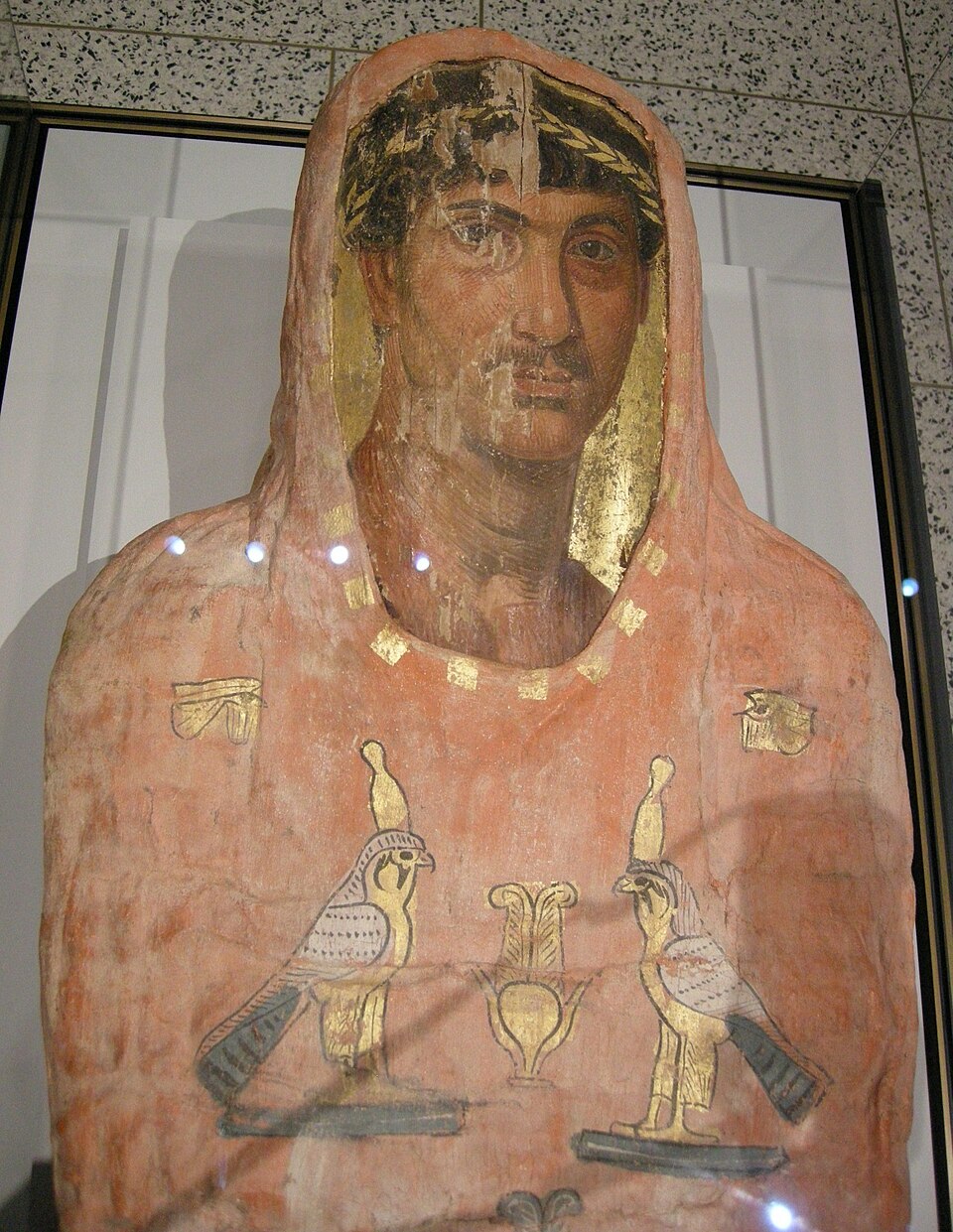
In the dry basin of Faiyum, southwest of Cairo, archaeologists began uncovering something startling: mummies whose wrappings framed not stylized Egyptian masks but strikingly lifelike human faces, painted with an intimacy that felt almost photographic. These are the Fayum mummy portraits, a body of work dating from the late 1st century BC or early 1st century AD, continuing perhaps until the middle of the 3rd century AD, during Egypt's time as a province of the Roman Empire.
The portraits were painted on wooden panels — cut from imported hardwoods like oak, lime, sycamore, cedar, cypress, fig, and citrus — then inserted into the layers of cloth wrapping a mummified body, creating the illusion of a window onto the face of the deceased. Occasionally, painters skipped the panel entirely and worked directly onto the canvas or linen rags of the wrapping itself, a technique called cartonnage painting.
Two methods dominate the surviving works: encaustic, or wax painting, and tempera made with animal glue. The encaustic portraits tend to be the finer of the two, their thick, vivid brushstrokes creating an almost Impressionistic texture, rich in color and contrast. The tempera portraits, by comparison, are softer and chalkier, with finer gradations of tone. In some paintings, gold leaf was added to render jewelry and wreaths, a small luxury glinting against the wood.
What makes these portraits remarkable is their naturalism. The artists understood anatomy, shading, and directional light well enough to give faces real volume — cheekbones catching light, shadows pooling beneath eyes, skin tones graded with highlights that suggest three-dimensional form. Nearly all show a single figure as a bust, turned slightly from full face, gazing directly at the viewer across two millennia.
The people depicted were not a single, simple category. Faiyum had long been a meeting point of populations: Ptolemaic-era Greek soldiers and administrators settled there among a much larger native Egyptian population, and over centuries the two groups intermarried and blended culturally. By the Roman period, Roman army veterans of diverse origins added another thread to this mixture, settling in the area after their service and forming families with local people. The portraits, once assumed to depict pure Greek settlers, actually reflect this complex synthesis of Egyptian and Greek — and eventually Roman — identity.
More from Archaeology

The Bronze Disc That Rewrote the Sky
Two looters with a metal detector dug up something illegal, invisible in value, and older than Stonehenge's final stones — a map of the heavens buried for over three thousand years.

The Faceless Women of the Ice Age
Long before writing, before cities, before the wheel, someone carved a woman's body into stone and ivory — and left no name, no face, no explanation.

The Pebble That Might Be Human
A palm-sized stone found on a Moroccan riverbank may be humanity's oldest attempt to see itself — or simply a trick of erosion.

The Crown That Vanished: Deshret and the Red Land
A crown worn by kings for three thousand years has never once been found in a tomb — not one. So where did it go?

The Face That Traveled Between Empires
A farm worker's shovel struck stone in 1897 and unearthed a face so striking it would be sold to France, seized as war booty, and finally traded back for a Velázquez.

The Boy in the Dark Tunnel
A schoolboy fell into black water inside an ancient tunnel and surfaced with his fingers brushing letters no one had noticed for 2,600 years.