The Fanatic on the Wall
A wild-eyed giant holds a Bible in one hand and a rifle in the other — and the state that commissioned him tried to bury the painting rather than hang it.
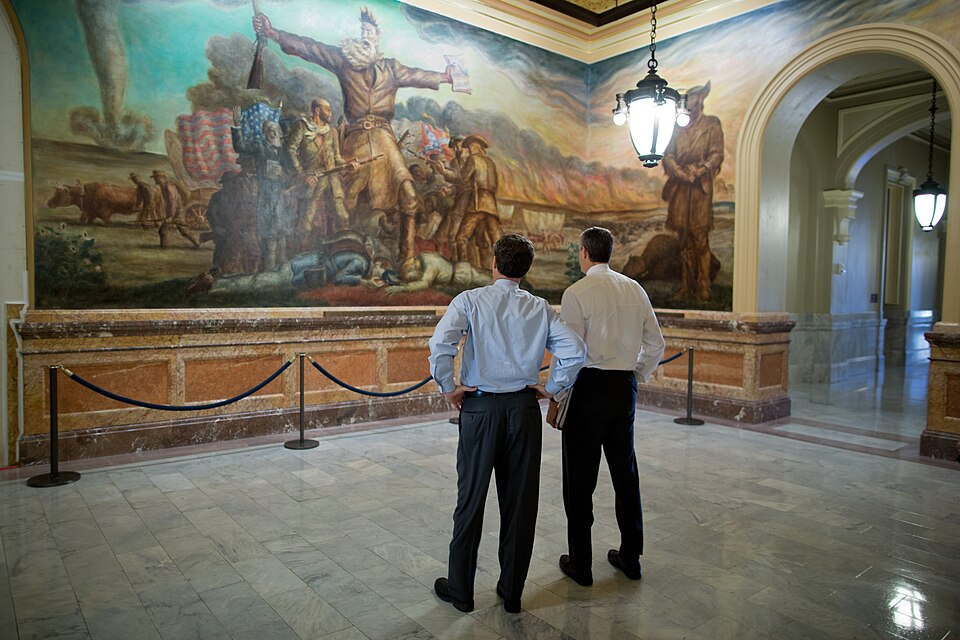
Walk into the east side of the second-floor rotunda of the Kansas State Capitol in Topeka, and you will find yourself standing before a towering figure of John Brown, arms outstretched, a Bible in one hand marked with the Greek letters alpha and omega from Revelation, and in the other a rifle nicknamed 'Beecher's Bible.' Behind him, Union and Confederate soldiers, living and dead, are locked in fury, while a tornado and a prairie fire rage in the distance and covered wagons of emigrants roll endlessly westward. This is Tragic Prelude, painted by American artist John Steuart Curry, and it remains, decades later, the most famous work he ever made.
The title refers to the Bleeding Kansas period of 1854 to 1860, when pro-slavery and free-soil forces fought bitterly over whether Kansas would enter the Union as a slave state — a violent dress rehearsal for the Civil War itself. John Brown stood at the center of that struggle, and Curry credited his patron, newspaper editor William Allen White, with coining the phrase 'tragic prelude' for the era.
Few people realize the mural doesn't end with Brown. It turns a corner and continues onto another wall, making it nearly impossible to photograph as a whole. There, chronologically from right to left, appear the Franciscan missionary Fray Juan de Padilla and the conquistador Coronado — the first Europeans to set foot on land that would become Kansas — followed by a plainsman standing over a buffalo he has just killed.
The mural exists because William Allen White, editor of the Emporia Gazette, campaigned to bring Curry home to paint for Kansas rather than see him work for the University of Wisconsin, which had offered him employment his own state hadn't. Other newspapers joined the cause, and the Kansas Murals Commission was formed under Governor Walter Huxman. Missouri artist Thomas Hart Benton had already painted a sprawling mural, A Social History of Missouri, for his state's capitol, and Kansas wanted its own answer. The commission decided Curry alone would paint the Kansas Capitol's murals, and White raised the funds privately — no state money was spent.
Curry worked on Tragic Prelude from 1937 to 1942, using egg tempera and oils across a canvas eleven feet four inches tall and thirty-one feet long. He later described it in his own words: the gigantic figure of John Brown, the word of God in one hand and a Beecher's Bible in the other, contending free-soil and pro-slavery forces facing each other, and at their feet two figures symbolizing the million and a half dead of the North and South. In a 1939 interview, he admitted he wanted to paint Brown 'as a fanatic, for John Brown was a fanatic,' possessing 'the wild zeal of the extremist.' In a letter, Curry went further, calling Brown 'the prototype of a great many Kansans' — people who went about, as someone once put it, 'wreaking good on humanity.'
More from Art

The Painting With No Foreground
A single robed figure stares out at an empty grey sea — and the emptiness itself became a scandal. When it was unveiled in Berlin in 1810, no one knew quite what to do with it.

The Painter Who Chased the Light
For a few purple minutes each evening, an American exile knelt in an English garden and raced the dying sun to paint two little girls lighting lanterns. It took him two years to finish.

When a President Became a God
Look straight up inside the U.S. Capitol dome and you will find George Washington enthroned among the clouds, surrounded by goddesses — the founding father transformed into myth.

Marble Brought Back to Life
A corpse asleep, a wing barely brushing her skin — and marble somehow learns to breathe. This is the moment Antonio Canova dared to carve.

The World Turned Upside Down
Look closely at a sixteenth-century Flemish village and you'll find a man biting a pillar, another carrying daylight in a basket, and a wife slipping a blue cloak over her husband's shoulders. Every gesture is a joke — if you know the language.

The Girl in the Glass Case
She stood two-thirds life size, dressed in a real tutu and human hair — and the critics who saw her in 1881 recoiled as if she were something obscene.