The Finger That Faces the Stock Exchange
A giant marble hand rises in the heart of Italian finance — four fingers severed, one raised in silent defiance. No one, not even its creator, will say exactly what it means.
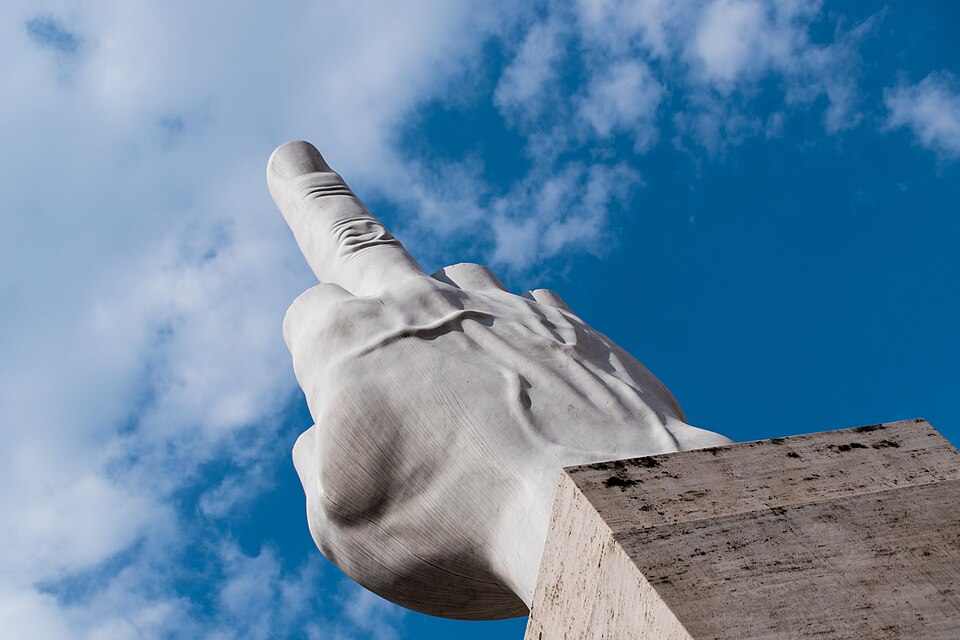
In the autumn of 2010, a strange marble object appeared in Piazza degli Affari, the square in Milan that houses the Italian stock exchange. It was a colossal hand, carved with unsettling realism, its fingers severed except for one: the middle finger, thrust upward in an unmistakable gesture. Italian artist Maurizio Cattelan called it L.O.V.E., and almost immediately, Milanese passersby gave it a blunter nickname — Il Dito, 'the finger.'
The title was not a simple romantic gesture. L.O.V.E. was an acronym: Libertà, Odio, Vendetta, Eternità — Freedom, Hatred, Revenge, Eternity. The words hinted at something far darker and more ambivalent than the word 'love' alone would suggest, and Cattelan, true to his reputation as an artist who thrives on ambiguity, never explained the sculpture's meaning any further.
The piece was originally built as part of a retrospective of Cattelan's work at the Royal Palace of Milan in 2010. It was installed in Piazza degli Affari as a temporary companion to that exhibition, expected to stand in the square for only about a week before being removed.
But the sculpture's presence outside the stock exchange building sparked immediate conversation. Was it a mocking gesture aimed at the financial institutions still reeling from the 2008 financial crisis, a raised finger to the bankers and traders who worked behind those walls? Or was it something older and darker — an echo of the Fascist salute, or a critique of religious fanaticism? Cattelan offered no answers, and the two interpretations have coexisted ever since, neither confirmed nor denied.
The sculpture was inaugurated on 24 September 2010 by Milan's then-mayor, Letizia Moratti. Even before its planned removal, discussions had already begun about whether it might stay permanently. Cattelan himself wrote a letter to Massimiliano Finazzer Flory, the city's Councillor for Culture at the time, offering to donate the work to Milan outright — but on one condition. 'The original spirit of the work was respected,' he insisted. 'The project was created for Piazza Affari and must remain there, this is my condition.'
More from Art

The Painting With No Foreground
A single robed figure stares out at an empty grey sea — and the emptiness itself became a scandal. When it was unveiled in Berlin in 1810, no one knew quite what to do with it.

The Painter Who Chased the Light
For a few purple minutes each evening, an American exile knelt in an English garden and raced the dying sun to paint two little girls lighting lanterns. It took him two years to finish.

When a President Became a God
Look straight up inside the U.S. Capitol dome and you will find George Washington enthroned among the clouds, surrounded by goddesses — the founding father transformed into myth.

Marble Brought Back to Life
A corpse asleep, a wing barely brushing her skin — and marble somehow learns to breathe. This is the moment Antonio Canova dared to carve.

The World Turned Upside Down
Look closely at a sixteenth-century Flemish village and you'll find a man biting a pillar, another carrying daylight in a basket, and a wife slipping a blue cloak over her husband's shoulders. Every gesture is a joke — if you know the language.

The Girl in the Glass Case
She stood two-thirds life size, dressed in a real tutu and human hair — and the critics who saw her in 1881 recoiled as if she were something obscene.