The Fire That Made a Painter Famous
For five years a Russian artist chased the ghosts of a buried city — and when he finally unveiled his masterpiece in Rome, a room fell silent, then erupted in awe.
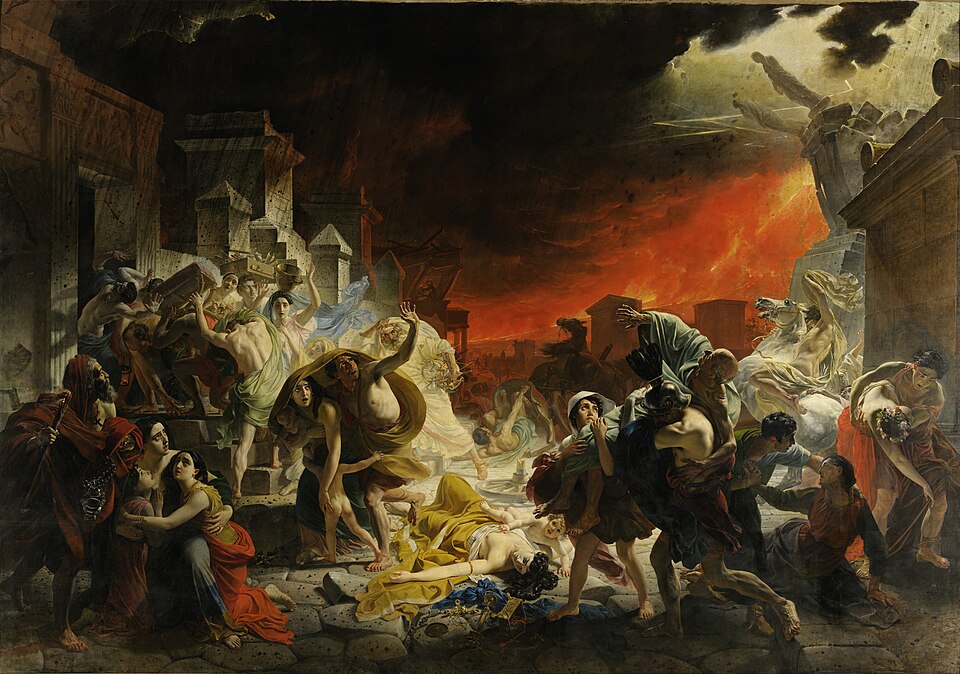
In the early 19th century, the ruins of Pompeii, buried since AD 79 beneath the ash of Mount Vesuvius, were being slowly uncovered south of Naples, alongside its neighbor Herculaneum. Excavations had begun decades earlier, and artists had already sensed the dramatic potential of the site — John Martin had painted The Destruction of Pompeii and Herculaneum in 1822, and engravers had sketched its haunting remains.
Into this atmosphere arrived Karl Bryullov, a Russian painter who came to Rome in 1823 with his brother Aleksandr, traveling by way of Venice and Florence. Aleksandr took part in a scientific study and restoration of the Pompeii baths in 1825–26, later publishing Thermes de Pompéi in Paris in 1829. Karl may have first visited Pompeii in 1824, and he certainly returned in 1827, walking the Via dei Sepolcri — the Street of the Tombs — an experience so powerful that he chose to set his future painting there.
Bryullov steeped himself in sources beyond the ruins themselves. He saw Alessandro Sanquirico's stage designs for Giovanni Pacini's opera L'ultimo giorno di Pompei, studied artifacts in the Naples museum, and read Pliny the Younger's eyewitness account of the eruption — the disaster in which Pliny's uncle died. He also read Alessandro Manzoni's novel I promessi sposi, with its portrayal of ordinary people facing catastrophe.
These threads converged into The Last Day of Pompeii. In 1828, at the request of Countess Maria Razumovskaya, Bryullov produced a compositional sketch. The full canvas was commissioned by Count Anatoly Demidov, whom he had met in Naples and for whom he also painted an equestrian portrait. The agreement called for completion by 1830 for 40,000 francs, but by year's end Bryullov had done little more than outline his figures in two colors. A trip to Bologna and Venice, where he studied Tintoretto and Titian, finally gave him the answers he needed.
The subject — Vesuvius's eruption engulfing Pompeii and killing most of its people — suited the grand tradition of history painting, then considered the highest genre, and its scale let Bryullov display his full range of skill. He said he could only have completed the work using Raphael's The School of Athens as a model, blending classical forms with Romantic drama: intense color, chiaroscuro, and high emotion. Raphael's Fire in the Borgo and Poussin's Plague at Ashdod are also thought to have shaped his approach.
More from Art

The Painting With No Foreground
A single robed figure stares out at an empty grey sea — and the emptiness itself became a scandal. When it was unveiled in Berlin in 1810, no one knew quite what to do with it.

The Painter Who Chased the Light
For a few purple minutes each evening, an American exile knelt in an English garden and raced the dying sun to paint two little girls lighting lanterns. It took him two years to finish.

When a President Became a God
Look straight up inside the U.S. Capitol dome and you will find George Washington enthroned among the clouds, surrounded by goddesses — the founding father transformed into myth.

Marble Brought Back to Life
A corpse asleep, a wing barely brushing her skin — and marble somehow learns to breathe. This is the moment Antonio Canova dared to carve.

The World Turned Upside Down
Look closely at a sixteenth-century Flemish village and you'll find a man biting a pillar, another carrying daylight in a basket, and a wife slipping a blue cloak over her husband's shoulders. Every gesture is a joke — if you know the language.

The Girl in the Glass Case
She stood two-thirds life size, dressed in a real tutu and human hair — and the critics who saw her in 1881 recoiled as if she were something obscene.