The Fish-Tailed Women Who Haunted Sailors' Dreams
For thousands of years, seafarers swore they saw women rise from the waves — beautiful, singing, and deadly. Were they gods, ghosts, or something far more ordinary?
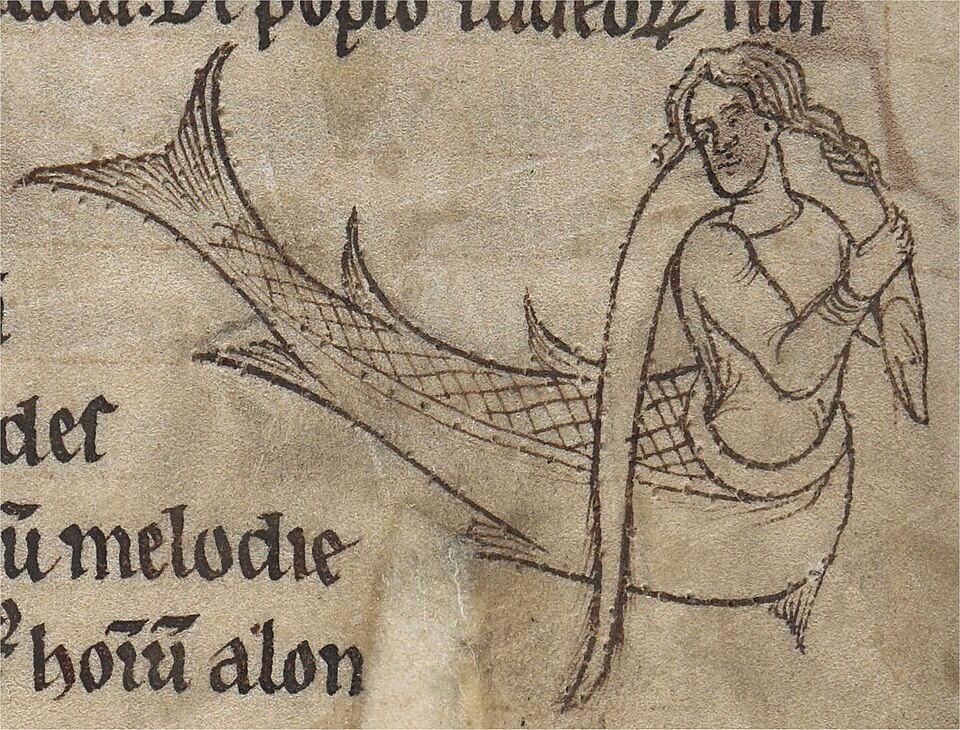
Long before Hans Christian Andersen gave the world his tragic Little Mermaid, sailors across the ancient Near East already whispered of women who lived beneath the waves. The earliest known mermaid tale comes from Assyria around 1000 BCE: the goddess Atargatis, mother of Queen Semiramis, fell in love with a mortal shepherd. When he died, grief drove her to leap into a lake and become a fish — but the water refused to hide her beauty, leaving her with a human torso, a fish's tail, and the ability to breathe underwater. Early images of Atargatis show her as a fish with a human head and legs, much like the Babylonian god Ea. The Greeks later identified her with Derketo and placed her alongside Aphrodite.
A popular Greek legend tells of Thessalonike, sister of Alexander the Great, who was said to have become a mermaid after death, living in the Aegean Sea. Sailors who encountered her were asked a single question: does King Alexander still live? Only the answer 'He lives and still reigns' would satisfy her — any other reply would turn her into a Gorgon who sank ships and drowned crews.
The Syrian writer Lucian, writing in the second century CE, described visiting temples in Syria and seeing a likeness of Derketo in Phoenicia: half a complete woman, and from the waist to the feet, covered in a fish's tail. In Jerusalem, however, her image appeared entirely human. Fish were considered sacred there and never eaten, while other birds — except the dove, itself sacred because Semiramis was believed to have transformed into one — were freely consumed.
The word 'mermaid' itself has deep linguistic roots. English 'mermaid' first appears in Chaucer's Nun's Priest's Tale around 1390, built from 'mere' (sea) and 'maid'. An older, now obsolete word, 'mermin', traces back to Old English mæremænen, itself a compound of mære (sea) and mænen (female slave), first recorded around 725 CE as a gloss for 'siren'. Cognate words appear across Old High German, Middle High German, Old Norse, and Old Swedish texts, showing how widespread and ancient the image of the sea-woman truly was.
The siren of Greek mythology, originally imagined as a bird with a human head, gradually merged with the mermaid image during the medieval period. Some Romance languages still use words derived from 'siren' to mean mermaid — French sirène, Spanish and Italian sirena. The earliest text describing sirens with fish tails appears in the Liber Monstrorum, written between the seventh and mid-eighth centuries, which calls them 'sea girls' whose beauty and sweet song lure sailors, though beneath their human upper bodies lies a scaled fish tail. By the eleventh century, an Old High German Physiologus explicitly stated that sirens are mermaids.```
More from Mythology

The Doctor Who Sang a Nation Into Being
A country doctor rode into the forests of Karelia armed with nothing but a notebook — and rode out with the soul of a nation.

The Boat That Carried the Sun
Every sunset, the ancient Egyptians believed, the sun climbed into a boat and sailed straight into the realm of the dead — only to fight a monstrous serpent before dawn could return.

The Wild Man of the Snows
At 21,000 feet, a colonel found tracks in the snow that he blamed on a wolf — but his guides knew better, and gave the world a name that would echo for a century.

The Knight Who Went Mad for Love: Orlando Furioso
A hero so devoted to duty he was Charlemagne's greatest paladin loses his mind—not to a sword wound, but to heartbreak. To cure him, a friend must ride a flying horse to the Moon.

The Book That Turned the World Into Myth
A poet condemned to exile spent his final years in Rome finishing a poem that would outlive empires—a poem about nothing standing still, not gods, not lovers, not even the shape of a man.

Paradise Lost: Milton's Rebel Angel
A blind poet, dictating verses in the dark, dared to explain the ways of God to men — and in doing so, made Hell's ruler unforgettable.