The Flower That Refused to Mean What Everyone Said It Meant
A single flower, painted enormous, sparked one of the loudest arguments in American art history — and the artist herself flatly refused to join in.
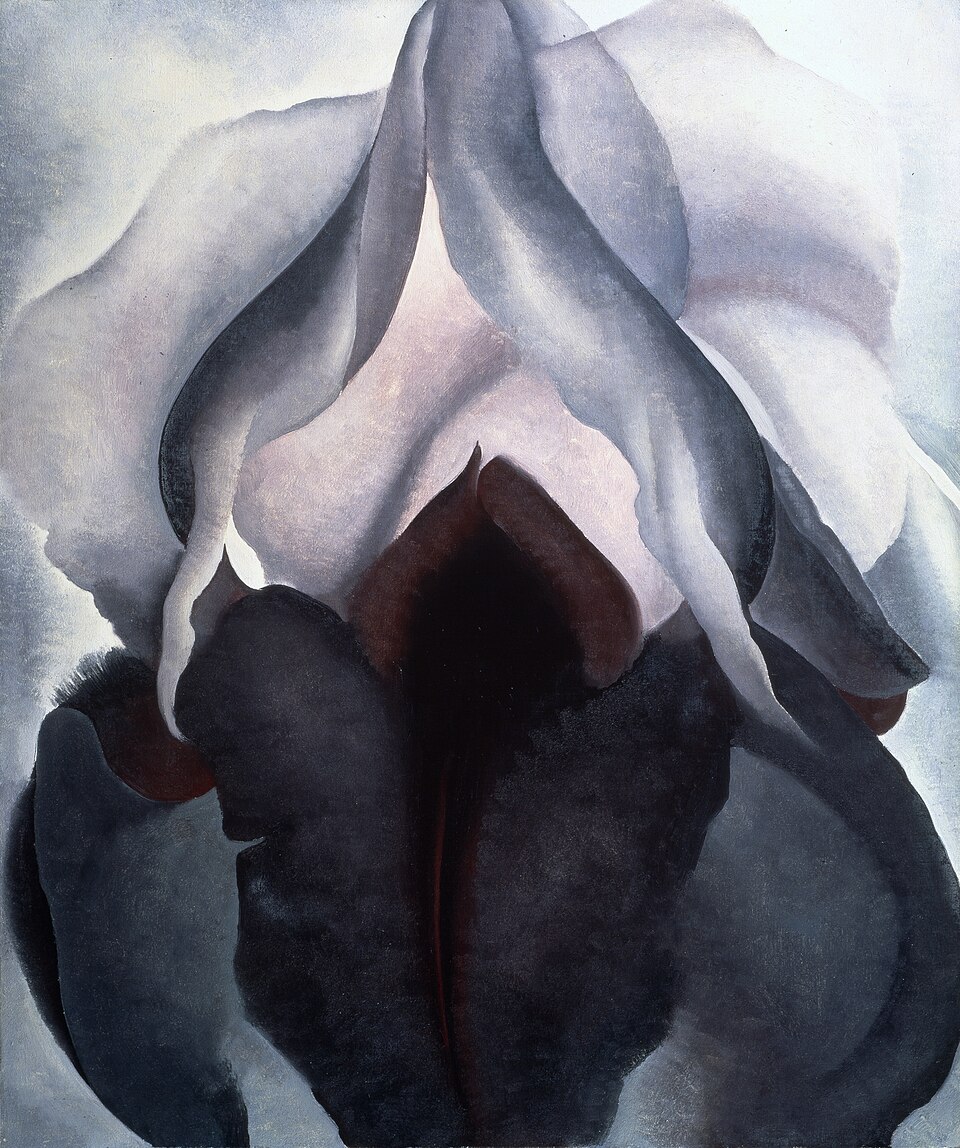
In 1926, Georgia O'Keeffe finished a painting of an iris, rendered so close and so large that its petals filled the canvas edge to edge. The work is formerly known as Black Iris III, though its current title is simply Black Iris. Within its dark center and lower petals she layered black, purple, and maroon, while the upper petals dissolved into pink, gray, and white, the edges softened by outward blending. There was no visible light source, yet the painting seemed to glow from within — a technique that reflected O'Keeffe's long-held belief that nature carried its own inner vitality, one she associated directly with light.
The painting was not an isolated experiment. O'Keeffe had begun magnifying flower centers back in 1924, and by 1926 she debuted her enlarged flowers at the Anderson Galleries. Black irises in particular became a recurring subject for her: another oil, also called The Black Iris and known as well as The Dark Iris No. II and Dark Iris, a small 9x7-inch canvas from 1926; a pastel titled Dark Iris No. III in 1927; an elongated Iris in 1929 now held by the Colorado Springs Fine Arts Center; and a return to the theme in 1936 with Black Iris II. But it was the 1926 canvas, later simply called Black Iris, that would become the most famous of them all.
It was first shown to the public at the Intimate Gallery in New York, from January 11 to February 27, 1927, catalogued then as Dark Iris No. 3. The exhibition marked a departure from O'Keeffe's earlier shows, which had leaned on vivid color and won her critical acclaim. This one was starker, moodier — and it provoked a reaction few painters could have anticipated.
Critic Lewis Mumford, writing about the opening, described the show as 'one long, loud blast of sex' — sex in youth, in adolescence, in maturity, gaudy as a lurid stage melodrama and pure as vestal vigils, 'sex bulging... sex tumescent, sex deflated.' He even warned readers that visiting the exhibition might disappoint them, since 'perhaps only half the sex is on the walls; the rest is probably in me.' Decades later, art historian Linda Nochlin would offer her own reading, interpreting Black Iris as a morphological metaphor for female genitalia.
O'Keeffe pushed back hard against these interpretations. In a 1939 text written to accompany an exhibition of her work, she addressed viewers directly: 'Well—I made you take time to look at what I saw and when you took time to really notice my flower you hung all your own associations with flowers on my flower and you write about my flower as if I think and see what you think and see of the flower—and I don't.' She went further in her painting practice itself, adding a lot of detail specifically to resist sexualized readings of her enlarged blooms.
More from Art

The Painting With No Foreground
A single robed figure stares out at an empty grey sea — and the emptiness itself became a scandal. When it was unveiled in Berlin in 1810, no one knew quite what to do with it.

The Painter Who Chased the Light
For a few purple minutes each evening, an American exile knelt in an English garden and raced the dying sun to paint two little girls lighting lanterns. It took him two years to finish.

When a President Became a God
Look straight up inside the U.S. Capitol dome and you will find George Washington enthroned among the clouds, surrounded by goddesses — the founding father transformed into myth.

Marble Brought Back to Life
A corpse asleep, a wing barely brushing her skin — and marble somehow learns to breathe. This is the moment Antonio Canova dared to carve.

The World Turned Upside Down
Look closely at a sixteenth-century Flemish village and you'll find a man biting a pillar, another carrying daylight in a basket, and a wife slipping a blue cloak over her husband's shoulders. Every gesture is a joke — if you know the language.

The Girl in the Glass Case
She stood two-thirds life size, dressed in a real tutu and human hair — and the critics who saw her in 1881 recoiled as if she were something obscene.