The Fresco That Would Not Compromise
A worker's hand on a machine, a face that shouldn't have been there — and a fortune's worth of wall about to be smashed to dust.
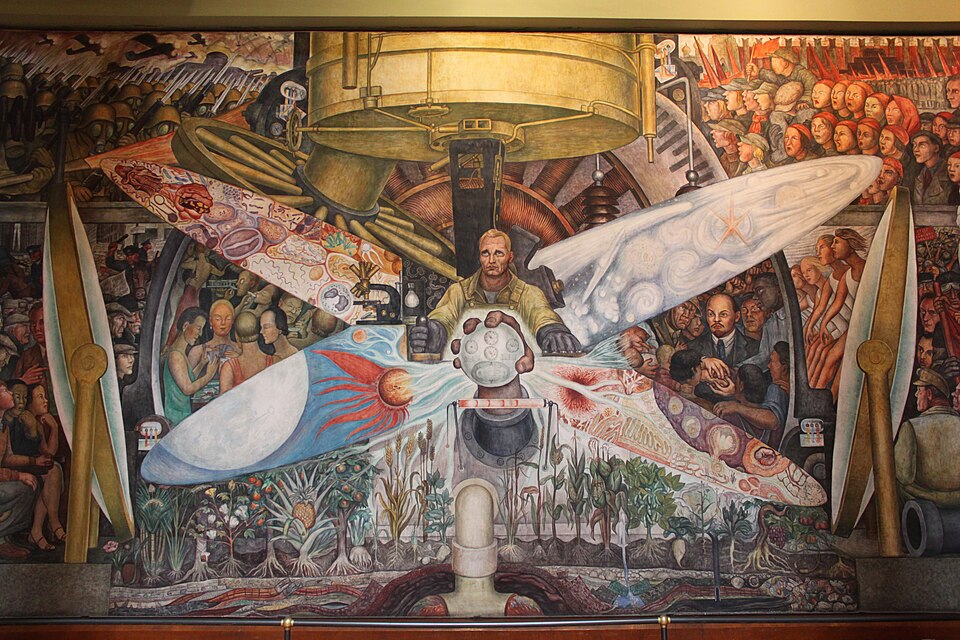
In the winter of 1931-1932, Abby Aldrich Rockefeller stood in a Museum of Modern Art exhibition hall and bought up pieces by a Mexican painter named Diego Rivera. She was a patron of the arts, married to businessman John D. Rockefeller Jr., who at that moment was overseeing the construction of Rockefeller Center in Manhattan. He wanted something grand for the lobby of the RCA Building: a mural, 63 by 17 feet, that would make people stop and think.
At a luncheon Abby hosted in January 1932, Rivera was a guest, and Abby suggested his talent might suit the new building. Over the following months the Rockefeller family grew close to Rivera and his wife, Frida Kahlo, even though Rivera had recently been expelled from the Communist Party USA for accepting commissions from wealthy patrons, including a controversial fresco for Edsel Ford in Detroit. The historian Alan Balfour has written that the Rockefellers knew full well about Rivera's communist sympathies when they hired him.
The commission, arranged through developers Todd, Robertson & Todd, carried the theme 'Man at the Crossroads Looking with Hope and High Vision to the Choosing of a New and Better Future.' It was planned as three panels: a central figure representing the man at the crossroads, flanked by The Frontier of Ethical Evolution, representing socialism, and The Frontier of Material Development, representing capitalism. Nelson Rockefeller had originally hoped Henri Matisse and Pablo Picasso would paint the side panels, but Matisse was busy with a Barnes Foundation commission, and Picasso never answered a telegram that had requested a meeting with 'Pierre Picasso' — a mistranslation of his name that meant the message may never have reached him as intended. Josep Maria Sert and Frank Brangwyn were hired instead, prompting Rivera to briefly quit, calling them 'two inferior painters.' He returned to the project by the fall of 1932.
Rivera also clashed with architect Raymond Hood, who wanted the mural rendered only in grayscale. Nelson intervened, the grayscale requirement was dropped, and Rivera was allowed to paint in true fresco. The Rockefeller family had approved the concept from the start: a visual contrast between capitalism and communism, sitting side by side in the heart of capitalist New York.
The trouble began when the New York World-Telegram denounced the unfinished work as 'anti-capitalist propaganda.' Rivera responded not by softening the mural but by sharpening it — adding a portrait of Vladimir Lenin and a scene of a Soviet May Day parade. When Nelson Rockefeller discovered these additions, he asked Rivera to remove Lenin's face. Rivera refused.
More from Art

The Painting With No Foreground
A single robed figure stares out at an empty grey sea — and the emptiness itself became a scandal. When it was unveiled in Berlin in 1810, no one knew quite what to do with it.

The Painter Who Chased the Light
For a few purple minutes each evening, an American exile knelt in an English garden and raced the dying sun to paint two little girls lighting lanterns. It took him two years to finish.

When a President Became a God
Look straight up inside the U.S. Capitol dome and you will find George Washington enthroned among the clouds, surrounded by goddesses — the founding father transformed into myth.

Marble Brought Back to Life
A corpse asleep, a wing barely brushing her skin — and marble somehow learns to breathe. This is the moment Antonio Canova dared to carve.

The World Turned Upside Down
Look closely at a sixteenth-century Flemish village and you'll find a man biting a pillar, another carrying daylight in a basket, and a wife slipping a blue cloak over her husband's shoulders. Every gesture is a joke — if you know the language.

The Girl in the Glass Case
She stood two-thirds life size, dressed in a real tutu and human hair — and the critics who saw her in 1881 recoiled as if she were something obscene.