The Garden of Earthly Delights: Bosch's Strange World
Close the wooden panels and you see a gray, silent globe on the third day of creation. Open them, and the world explodes into naked bodies, giant fruit, and fire.
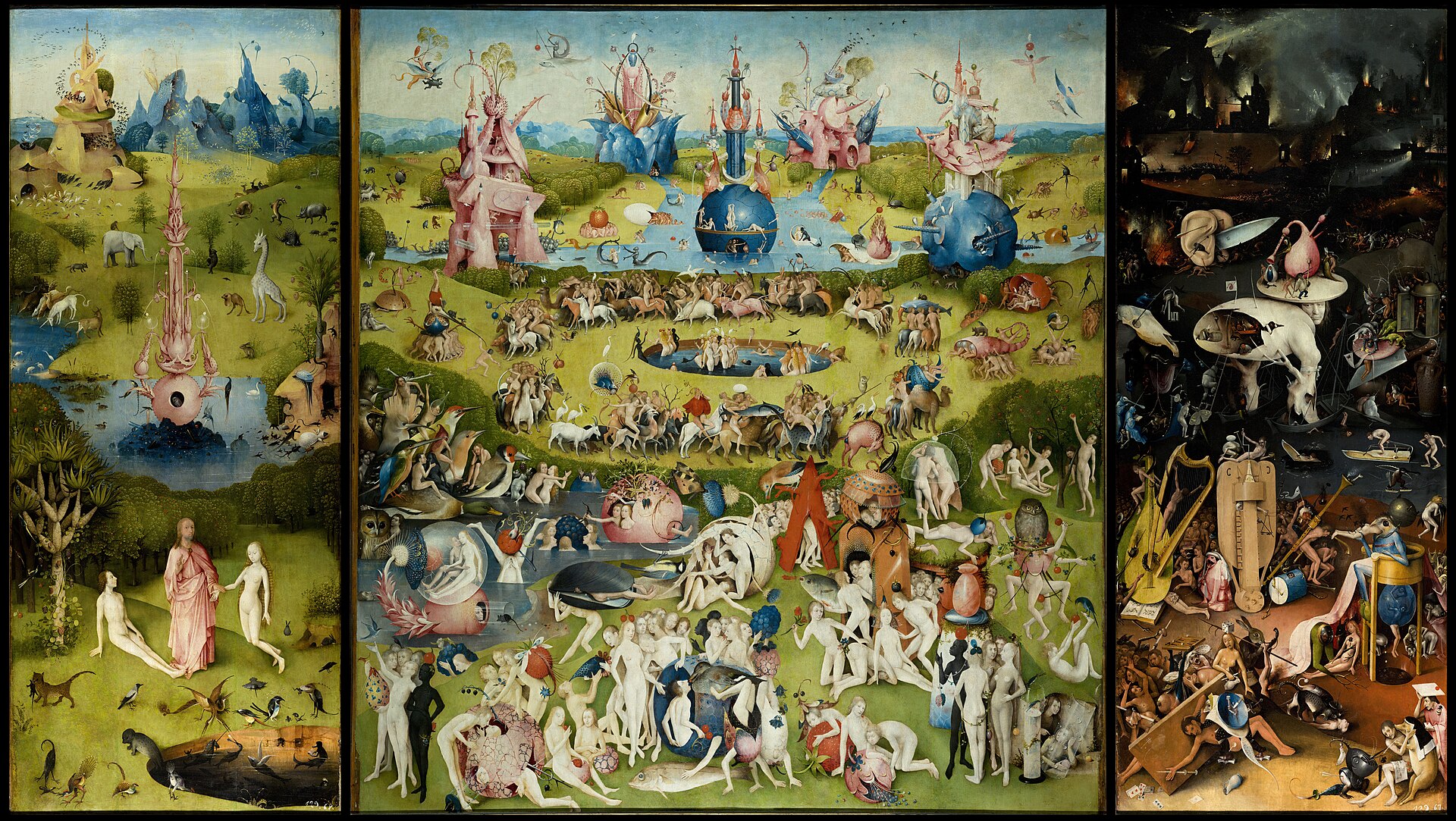
Sometime between 1490 and 1510, when Hieronymus Bosch was somewhere between forty and sixty years old, he painted a triptych so strange that art historians are still arguing about what it means. Today it hangs in the Museo del Prado in Madrid, where it has lived since 1939, and visitors still lean in close to decode its impossible details.
The painting is built like a folding altarpiece: three oil-painted oak panels visible when open, two grisaille panels visible when closed. Bosch rendered the exterior in green-gray tones without color, a choice common to Netherlandish triptychs of the period but also fitting for the scene he chose to depict — the Third Day of Creation, before the sun and moon existed to give light to the earth. A tiny God, wearing a papal-tiara-like crown, sits at the upper left with a Bible on his lap, presiding passively over a still lifeless globe of gray plants and rock, ringed by a firmament and floating in impenetrable darkness. Above him runs a Latin inscription from Psalm 33:9: 'For he spoke and it was done; he commanded, and it stood fast.'
Open the wings and the story shifts into full color and moves, left to right, through what scholars read as a chronological sequence: Eden, the garden of earthly delights, and Hell.
The left panel shows the Joining of Adam and Eve — God, now young, blue-eyed, golden-curled, holding Eve by the wrist and presenting her to a newly woken Adam, his right hand raised in blessing. Art historian Charles de Tolnay argued that even here, in Adam's seductive gaze, God's influence over the earth is already beginning to wane — an idea reinforced by how small God appears against the vastness of the world on the outer panels.
The central panel is where Bosch breaks from his other two surviving triptychs, The Last Judgment (c. 1482) and The Haywain Triptych (after 1510): God disappears entirely. In his place, naked men and women fill an imagined earth, engaged in every kind of pleasure-seeking, surrounded by oversized fruit and impossible creatures. Twentieth-century historians remain split on whether this is a paradise lost or a moral warning about temptation — Bosch's own religious beliefs suggest the latter, but the sheer joy and strangeness of the scene resists easy judgment.
More from Art

The Painting With No Foreground
A single robed figure stares out at an empty grey sea — and the emptiness itself became a scandal. When it was unveiled in Berlin in 1810, no one knew quite what to do with it.

The Painter Who Chased the Light
For a few purple minutes each evening, an American exile knelt in an English garden and raced the dying sun to paint two little girls lighting lanterns. It took him two years to finish.

When a President Became a God
Look straight up inside the U.S. Capitol dome and you will find George Washington enthroned among the clouds, surrounded by goddesses — the founding father transformed into myth.

Marble Brought Back to Life
A corpse asleep, a wing barely brushing her skin — and marble somehow learns to breathe. This is the moment Antonio Canova dared to carve.

The World Turned Upside Down
Look closely at a sixteenth-century Flemish village and you'll find a man biting a pillar, another carrying daylight in a basket, and a wife slipping a blue cloak over her husband's shoulders. Every gesture is a joke — if you know the language.

The Girl in the Glass Case
She stood two-thirds life size, dressed in a real tutu and human hair — and the critics who saw her in 1881 recoiled as if she were something obscene.