The Garden That Outlived His Sight
For thirty-one years, a half-blind old man kept painting the same pond — and it became one of the largest artistic obsessions in history.
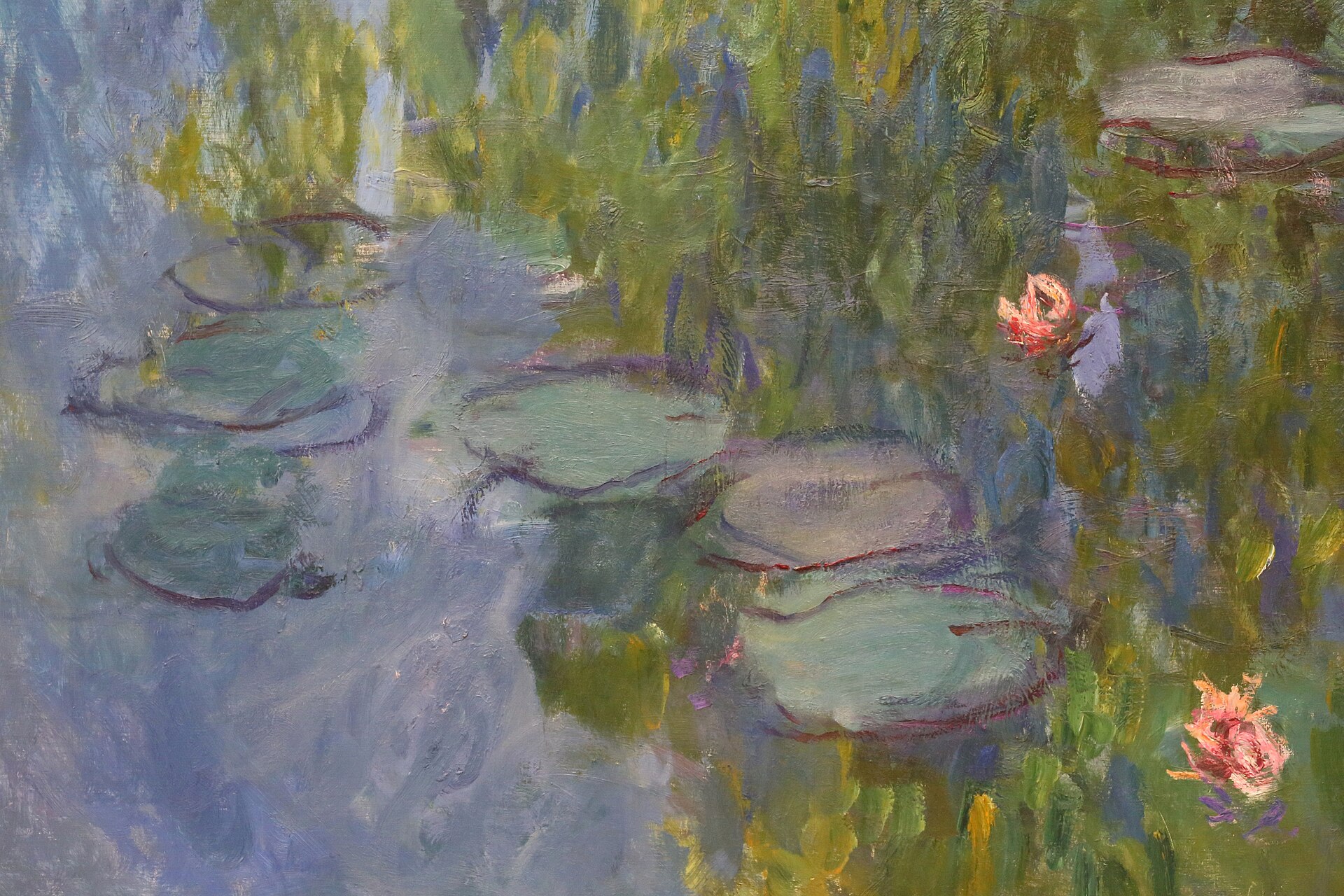
In November 1890, Claude Monet bought a modest house at Giverny, a village outside Paris, and set about reshaping its grounds into a garden of his own design. He redirected the flow of the nearby Epte River in 1901 so that exotic plants he had gathered could thrive beside a small pool. It was here, among lily pads and reflected sky, that Monet would spend the last three decades of his life, producing roughly 250 oil paintings of water lilies — a body of work that became the central obsession of his old age.
The series began in earnest in May 1895, following the same logic that had driven his earlier studies of Saint-Lazare railway station and his haystacks: the idea that a single subject, painted repeatedly under shifting light and weather, could reveal something truer than any single image. By 1902, the water lilies had become serious, sustained work, and by 1909 dealer Paul Durand-Ruel exhibited forty-eight of the paintings in Paris.
Progress slowed in 1906 as Monet reconsidered his plans, eliminating some canvases and delaying exhibitions. Then, in July 1912, he was diagnosed with cataracts in both eyes — a condition that would shadow the rest of his working life. Remarkably, many of his most ambitious water lily paintings were made while his vision was failing.
In 1914, encouraged by the French statesman Georges Clemenceau, Monet began an even more monumental project: a series of decorative water lily panels intended as a public gift to France. On 12 April 1922, before a notary in Vernon, he signed a contract agreeing to complete the panels and formally donate them to the state by April 1924. By then Monet was nearly blind, yet determined to finish the work — enough so that he agreed to undergo surgery to remove the cataracts from both eyes.
His eyesight troubles nonetheless forced delays, and Clemenceau intervened again in 1924 to extend the contract's deadlines. In February of that year, Durand-Ruel exhibited several of the newest water lily paintings in New York. Monet never saw the completed installation of his life's great gift: he died at Giverny on 5 December 1926, at the age of eighty-six.
More from Art

The Painting With No Foreground
A single robed figure stares out at an empty grey sea — and the emptiness itself became a scandal. When it was unveiled in Berlin in 1810, no one knew quite what to do with it.

The Painter Who Chased the Light
For a few purple minutes each evening, an American exile knelt in an English garden and raced the dying sun to paint two little girls lighting lanterns. It took him two years to finish.

When a President Became a God
Look straight up inside the U.S. Capitol dome and you will find George Washington enthroned among the clouds, surrounded by goddesses — the founding father transformed into myth.

Marble Brought Back to Life
A corpse asleep, a wing barely brushing her skin — and marble somehow learns to breathe. This is the moment Antonio Canova dared to carve.

The World Turned Upside Down
Look closely at a sixteenth-century Flemish village and you'll find a man biting a pillar, another carrying daylight in a basket, and a wife slipping a blue cloak over her husband's shoulders. Every gesture is a joke — if you know the language.

The Girl in the Glass Case
She stood two-thirds life size, dressed in a real tutu and human hair — and the critics who saw her in 1881 recoiled as if she were something obscene.