The Garden That Speaks in Riddles
Six women, two men, a blindfolded cupid, and over five hundred plants — Botticelli painted a myth that no ancient author ever told.
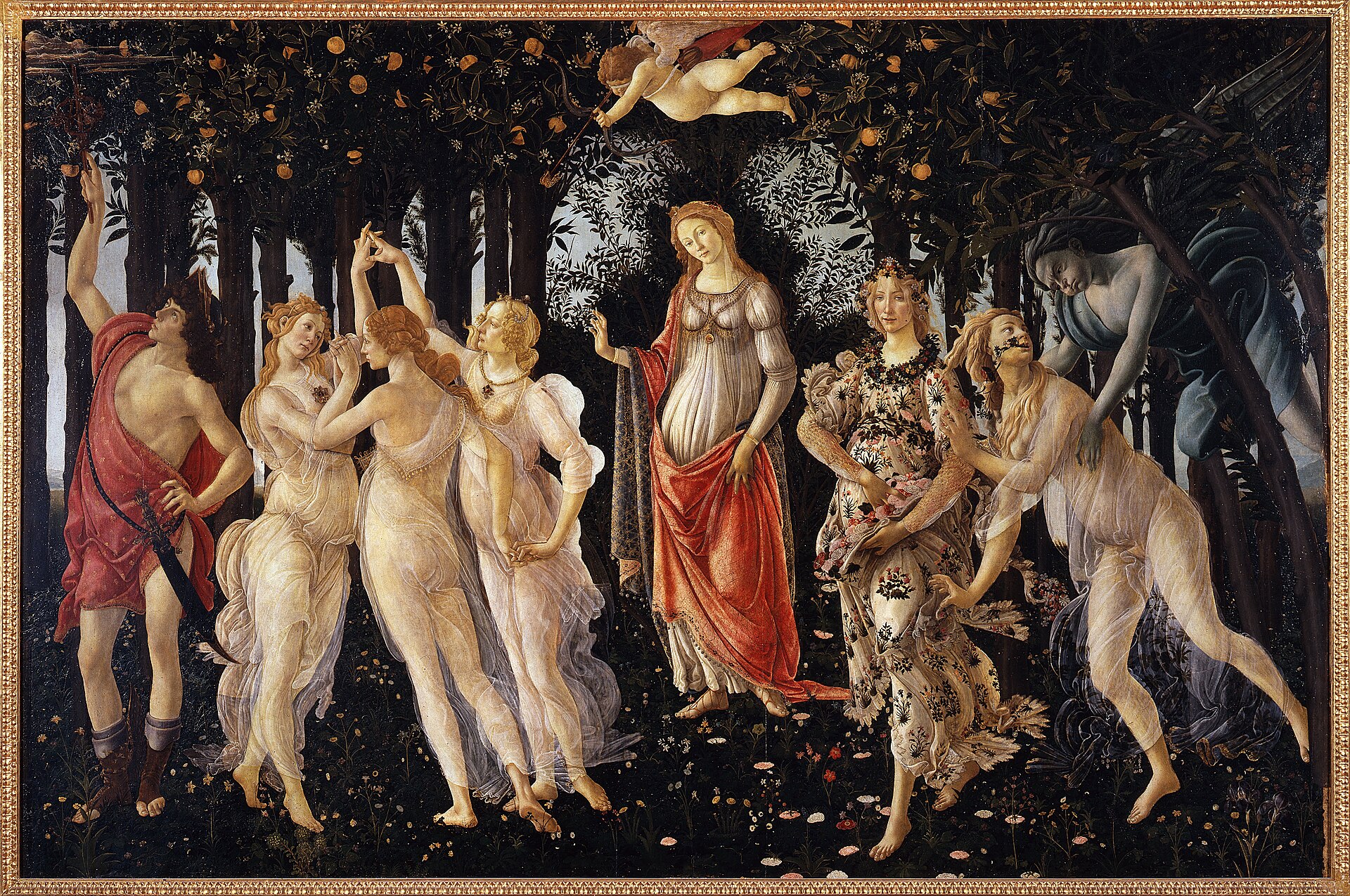
Sometime in the late 1470s or early 1480s, Sandro Botticelli set down his brush on a panel that would become one of the most argued-over paintings in Western art. He called it nothing in particular; it was the historian Giorgio Vasari, seeing it at the Villa Castello outside Florence by 1550, who gave it the name Primavera — Spring.
The painting shows eight figures moving through an orange grove, and reading it from right to left tells a strange, wordless story. Zephyrus, the biting wind of March, seizes the nymph Chloris; flowers spill from her mouth as she transforms into Flora, goddess of spring, scattering roses as she walks. Whether Chloris and Flora are the same woman shown twice, or two separate figures, remains unresolved.
At the center, slightly set back from the rest, stands Venus, a red-draped woman in blue, beneath a broken arch of trees, her gaze meeting the viewer's directly. Above her, a blindfolded Cupid draws his bow toward the left, where the Three Graces dance in a ring of transparent white, hands joined. At the far edge, Mercury in red, sword and helmet at his side, raises his caduceus toward a scatter of gray clouds, his back turned to everyone else.
No classical myth actually gathers these particular figures together, which is part of what has made the painting so endlessly debated. Most scholars read it as an allegory of spring's fertility, often tied to the Neoplatonic ideas fashionable among Florentine intellectuals of the time — ideas Botticelli likely did not develop alone. The poet Poliziano, the Medici family's house writer, is thought to have helped shape the composition, drawing on Ovid and possibly Lucretius.
The painting's origins are genuinely uncertain. It may have been commissioned by a member of the Medici family, but no record confirms this with certainty. What is clear is the sheer botanical ambition of the work: researchers have identified roughly 500 plant species within it, including about 190 distinct flowers, at least 130 of which can be named precisely — a level of detail recalling the Flemish 'millefleur' tapestries fashionable in palaces at the time.
More from Art

The Painting With No Foreground
A single robed figure stares out at an empty grey sea — and the emptiness itself became a scandal. When it was unveiled in Berlin in 1810, no one knew quite what to do with it.

The Painter Who Chased the Light
For a few purple minutes each evening, an American exile knelt in an English garden and raced the dying sun to paint two little girls lighting lanterns. It took him two years to finish.

When a President Became a God
Look straight up inside the U.S. Capitol dome and you will find George Washington enthroned among the clouds, surrounded by goddesses — the founding father transformed into myth.

Marble Brought Back to Life
A corpse asleep, a wing barely brushing her skin — and marble somehow learns to breathe. This is the moment Antonio Canova dared to carve.

The World Turned Upside Down
Look closely at a sixteenth-century Flemish village and you'll find a man biting a pillar, another carrying daylight in a basket, and a wife slipping a blue cloak over her husband's shoulders. Every gesture is a joke — if you know the language.

The Girl in the Glass Case
She stood two-thirds life size, dressed in a real tutu and human hair — and the critics who saw her in 1881 recoiled as if she were something obscene.