The Gaze That Scandalized Paris
A pale woman lies on white linen, staring straight back at the viewer without shame — and in 1865, that stare nearly caused a riot.
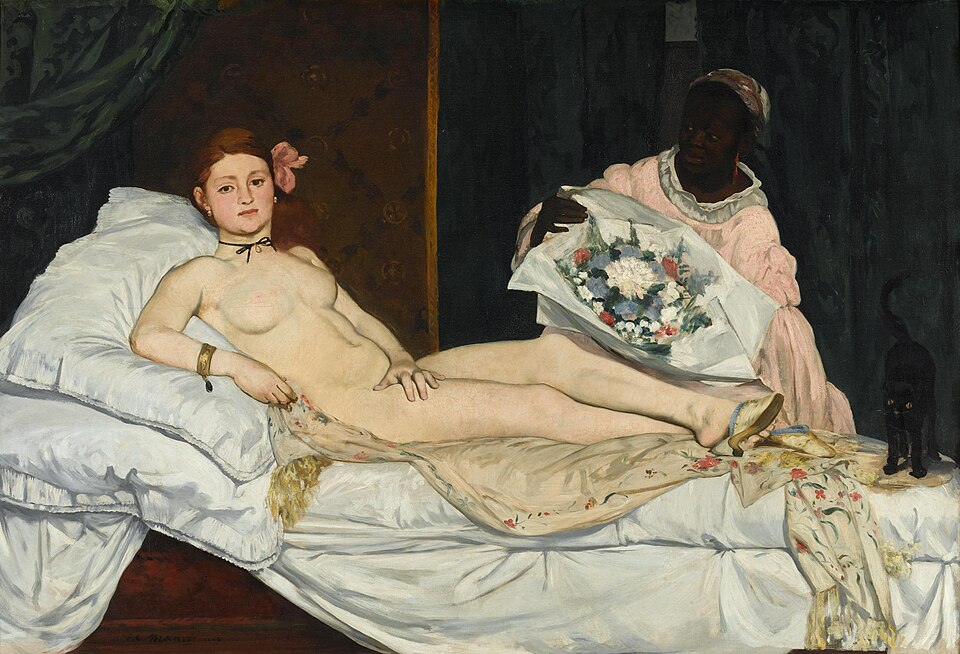
Édouard Manet completed Olympia in 1863, but it was not until the 1865 Paris Salon that the painting met the public — and the public did not take it well. Guards had to move the canvas to a higher, safer spot alongside Manet's other Salon entry, Jesus Mocked by the Soldiers, fearing it might be attacked. Manet had painted a nude white woman reclining on a bed, attended by a black maid holding a bouquet, with a black cat perched at her feet. Of the 85 articles written about that year's Salon, 72 mentioned Olympia, and young girls and pregnant women were warned to stay away.
The model was Victorine Meurent, a 19-year-old who had been modeling since she was sixteen and would later exhibit her own paintings at the Salon in 1876, 1879, 1885, and 1904. The maid was modeled by a woman named Laure. The title, most likely given by Manet's friend Zacharie Astruc, carried a loaded meaning: in 1860s Paris, 'Olympia' was a name associated with prostitutes.
Manet drew directly from Titian's Venus of Urbino, but inverted its every symbol. Titian's Venus curls her hand invitingly; Olympia's hand seems to block access, as if granting entry only for payment. Titian placed a small dog — a symbol of fidelity — at the foot of the bed; Manet replaced it with a black cat, associated with nocturnal promiscuity, its aroused posture adding to the provocation. Titian's myrtle bush, a symbol of marriage, is answered by cut flowers wrapped in flimsy paper, a gift Olympia coolly ignores, perhaps a client's offering as he barges in unannounced.
Every detail on Olympia's body reinforced the reading: the flower in her hair — often mistaken by writers for an orchid, though it is in fact an amber flower — the gold bracelet, pearl earrings, the oriental shawl beneath her, the black ribbon at her throat against pale skin, and the single cast-off slipper. These were the visual shorthand of wealth and sensuality sold on the sidewalks of contemporary Paris — not the trappings of myth.
The style itself broke academic convention: broad, quick brushstrokes, harsh studio lighting that flattened mid-tones, and large flat color surfaces instead of smooth idealized modeling. Unlike Alexandre Cabanel's polished Birth of Venus, also painted in 1863, Olympia looked like a real woman, unapologetically naked rather than mythologically undressed. At 130.5 by 190 centimeters, the canvas was sized for grand historical or mythological subjects — not for a scene many read as commercial sex.
More from Art

The Painting With No Foreground
A single robed figure stares out at an empty grey sea — and the emptiness itself became a scandal. When it was unveiled in Berlin in 1810, no one knew quite what to do with it.

The Painter Who Chased the Light
For a few purple minutes each evening, an American exile knelt in an English garden and raced the dying sun to paint two little girls lighting lanterns. It took him two years to finish.

When a President Became a God
Look straight up inside the U.S. Capitol dome and you will find George Washington enthroned among the clouds, surrounded by goddesses — the founding father transformed into myth.

Marble Brought Back to Life
A corpse asleep, a wing barely brushing her skin — and marble somehow learns to breathe. This is the moment Antonio Canova dared to carve.

The World Turned Upside Down
Look closely at a sixteenth-century Flemish village and you'll find a man biting a pillar, another carrying daylight in a basket, and a wife slipping a blue cloak over her husband's shoulders. Every gesture is a joke — if you know the language.

The Girl in the Glass Case
She stood two-thirds life size, dressed in a real tutu and human hair — and the critics who saw her in 1881 recoiled as if she were something obscene.