The General Who Refused to Sit Still
He crossed the Alps on a mule in fine weather — but he asked to be painted as a god on a rearing stallion. Jacques-Louis David gave him exactly that.
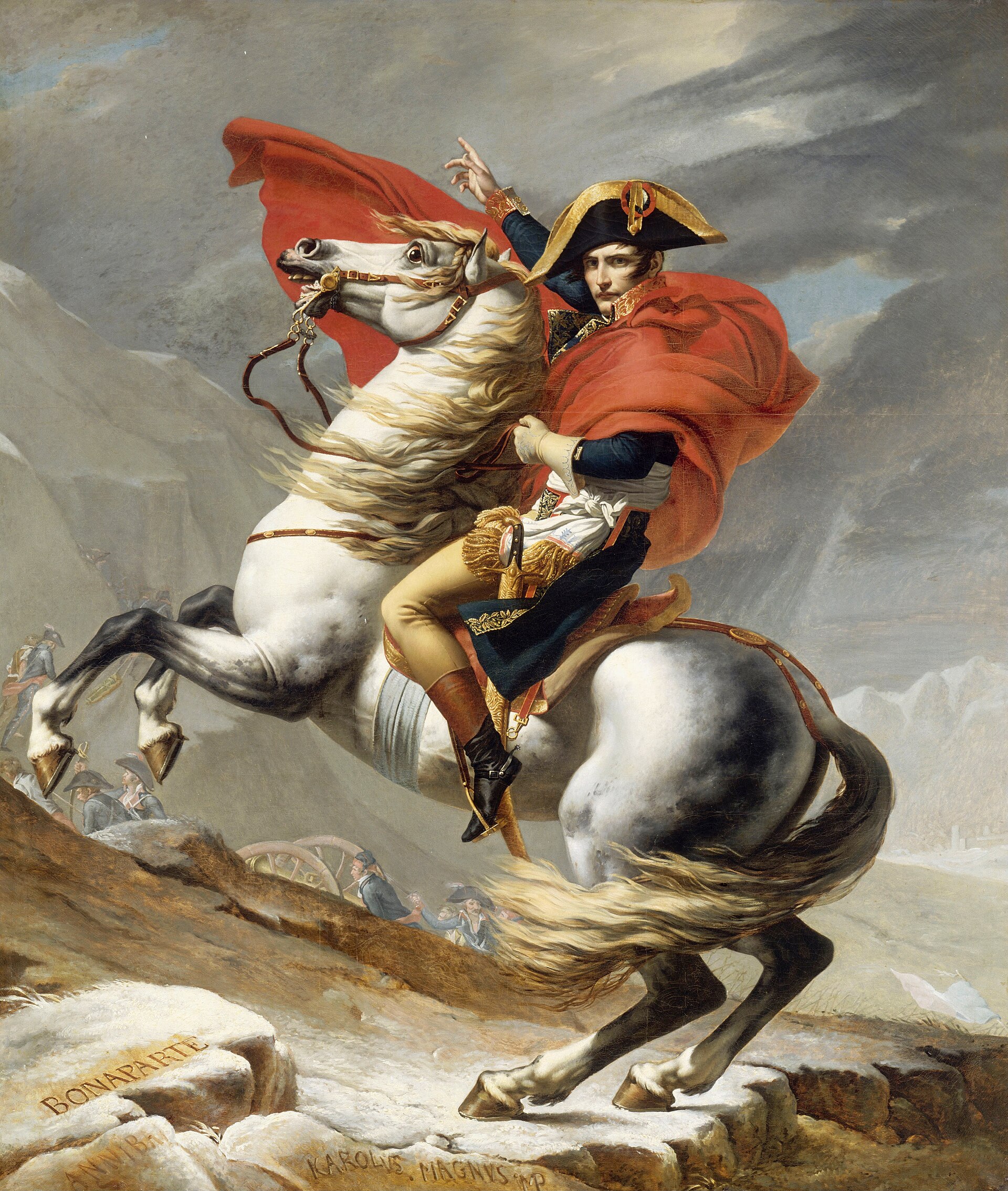
In the spring of 1800, Napoleon Bonaparte led France's Reserve Army over the Great St Bernard Pass, hoping to surprise the Austrian forces under Michael von Melas before they could regroup after taking Genoa. The march itself was unglamorous: fine weather, a guide, and Bonaparte perched on a humble mule picking his way through the mountains. The Reserve Army fought a battle at Montebello on 9 June before eventually securing a decisive victory at the Battle of Marengo. That triumph, and Napoleon's new position as First Consul, called for a diplomatic thaw with Spain's Charles IV.
As part of a traditional exchange of gifts between the two courts, Charles received Versailles-made pistols, Parisian dresses, jewels for his queen, and armour for his minister Manuel Godoy. In return, Napoleon was offered sixteen Spanish horses, royal portraits by Goya, and a painting to be commissioned from Jacques-Louis David. The French ambassador to Spain, Charles-Jean-Marie Alquier, arranged for the original canvas to hang in the Royal Palace of Madrid, sealing the new friendship between the nations.
David, once the Revolution's fiercest artistic voice, had transferred his devotion to the Consulate and took up the commission eagerly. The Spanish ambassador, Ignacio Muzquiz, asked how Napoleon wished to be shown. He first suggested a scene reviewing his troops, then settled on something grander: himself crossing the Alps. The Spanish had actually expected a standing portrait in consular uniform, the kind later painted by Antoine-Jean Gros or Robert Lefèvre — but David wanted an equestrian scene, and got his way.
Bonaparte was explicit about the effect he wanted: he should appear 'calm, mounted on a fiery steed' — Calme sur un cheval fougueux. It is likely he also suggested inscribing the names of history's other Alp-crossing commanders, Hannibal and Charlemagne, onto the rocks at his horse's feet, binding himself to their legend. The truth of the mule and the calm weather would simply vanish from the record.
David worked with unusually few preparatory studies. His pupil Antoine-Jean Gros made a small oil sketch of a rearing horse, likely the model for Napoleon's mount, and David's notebooks show only rough first thoughts on the rider's pose. Much of this improvisation came from necessity: Bonaparte refused to sit for the portrait. He had sat once before, for Gros in 1796 at Joséphine's insistence, and Gros had found him a restless subject.
More from Art

The Painting With No Foreground
A single robed figure stares out at an empty grey sea — and the emptiness itself became a scandal. When it was unveiled in Berlin in 1810, no one knew quite what to do with it.

The Painter Who Chased the Light
For a few purple minutes each evening, an American exile knelt in an English garden and raced the dying sun to paint two little girls lighting lanterns. It took him two years to finish.

When a President Became a God
Look straight up inside the U.S. Capitol dome and you will find George Washington enthroned among the clouds, surrounded by goddesses — the founding father transformed into myth.

Marble Brought Back to Life
A corpse asleep, a wing barely brushing her skin — and marble somehow learns to breathe. This is the moment Antonio Canova dared to carve.

The World Turned Upside Down
Look closely at a sixteenth-century Flemish village and you'll find a man biting a pillar, another carrying daylight in a basket, and a wife slipping a blue cloak over her husband's shoulders. Every gesture is a joke — if you know the language.

The Girl in the Glass Case
She stood two-thirds life size, dressed in a real tutu and human hair — and the critics who saw her in 1881 recoiled as if she were something obscene.