The Ghost Ship of Ocracoke: Blackbeard's Queen Anne's Revenge
A fearsome beard, smoking fuses tucked beneath a hat, and a stolen slave ship renamed for a queen — this is how a Bristol sailor became history's most legendary pirate.
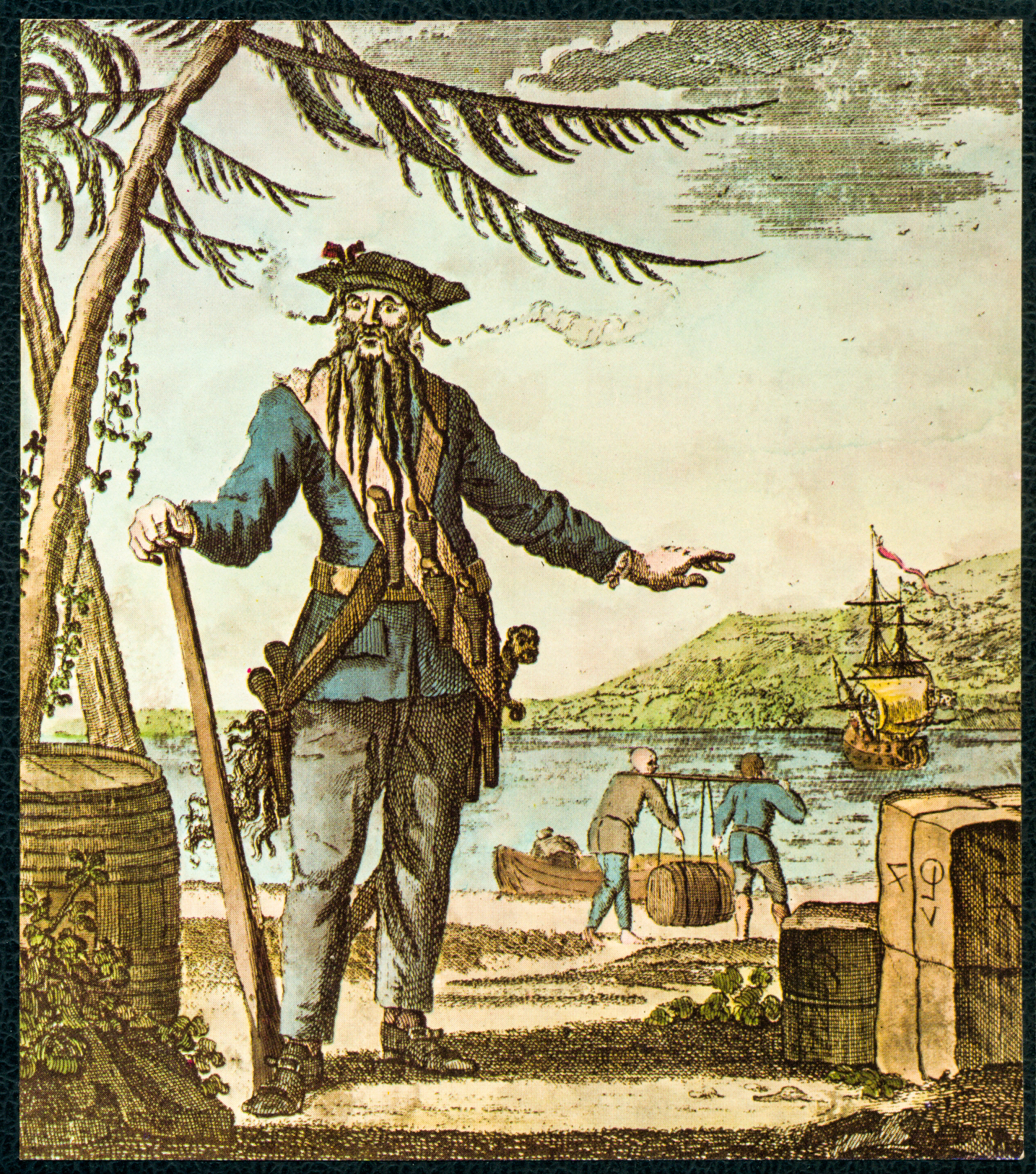
Little is certain about the man born around 1680, most likely in Bristol, England, then the second-largest city in the kingdom and a hub of transatlantic trade. Contemporary records call him Blackbeard, Edward Thatch, or Edward Teach — the spelling varies wildly across sources, from Thach to Thache to Tack. Pirates commonly used false surnames to protect their families' reputations, so his true identity may never be settled. What is clear is that he could read and write, corresponded with merchants, and at his death carried a letter from Tobias Knight, Chief Justice and Secretary of the Province of Carolina — evidence, some historians argue, of a respectable upbringing.
He likely crossed to the Caribbean on a merchant or slave vessel in the final years of the 1600s, and by some accounts served as a sailor on privateering ships out of Jamaica during the War of the Spanish Succession, distinguishing himself for boldness. When that war ended with the Treaty of Utrecht, he drifted, like many former privateers, toward outright piracy, settling on the lawless Bahamian island of New Providence.
New Providence's harbor was deep enough for hundreds of ships yet too shallow for the Royal Navy's warships, making it a perfect pirate haven — a floating population of traders, camp followers, and outlaws with almost no permanent residents. Around 1716, Teach joined the crew of Captain Benjamin Hornigold, a well-known pirate operating from the island. Hornigold soon gave him command of a captured sloop, and together the two set out raiding along the mainland coast, seizing barrels of flour, wine, and other cargo from merchant ships.
Their fleet grew to include more vessels, one commanded by Stede Bonnet, but by late 1717 Hornigold retired from piracy and sailed off with two ships, leaving Teach to make his own name. That name would soon become the stuff of legend: he captured a French slave ship called La Concorde, rechristened her Queen Anne's Revenge, armed her with forty guns, and crewed her with more than three hundred men.
His nickname came from his thick black beard and menacing appearance, and he was said to tie lit fuses — slow matches — under his hat to terrify those he confronted. Yet by most accounts he was a shrewd, calculating leader who avoided unnecessary violence, relying instead on sheer visual terror to make his targets surrender without a fight. He formed an alliance of pirates and blockaded Charles Town, South Carolina, holding its residents ransom until they paid.
More from Treasures

The Legend of the Nazi Gold Train
Somewhere beneath the hills of Poland, rumor insists, a train loaded with looted treasure vanished into a tunnel and was never seen again. The story survives because the plunder behind it was terrifyingly real.

The Treasure List Carved in Copper
While every other Dead Sea Scroll was written on parchment or papyrus, one was hammered into metal — a list of buried gold and silver that no one has ever found.

The Diamond That Vanished for a Century
For decades, treasure hunters and novelists spun theories about a lost 137-carat gem — sold, recut, melted into legend. It was sitting in a Quebec bank vault the entire time.

Gold, Ghosts, and the Mountain That Keeps Its Secret
For over a century, treasure hunters have vanished into a jagged Arizona range chasing a fortune that may never have existed at all. What they left behind was not gold, but one of America's most enduring legends.

The King Who Buried a River
When Rome finally cornered the Dacian king, it wasn't a sword that gave up his secret — it was a traitor's whisper about a riverbed.

The Fortune Dutch Schultz Took to His Grave
He asked New York's mob bosses for permission to kill a federal prosecutor — and when they said no, he disobeyed them anyway. It was a decision that would end his life and leave behind a fortune that has never been found.