The Giant That Flew: Sikorsky's Ilya Muromets
Named for a folklore giant, this four-engine colossus carried a bedroom, a toilet, and sixteen passengers into the sky before it ever dropped a bomb.
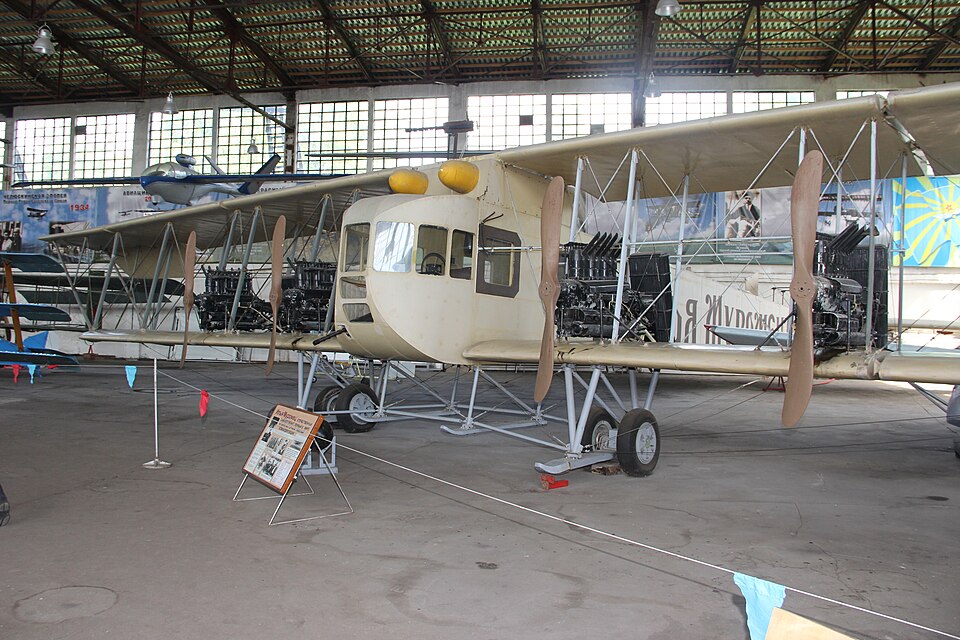
In 1913, at the Russo-Baltic Carriage Factory in Saint Petersburg, a young engineer named Igor Sikorsky unveiled an aircraft unlike anything the world had seen. He called it the Ilya Muromets, after the towering hero of Russian folklore, and the name fit: this was the first multi-engine aircraft ever put into production, a machine built not for war but for luxury.
The original design was startling in its ambition. Passengers sat in wicker chairs inside an insulated cabin warmed by heat drawn from the engine exhaust pipes and lit by a wind-driven generator. There was a lounge, a private bedroom with a small table and cabinet, and — remarkably for 1913 — the first airborne toilet. Mechanics could even climb out through openings in the fuselage onto the lower wings to service the engines mid-flight.
On 11 February 1914, the second prototype took to the air carrying sixteen passengers, a record for the era. Just months later, from 30 June to 12 July 1914, Sikorsky's creation flew roughly 1,200 kilometers from Saint Petersburg to Kiev and back, with brief refueling stops in Orsha and Novosokolniki. The outbound leg took 14 hours and 38 minutes; the return, just 13. Sikorsky later called it proof of the value of large, multi-engine aircraft.
The flight brought him extraordinary recognition. Tsar Nicholas II awarded him the Order of St. Vladimir, Fourth Degree, exempted him from wartime conscription so he could keep designing, and promised a grant of 100,000 rubles from the State Duma. During a military review at Krasnoye Selo, the Tsar personally christened prototype No. 128 the 'Kievsky.' The army, impressed, ordered ten four-engine aircraft of the type.
But the outbreak of World War I redirected everything. Sikorsky redesigned his luxurious airliner into the 'Military Ilya Muromets, Type V' — the world's first purpose-built heavy bomber. Internal racks could carry up to 800 kilograms of bombs, and positions for as many as nine machine guns were fitted around the aircraft, including a pioneering tail gunner position introduced with the S-25 variant in March 1916. The engines themselves were shielded with 5mm armor plating.
More from Mythology

The Doctor Who Sang a Nation Into Being
A country doctor rode into the forests of Karelia armed with nothing but a notebook — and rode out with the soul of a nation.

The Boat That Carried the Sun
Every sunset, the ancient Egyptians believed, the sun climbed into a boat and sailed straight into the realm of the dead — only to fight a monstrous serpent before dawn could return.

The Wild Man of the Snows
At 21,000 feet, a colonel found tracks in the snow that he blamed on a wolf — but his guides knew better, and gave the world a name that would echo for a century.

The Knight Who Went Mad for Love: Orlando Furioso
A hero so devoted to duty he was Charlemagne's greatest paladin loses his mind—not to a sword wound, but to heartbreak. To cure him, a friend must ride a flying horse to the Moon.

The Book That Turned the World Into Myth
A poet condemned to exile spent his final years in Rome finishing a poem that would outlive empires—a poem about nothing standing still, not gods, not lovers, not even the shape of a man.

Paradise Lost: Milton's Rebel Angel
A blind poet, dictating verses in the dark, dared to explain the ways of God to men — and in doing so, made Hell's ruler unforgettable.