The Giant Who Guards the Gates of Hell
He hurled boulders at his enemies, built entire towns with his bare hands, and died by his own cursed sword — yet even in death, he was sent back to stand guard forever. This is the story of Estonia's national epic and the strange, sorrowful giant at its heart.
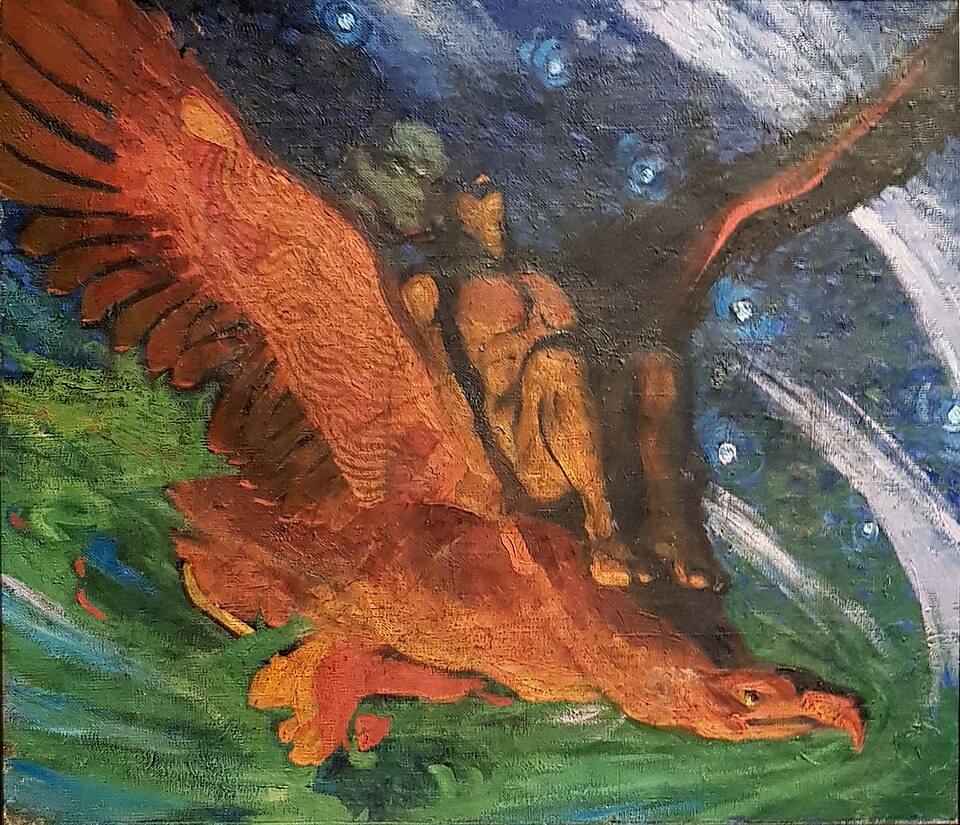
In the oral tradition of pre-Christian Estonia, long before anyone wrote a single line down, storytellers sang of a benevolent giant named Kalev, and later of his even mightier son, Kalevipoeg — Kalev's Son. These runic songs explained the shape of the land itself: a boulder here, a lake there, all said to be the traces of a giant's deeds. The earliest known written trace of this figure may reach back even further, to a 6th or 7th century Anglo-Saxon poem called Widsith, which mentions a ruler named 'Caelic' among the Finns — a name many historians and folklorists connect to Kaleva, the same figure who appears in both the Finnish Kalevala and the Estonian Kalevipoeg.
The character resurfaces in written Estonian sources in the 17th century, first mentioned by Heinrich Stahl. But it was in the 19th century that Kalevipoeg was truly born as a national epic. In 1839, Friedrich Robert Faehlmann presented a paper to the Learned Estonian Society sketching out the legends of Kalevipoeg and proposing the idea of a national romantic epic poem. Faehlmann died before he could write it, and in 1850 Friedrich Reinhold Kreutzwald picked up the task, gathering scattered oral tales and weaving them into a single continuous story, presenting his work as the reconstruction of a lost oral epic.
The road to publication was not smooth. Kreutzwald's first version, completed in 1853 and running to 13,817 verses, could not be printed because of censorship. He revised and expanded it into a second version of 19,087 verses, which the Learned Estonian Society published in installments between 1857 and 1861, alongside a German translation. A third version, slightly trimmed to 19,023 verses, appeared in 1862 — this time meant for ordinary readers, and printed not in Estonia but in Kuopio, Finland.
The epic itself unfolds across twenty cantos, written in old Estonian alliterative verse; only around one eighth of the actual lines are drawn from authentic folk material, the rest composed by Kreutzwald in imitation of that style. It opens with the marriages of two sisters, Salme and Linda, born strangely from a hen's egg and a grouse's egg discovered by a widow. Linda chooses the giant Kalev as her husband over the sun, moon, and stars themselves who come to court her.
Kalev dies, prophesying greatness for his unborn sons, and Linda weeps for seven days and nights — her tears forming Lake Ülemiste, which sits in what is now Tallinn. Her youngest son, born after his father's death, is Kalevipoeg, who grows to surpass his brothers Alevipoeg, Olevipoeg, and Sulevipoeg in both strength and intelligence.
More from Mythology

The Doctor Who Sang a Nation Into Being
A country doctor rode into the forests of Karelia armed with nothing but a notebook — and rode out with the soul of a nation.

The Boat That Carried the Sun
Every sunset, the ancient Egyptians believed, the sun climbed into a boat and sailed straight into the realm of the dead — only to fight a monstrous serpent before dawn could return.

The Wild Man of the Snows
At 21,000 feet, a colonel found tracks in the snow that he blamed on a wolf — but his guides knew better, and gave the world a name that would echo for a century.

The Knight Who Went Mad for Love: Orlando Furioso
A hero so devoted to duty he was Charlemagne's greatest paladin loses his mind—not to a sword wound, but to heartbreak. To cure him, a friend must ride a flying horse to the Moon.

The Book That Turned the World Into Myth
A poet condemned to exile spent his final years in Rome finishing a poem that would outlive empires—a poem about nothing standing still, not gods, not lovers, not even the shape of a man.

Paradise Lost: Milton's Rebel Angel
A blind poet, dictating verses in the dark, dared to explain the ways of God to men — and in doing so, made Hell's ruler unforgettable.