The Girl in the White Chiffon Shawl
A twenty-year-old heiress, painted in silk and imagined porcelain figures, would one day become the most expensive modern painting ever sold — and the woman who forged a father to survive.
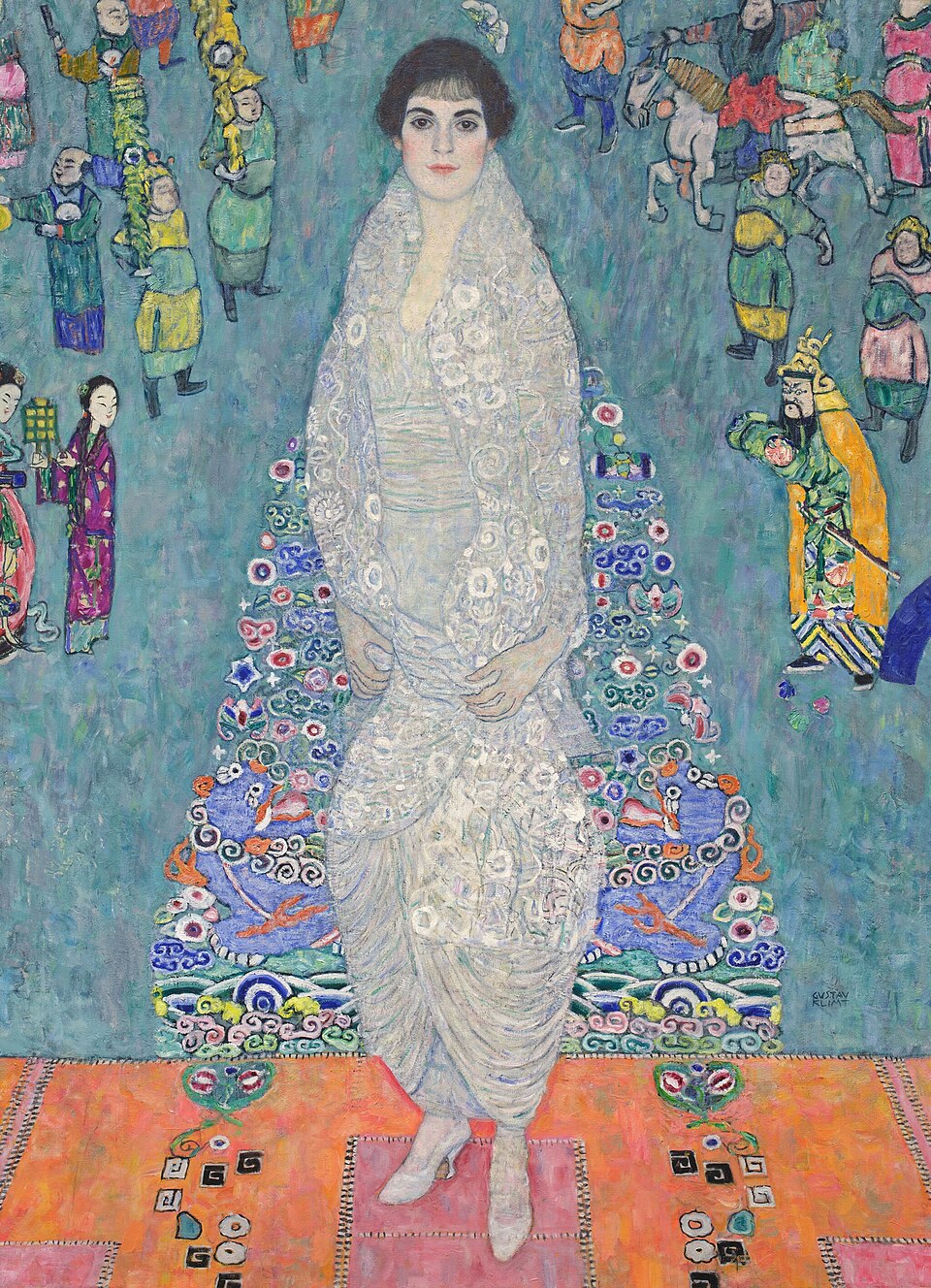
In 1914, Gustav Klimt began a portrait that would take him years to abandon rather than finish. His subject was Elisabeth Lederer, the daughter of August and Serena Lederer, Viennese industrialists who ranked, after the Rothschilds, as the wealthiest Jewish family in the city. Klimt lived nearby and visited often; he had already painted Elisabeth's mother in 1899, and would later turn to her grandmother, Charlotte Pulitzer, in 1915. Elisabeth's portrait was commissioned by her parents while she still lived at home, a young woman on the threshold of her own life.
Klimt dressed her, as he had dressed her mother, in white — but where Serena wore a loose gown, Elisabeth appears in a close-fitting top and an ambiguous, trouser-like skirt derived from Paul Poiret's fashionable 'hobble skirt', draped with a floral chiffon shawl. The look borrowed from Poiret's Paris, from his harem pantaloons and Chinese-inspired tunics that swept through early 1910s fashion. Beneath her white silk shoes lies a carpet of bold pink-orange, bordered in black and white in a style recalling the Wiener Werkstätte designers Josef Hoffmann and Wimmer-Wisgrill, its irregular green-and-white circles echoing Chinese jade.
Behind Elisabeth, the canvas grows harder to read. Art historian Emily Braun has argued that the background contains figures drawn from Chinese material culture and Peking opera — low-ranking soldiers, scholars, courtiers — rendered almost like a narrative unfolding behind her. Klimt owned ukiyo-e prints, kimonos, and Qing court robes, and kept books on East Asian art in his library; these interests surface here as they had in his Portrait of Adele Bloch-Bauer II and Portrait of Friederike Maria Beer, both indebted to the decoration of oriental ceramics. Infrared study later showed Klimt had painted out even more figures that once filled the space above the carpet, revising the composition as he went.
The portrait was never, by Klimt's own account, truly complete. He made many preparatory drawings of Elisabeth, developing the ornamental elements directly on the canvas, and traces of his charcoal underdrawing are still visible beneath the white garment. In 1916, Serena Lederer is said to have simply taken the painting from his studio, convinced it was finished, over Klimt's objections. He was paid 35,000 crowns. The work left the Lederer collection only once in this period, travelling to the 1917 Austrian Art Exhibition in Stockholm.
Elisabeth's own life soon diverged sharply from the poised figure in the painting. In 1921 she married Baron Wolfgang von Bachofen-Echt, converting to Protestantism, though she returned to Judaism after their divorce in 1938. That same year, the Anschluss shattered her family's world: much of the Lederer clan fled Austria, and the Nazis looted their extraordinary art collection. Elisabeth, remaining in Vienna, obtained a document claiming that Klimt — not August Lederer — was her biological father, a fiction that, with help from a senior Nazi official who had once been her brother-in-law, allowed her to escape the worst persecution. She died of a severe illness on 19 October 1944, still in the city where she had sat for Klimt three decades earlier.
More from Art

The Painting With No Foreground
A single robed figure stares out at an empty grey sea — and the emptiness itself became a scandal. When it was unveiled in Berlin in 1810, no one knew quite what to do with it.

The Painter Who Chased the Light
For a few purple minutes each evening, an American exile knelt in an English garden and raced the dying sun to paint two little girls lighting lanterns. It took him two years to finish.

When a President Became a God
Look straight up inside the U.S. Capitol dome and you will find George Washington enthroned among the clouds, surrounded by goddesses — the founding father transformed into myth.

Marble Brought Back to Life
A corpse asleep, a wing barely brushing her skin — and marble somehow learns to breathe. This is the moment Antonio Canova dared to carve.

The World Turned Upside Down
Look closely at a sixteenth-century Flemish village and you'll find a man biting a pillar, another carrying daylight in a basket, and a wife slipping a blue cloak over her husband's shoulders. Every gesture is a joke — if you know the language.

The Girl in the Glass Case
She stood two-thirds life size, dressed in a real tutu and human hair — and the critics who saw her in 1881 recoiled as if she were something obscene.