The Girl Who Faced the Wrong Way
A young Florentine woman stares past the viewer with a gaze that refuses to charm — and in that refusal, Leonardo da Vinci left America its only public painting.
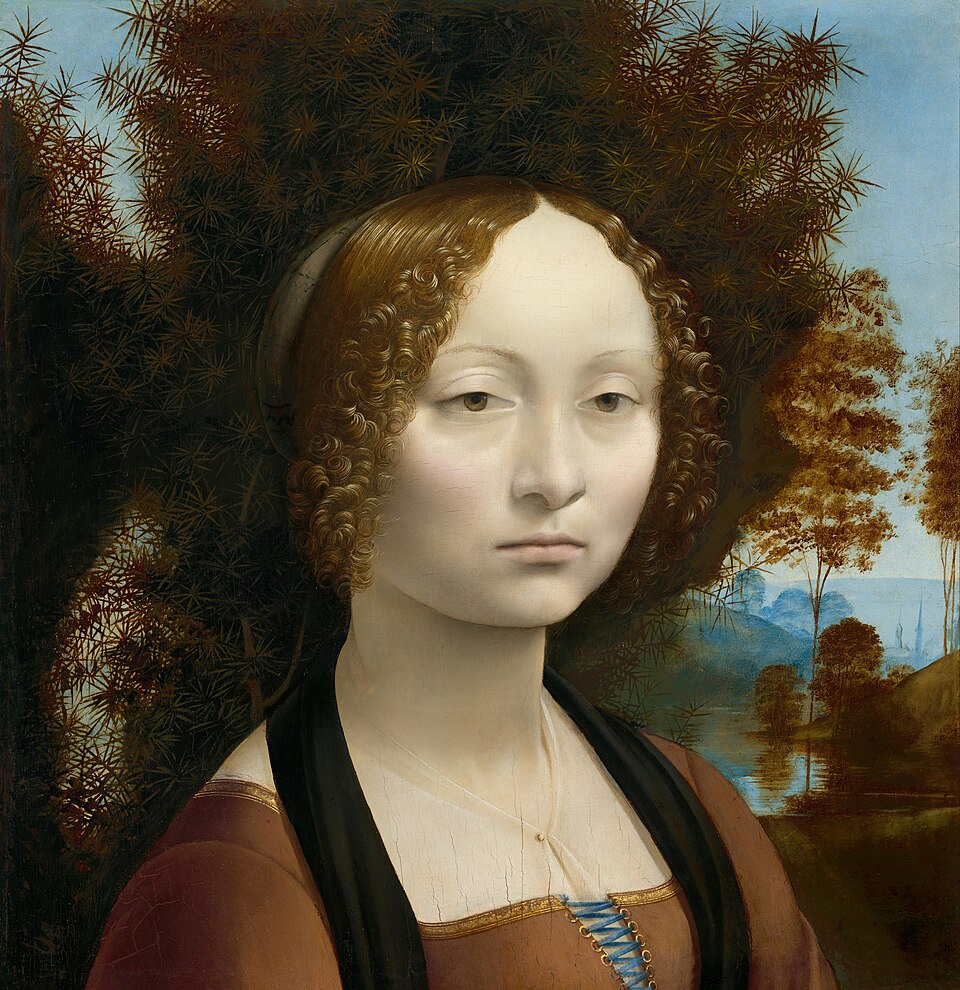
She looks at nothing in particular. That is the first strange thing about her. Painted sometime between 1474 and 1478 in Florence, Ginevra de' Benci gazes forward with an expression that seems almost bored by the person looking at her — no smile, no softness, just a level, indifferent stare that has unsettled and fascinated viewers for over five centuries.
Ginevra was a real young woman, born around 1458 into a prominent Florentine family, and the portrait is widely believed to commemorate her marriage — or more likely her engagement — to Luigi di Bernardo Niccolini when she was sixteen. Renaissance portraits of women were typically commissioned for one of two occasions: betrothal or marriage. Wedding portraits usually came in pairs, with the woman positioned on the right side of the panel, facing left toward her husband's matching image. Ginevra faces right instead, which art historians take as a clue that this was painted to mark her engagement rather than her wedding day.
Behind her, filling most of the background, is a dense screen of juniper — not simply decorative. In Renaissance Italy the juniper bush symbolized female virtue, and its Italian name, ginepro, doubles as a pun on Ginevra's own name. The plant is not just scenery; it is a signature, a visual echo of the woman it surrounds.
Turn the panel over, and the symbolism deepens. The reverse bears a painted sprig of juniper encircled by a wreath of laurel and palm, beneath the Latin motto Virtvtem Forma Decorat — 'Beauty adorns virtue.' The laurel and palm belonged to the personal emblem of Bernardo Bembo, a Venetian ambassador to Florence whose relationship with Ginevra, by all accounts platonic, is documented in poems the two exchanged. Infrared examination later revealed Bembo's own motto, 'Virtue and Honor,' hidden beneath the surface, suggesting he had some hand in commissioning the work.
Ginevra's beauty made her something of a celebrity in her own time, well beyond Leonardo's brush. Members of the Medici literary circle — Cristoforo Landino and Alessandro Braccesi — wrote ten poems about her, and Lorenzo de' Medici himself composed two sonnets in her honor. Giorgio Vasari later claimed she also appeared in Domenico Ghirlandaio's fresco of the Visitation of Mary and Elizabeth in Santa Maria Novella, though this claim is now considered mistaken — most scholars believe Vasari confused her with Giovanna Tornabuoni, whom Ghirlandaio actually painted.
More from Art

The Painting With No Foreground
A single robed figure stares out at an empty grey sea — and the emptiness itself became a scandal. When it was unveiled in Berlin in 1810, no one knew quite what to do with it.

The Painter Who Chased the Light
For a few purple minutes each evening, an American exile knelt in an English garden and raced the dying sun to paint two little girls lighting lanterns. It took him two years to finish.

When a President Became a God
Look straight up inside the U.S. Capitol dome and you will find George Washington enthroned among the clouds, surrounded by goddesses — the founding father transformed into myth.

Marble Brought Back to Life
A corpse asleep, a wing barely brushing her skin — and marble somehow learns to breathe. This is the moment Antonio Canova dared to carve.

The World Turned Upside Down
Look closely at a sixteenth-century Flemish village and you'll find a man biting a pillar, another carrying daylight in a basket, and a wife slipping a blue cloak over her husband's shoulders. Every gesture is a joke — if you know the language.

The Girl in the Glass Case
She stood two-thirds life size, dressed in a real tutu and human hair — and the critics who saw her in 1881 recoiled as if she were something obscene.