The Girl Who Sold for Two Guilders and a Handful of Coins
A tilted head, parted lips, one impossible pearl — and for two centuries almost nobody knew her name, or even where she had gone.
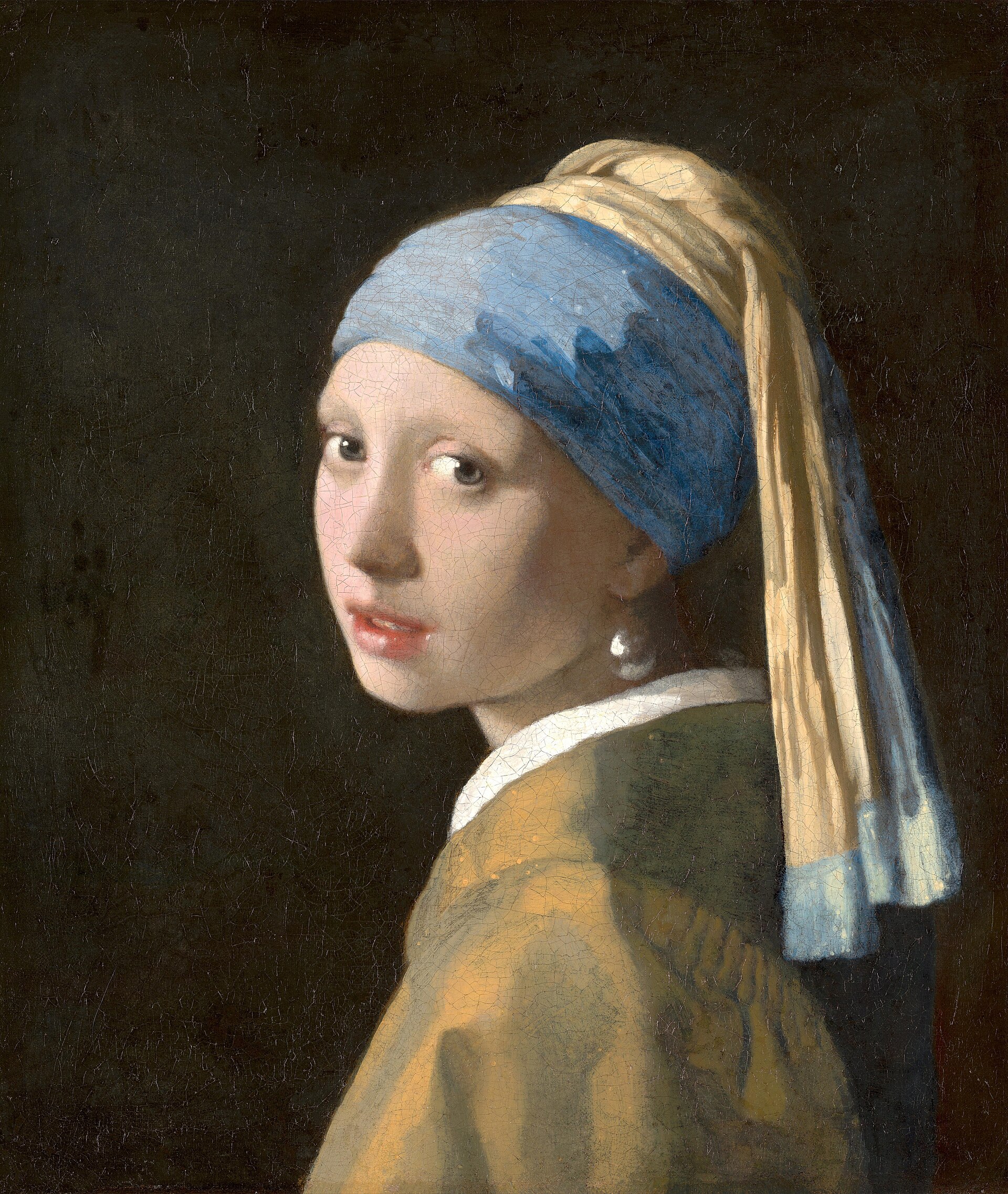
She turns over her shoulder as if someone has just called out to her, her grey-blue eyes catching the light, her lips slightly open, a giant pearl swinging from her ear. Johannes Vermeer painted her around 1665, in oil on canvas, just 44.5 centimetres tall and 39 wide — small enough to hold in two hands, yet vast enough to hold a mystery that still hasn't been solved.
The painting is not, technically, a portrait. It is what the Dutch of the seventeenth century called a tronie — a study of a head, an exercise in expression and costume rather than a record of a specific sitter. The girl wears an exotic turban-like blue headscarf with a long yellow tassel, and clothing unlike anything a European woman of the era would have worn day to day. Vermeer signed it simply 'IVMeer,' but left no date, and no name for the girl herself.
Who she was remains genuinely unknown. Some have guessed she was Vermeer's own eldest daughter, Maria, though many art historians reject this as an anachronistic guess. Others have proposed a household servant, a professional model, or pure invention — a face born entirely from imagination. Art historian Andrew Graham-Dixon has argued she might be Magdalena, the young daughter of Vermeer's patron Pieter van Ruijven, painted perhaps to mark a baptism. No document settles it.
The scarf's blue comes from ultramarine, ground from lapis lazuli, an extravagantly costly pigment that Vermeer used lavishly here. The dark background, now mottled and black, was originally a deep enamel-green, created with a thin glaze over black using indigo and weld — organic pigments that have since faded with time. Even the famous pearl is not what it seems: it has no visible contour and no hook to attach it to her ear, existing only as light and shadow. In 2014, astrophysicist Vincent Icke argued that its specular reflection and pear-like shape suggest polished tin rather than pearl at all.
For about two centuries after Vermeer's death, the painting vanished from the record. Its presumed first owner was the merchant Pieter van Ruijven, but afterward its trail goes cold until 1881, when it resurfaced at an auction in The Hague. There, a collector named Arnoldus des Tombe bought it for the astonishingly small sum of two guilders and thirty cents in buyer's premium — a painting bought, in effect, for pocket change, though it arrived damaged, with parts of its paint layer already detached.
More from Art

The Painting With No Foreground
A single robed figure stares out at an empty grey sea — and the emptiness itself became a scandal. When it was unveiled in Berlin in 1810, no one knew quite what to do with it.

The Painter Who Chased the Light
For a few purple minutes each evening, an American exile knelt in an English garden and raced the dying sun to paint two little girls lighting lanterns. It took him two years to finish.

When a President Became a God
Look straight up inside the U.S. Capitol dome and you will find George Washington enthroned among the clouds, surrounded by goddesses — the founding father transformed into myth.

Marble Brought Back to Life
A corpse asleep, a wing barely brushing her skin — and marble somehow learns to breathe. This is the moment Antonio Canova dared to carve.

The World Turned Upside Down
Look closely at a sixteenth-century Flemish village and you'll find a man biting a pillar, another carrying daylight in a basket, and a wife slipping a blue cloak over her husband's shoulders. Every gesture is a joke — if you know the language.

The Girl in the Glass Case
She stood two-thirds life size, dressed in a real tutu and human hair — and the critics who saw her in 1881 recoiled as if she were something obscene.