The Goat, the Crescent Moon, and the Dying Children
A horned goat crowned in oak leaves presides over a moonlit gathering of witches — and at its feet lie the bodies of infants. Goya painted it for a duchess in 1798, and it still unsettles.
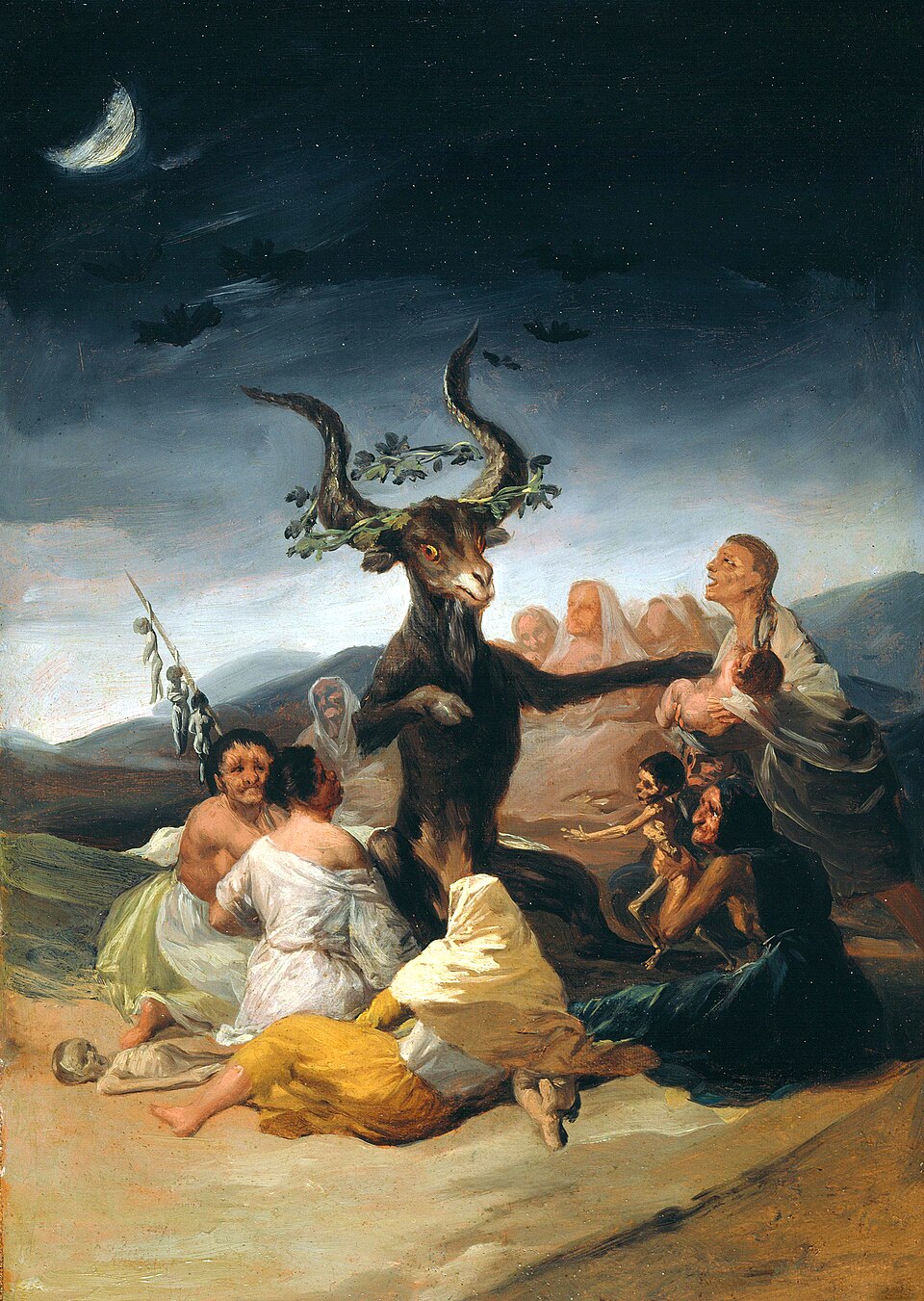
In the barren, moon-washed landscape of Francisco Goya's 1798 canvas, a monstrous goat sits enthroned among a coven of witches, young and old. Its horns are enormous, its head wreathed in oak leaves like some perverse crown. This is Satan, or a stand-in for him, presiding over what the painting's Spanish title calls an aquelarre — a witches' sabbath.
The scene is not merely eerie; it is horrifying in its particulars. To the right, an old crone holds an emaciated but still-living infant toward the goat, while a younger witch beside her offers a healthier child, as if in warning of the fate awaiting it. The Devil appears to act almost as an officiant, presiding over what looks like some grim initiation rite. Popular superstition of the era held that the Devil fed on children and unborn fetuses, and Goya leaned into that fear without flinching.
The painting does not spare the viewer further horrors: the dead body of an infant lies discarded on the left, while in the center foreground another child's legs are pinned to the ground, seemingly by a younger witch. In the background, more witches gather, and three dead infants hang by the neck from a stake. Overhead, bats wheel through the sky, their flight echoing the curve of a crescent moon that faces outward from the canvas's upper left corner — itself an inversion of expected symbolism, just as the goat extends its left hoof rather than its right toward the child before it.
Goya painted this canvas as part of a set of six works on witchcraft, purchased in 1798 by the Duke and Duchess of Osuna. It is believed that the duchess, rather than her husband, was behind the acquisition, though whether the paintings were commissioned outright or simply bought once finished remains unknown. Whatever the arrangement, an aristocratic household wanted these nightmarish images on its walls.
This was not the only time Goya returned to the imagery of the coven. Decades later, among his so-called Black Paintings, he painted another Witches' Sabbath, also called The Great He-Goat, between 1821 and 1823. The recurrence suggests the subject held a persistent grip on his imagination — or that it remained a useful vessel for ideas he wanted to express indirectly.
More from Art

The Painting With No Foreground
A single robed figure stares out at an empty grey sea — and the emptiness itself became a scandal. When it was unveiled in Berlin in 1810, no one knew quite what to do with it.

The Painter Who Chased the Light
For a few purple minutes each evening, an American exile knelt in an English garden and raced the dying sun to paint two little girls lighting lanterns. It took him two years to finish.

When a President Became a God
Look straight up inside the U.S. Capitol dome and you will find George Washington enthroned among the clouds, surrounded by goddesses — the founding father transformed into myth.

Marble Brought Back to Life
A corpse asleep, a wing barely brushing her skin — and marble somehow learns to breathe. This is the moment Antonio Canova dared to carve.

The World Turned Upside Down
Look closely at a sixteenth-century Flemish village and you'll find a man biting a pillar, another carrying daylight in a basket, and a wife slipping a blue cloak over her husband's shoulders. Every gesture is a joke — if you know the language.

The Girl in the Glass Case
She stood two-thirds life size, dressed in a real tutu and human hair — and the critics who saw her in 1881 recoiled as if she were something obscene.