The God Who Ruled the Eye of Europe
For three centuries, one marble archer defined what beauty meant to the Western world — until critics turned on him, and restorers finally gave him back a hand.
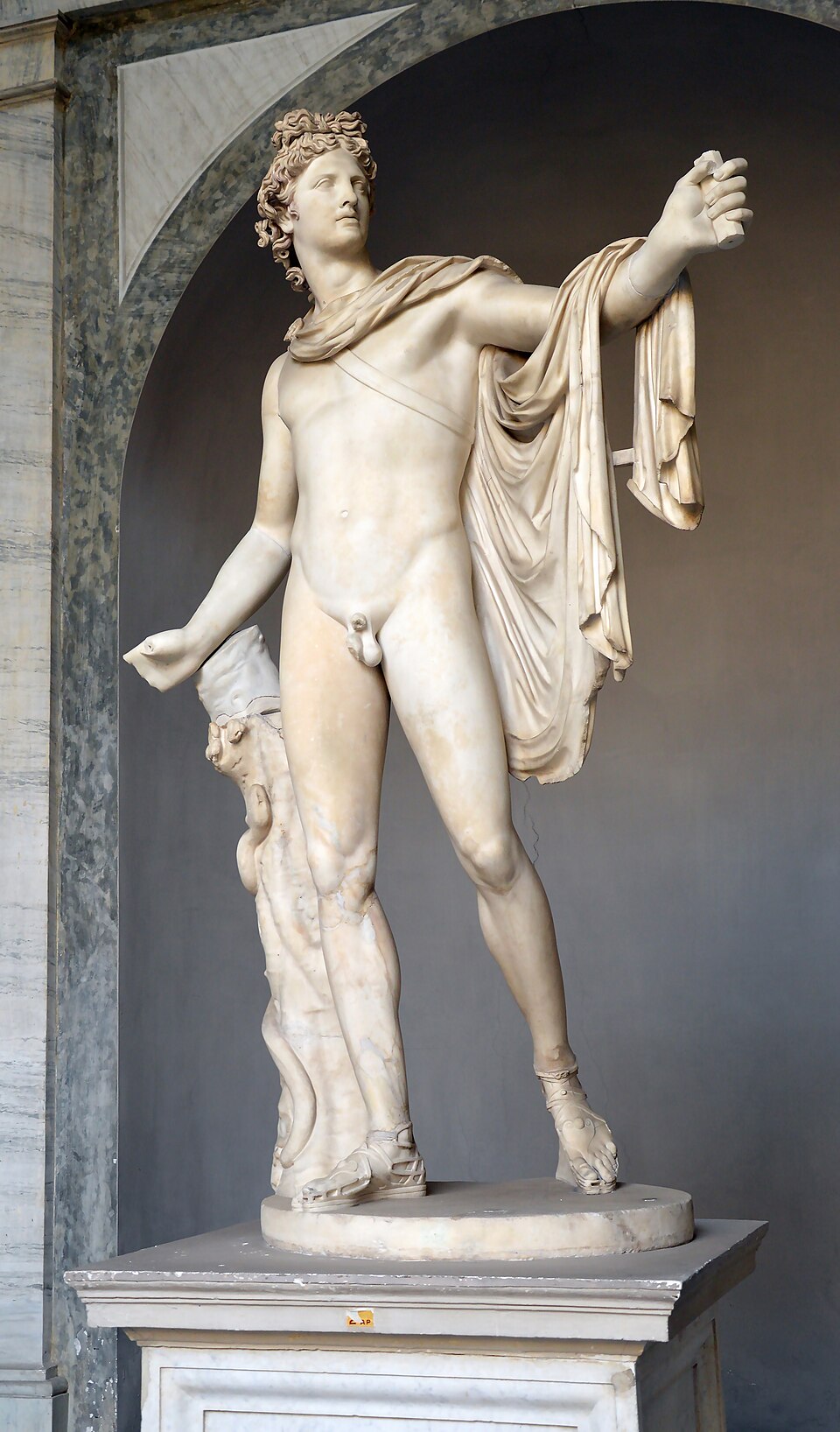
In 1489, somewhere near what is now Anzio, or perhaps in the abbot's garden at Grottaferrata, a marble statue emerged from the earth that would eventually command the admiration of emperors, poets, and popes. It depicted Apollo, the Greek god of light and archery, caught in the instant after loosing an arrow — his body twisted in a complex contrapposto, muscles still tensed with effort, hair curling in ringlets beneath a strophium, the band worn by gods and kings. Scholars still debate what exactly he had just done: slain the serpent Python at Delphi, struck down the giant Tityos, or intervened in the slaughter of the Niobids. Whatever the story, the sculpture itself needed no explanation to astonish those who saw it.
The statue belonged, before his papacy, to Cardinal Giuliano della Rovere. For a decade during the reign of Pope Alexander VI, della Rovere stayed away from Rome, and the Apollo stood quietly in his garden at SS. Apostoli — not, as long assumed, at his titular church of San Pietro in Vincoli. It was during these years that a pupil of Domenico Ghirlandaio sketched it twice, in drawings now kept at the Escorial, giving the world its first glimpses of the piece before fame found it.
Everything changed when della Rovere became Pope Julius II. In 1511, he moved the statue into the small sculpture court of the Belvedere, the summerhouse linked to the Vatican Palace by Bramante's grand Cortile del Belvedere. From that placement it took its enduring name. Artists flocked to see it. The Mantuan sculptor Pier Jacopo Alari Bonacolsi, known as 'L'Antico', modeled it in wax and cast it in gilded bronze for the Gonzaga collection. Albrecht Dürer, who likely saw it in Rome, reversed its pose for his Adam in a 1504 engraving of Adam and Eve. Michelangelo, Bandinelli, and Goltzius all sketched it, and in the 1530s Marcantonio Raimondi's engraving carried its silhouette across Europe.
When it was discovered, the lower right arm and the left hand were missing. The restoration fell to Giovanni Angelo Montorsoli, a pupil of Michelangelo, who reconstructed them in the 16th century — additions that shaped how the world saw the statue for nearly five hundred years.
The Apollo's true apotheosis came in the 18th century. In 1755, the German art historian Johann Joachim Winckelmann declared it the supreme expression of Greek aesthetic perfection, praising its 'noble simplicity and quiet grandeur.' The phrase became a rallying cry for neoclassicism and the Enlightenment itself. Goethe, Schiller, and Byron all added their endorsement. So total was its prestige that when Napoleon swept through Italy in 1796, the Apollo was among the treasures carried to Paris, entering the Louvre in 1798 during the First Empire — only to be returned to the Vatican after 1815.
More from Art

The Painting With No Foreground
A single robed figure stares out at an empty grey sea — and the emptiness itself became a scandal. When it was unveiled in Berlin in 1810, no one knew quite what to do with it.

The Painter Who Chased the Light
For a few purple minutes each evening, an American exile knelt in an English garden and raced the dying sun to paint two little girls lighting lanterns. It took him two years to finish.

When a President Became a God
Look straight up inside the U.S. Capitol dome and you will find George Washington enthroned among the clouds, surrounded by goddesses — the founding father transformed into myth.

Marble Brought Back to Life
A corpse asleep, a wing barely brushing her skin — and marble somehow learns to breathe. This is the moment Antonio Canova dared to carve.

The World Turned Upside Down
Look closely at a sixteenth-century Flemish village and you'll find a man biting a pillar, another carrying daylight in a basket, and a wife slipping a blue cloak over her husband's shoulders. Every gesture is a joke — if you know the language.

The Girl in the Glass Case
She stood two-thirds life size, dressed in a real tutu and human hair — and the critics who saw her in 1881 recoiled as if she were something obscene.