The God Who Sat Beneath a Roof He Could Break
A seated god, twelve meters tall, coated daily in oil to keep his ivory skin from cracking — a Roman general reportedly wept just from looking at him. Then, one day, he simply vanished.
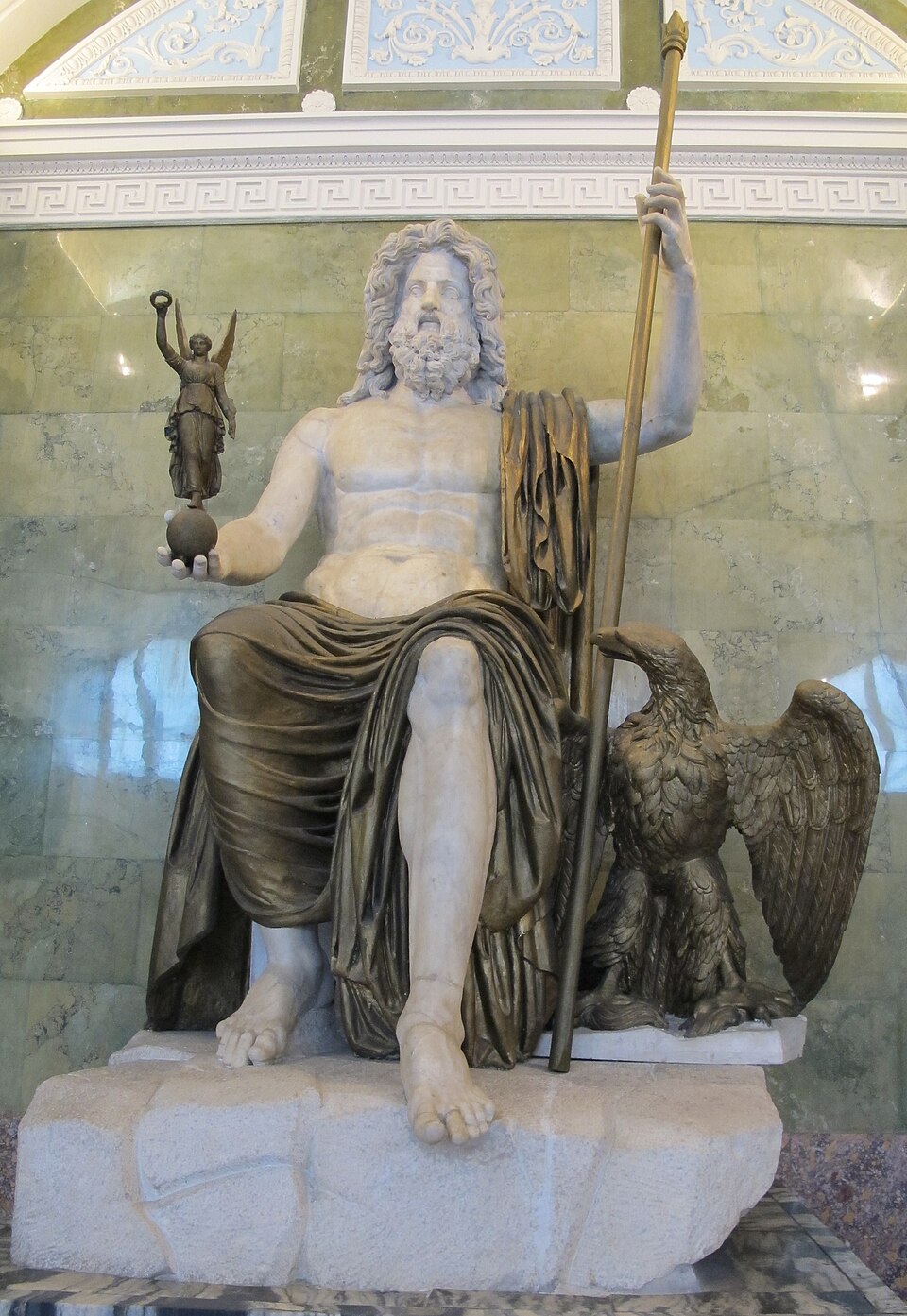
In the sanctuary of Olympia, around 435 BC, the sculptor Phidias began work on a statue so immense that the geographer Strabo would later joke it seemed as though, should the god rise from his throne, he would tear the roof clean off the temple built to house him. The Eleans, custodians of the Olympic Games, had commissioned the work in the latter half of the fifth century BC, eager to outdo their Athenian rivals. Phidias was their man — he had already given Athens its towering Athena Parthenos, and now he would give Olympia its Zeus.
The statue was chryselephantine: ivory plates for the god's flesh, gold panels for hair, robe, and beard, all mounted on a hidden wooden framework. Zeus sat upon a painted cedarwood throne inlaid with ebony, ivory, gold, and precious stones, a wreath of olive sprays crowning his head. His right hand cradled a small golden statue of Nike, goddess of victory; his left gripped a scepter topped with an eagle. Golden sandals rested on a footstool carved with a battle between Greeks and Amazons, and beneath the throne, painted screens restricted the passage.
The 2nd-century traveler Pausanias, who left the fullest surviving description, also recorded a strange practical detail: the statue had to be constantly anointed with olive oil, a defense against the dampness of the surrounding Altis grove that threatened to warp its ivory. A shallow pool paved in black tile and rimmed with marble caught the excess oil in front of the god's feet — and, some now suspect, doubled as a reflecting surface that made the towering figure seem to hover above still water.
Those who saw it did not forget it. The Roman historian Livy wrote that the general Aemilius Paullus, victor over Macedon, was 'moved to his soul, as if he had seen the god in person.' Plutarch recorded Paullus declaring that Phidias had sculpted 'the Zeus of Homer.' The orator Dio Chrysostom went further, claiming a single glimpse of the statue could make a man forget all his earthly troubles.
More from Art

The Painting With No Foreground
A single robed figure stares out at an empty grey sea — and the emptiness itself became a scandal. When it was unveiled in Berlin in 1810, no one knew quite what to do with it.

The Painter Who Chased the Light
For a few purple minutes each evening, an American exile knelt in an English garden and raced the dying sun to paint two little girls lighting lanterns. It took him two years to finish.

When a President Became a God
Look straight up inside the U.S. Capitol dome and you will find George Washington enthroned among the clouds, surrounded by goddesses — the founding father transformed into myth.

Marble Brought Back to Life
A corpse asleep, a wing barely brushing her skin — and marble somehow learns to breathe. This is the moment Antonio Canova dared to carve.

The World Turned Upside Down
Look closely at a sixteenth-century Flemish village and you'll find a man biting a pillar, another carrying daylight in a basket, and a wife slipping a blue cloak over her husband's shoulders. Every gesture is a joke — if you know the language.

The Girl in the Glass Case
She stood two-thirds life size, dressed in a real tutu and human hair — and the critics who saw her in 1881 recoiled as if she were something obscene.