The Goddess Who Went to Look at Herself
A marble woman stood alone in a temple open to the wind, and men crossed the sea just to look at her — one young visitor allegedly loved her too much for his own good.
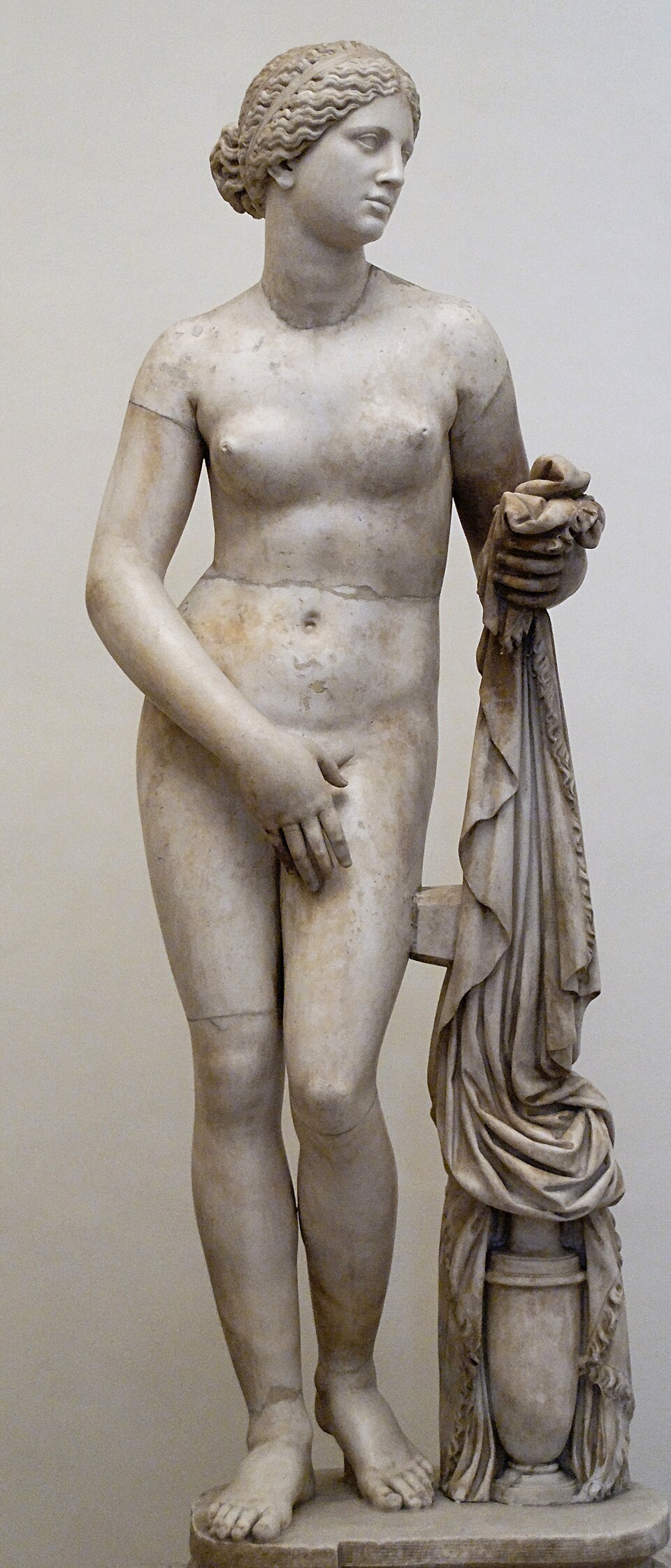
Sometime around the middle of the 4th century BC, the people of Knidos purchased a statue that would change the course of Western art. It was carved by Praxiteles of Athens, one of the most celebrated sculptors of his age, and it showed the goddess Aphrodite entirely nude — reaching for her bath towel with one hand while modestly shielding herself with the other. Until that moment, Greek sculpture had reserved nudity for men; heroic kouroi stood bare while goddesses like the kore figures remained clothed. Aphrodite of Knidos broke that rule completely, and nothing in Greek art would look the same again.
According to Pliny the Elder, Praxiteles had actually carved two versions of Aphrodite for the people of Kos: one draped, one nude. The Koans, wary of the naked figure, chose the clothed version instead. Knidos took the discarded nude one, and the decision made the small city famous. The statue was installed as the cult image in the Temple of Aphrodite at Knidos, a building ancient writers describe in slightly different terms — Pliny suggests an open colonnade, while Pseudo-Lucian describes doors and a more enclosed space. Excavations by Iris Love between 1969 and 1972 uncovered a round structure at Knidos, along with a stone inscribed 'PRAX,' which she proposed was the statue's base.
The Aphrodite was designed to be admired from every angle, her body twisting in a graceful contrapposto, weight resting on one foot, her head turned to the side. Most copies show her right hand covering her pubic area while her left holds drapery near a supporting vase — though it's never quite clear whether she is picking the cloth up or setting it down. She was painted in lifelike color, and ancient sources insist she was so convincing that men responded to her with genuine desire.
That desire became legend. In the dialogue Erotes, traditionally attributed to Lucian of Samosata, a temple priestess tells visitors that a young man once broke into the sanctuary at night and attempted to embrace the statue, leaving a stain behind. Ashamed at being discovered, he is said to have thrown himself from a nearby cliff. Whether literally true or not, the story captures how uncannily real the statue seemed to those who saw it.
Her fame reached royalty. Nicomedes I of Bithynia is said to have offered to erase the crushing debts of the city of Knidos in exchange for the statue — an offer so tempting that most cities would have leapt at it. The Knidians refused. They would rather remain poor with their Aphrodite than wealthy without her.
More from Art

The Painting With No Foreground
A single robed figure stares out at an empty grey sea — and the emptiness itself became a scandal. When it was unveiled in Berlin in 1810, no one knew quite what to do with it.

The Painter Who Chased the Light
For a few purple minutes each evening, an American exile knelt in an English garden and raced the dying sun to paint two little girls lighting lanterns. It took him two years to finish.

When a President Became a God
Look straight up inside the U.S. Capitol dome and you will find George Washington enthroned among the clouds, surrounded by goddesses — the founding father transformed into myth.

Marble Brought Back to Life
A corpse asleep, a wing barely brushing her skin — and marble somehow learns to breathe. This is the moment Antonio Canova dared to carve.

The World Turned Upside Down
Look closely at a sixteenth-century Flemish village and you'll find a man biting a pillar, another carrying daylight in a basket, and a wife slipping a blue cloak over her husband's shoulders. Every gesture is a joke — if you know the language.

The Girl in the Glass Case
She stood two-thirds life size, dressed in a real tutu and human hair — and the critics who saw her in 1881 recoiled as if she were something obscene.