The Golden Blindness of Gassed
On a fine August evening, an American painter chasing 'an epic' stumbled upon a field of blindfolded men — and found the war's truest image in their staggering line.
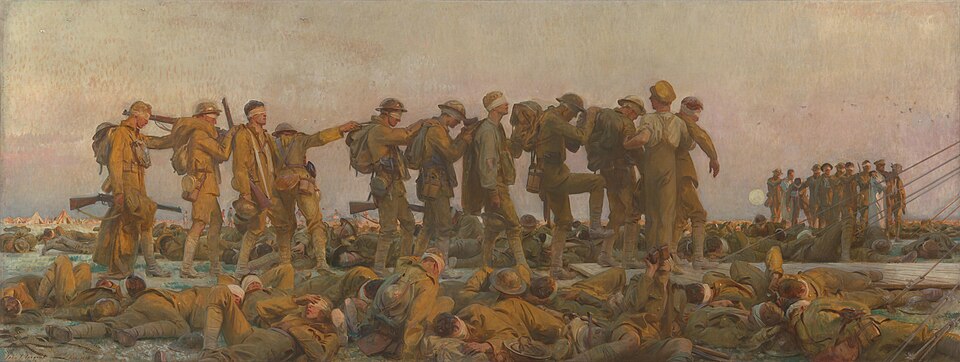
John Singer Sargent was 62 years old and already the most celebrated portraitist of his age when the British War Memorials Committee asked him to do something entirely new: paint the First World War. As an American expatriate, he was specifically wanted for a work that embodied Anglo-American co-operation, part of a grand plan for a Hall of Remembrance that would also feature commissions from Percy Wyndham Lewis, Paul Nash, Henry Lamb, John Nash and Stanley Spencer, all inspired by the scale of Uccello's Battle of San Romano triptych.
In July 1918, accompanied by fellow painter Henry Tonks, Sargent travelled to the Western Front, spending time first with the Guards Division near Arras, then with the American Expeditionary Forces near Ypres. He was determined to paint something monumental, full of human figures, but struggled for weeks to find British and American troops sharing a single scene. In September he confided to Evan Charteris his frustration: the Ministry expected an epic, yet he had seen only three subjects with 'masses of men' — a road crowded with troops, a train of trucks packed with soldiers, and, most harrowing of all, a field full of gassed and blindfolded men.
That harrowing sight had come on 21 August 1918, at Le Bac-du-Sud, near Bailleulval between Arras and Doullens. German mustard gas had struck the advancing 99th Brigade of the 2nd Infantry Division and the 8th Brigade of the 3rd Infantry Division during the Second Battle of Arras. General Haldane, commanding VI Corps, later recalled the moment: the sun had burst through the morning mist, vaporizing the gas, and soon after, officers and men were blinded and disabled. Sargent, who happened to arrive at the dressing station, had earlier told Haldane he wanted to paint something typical of the war; Haldane had suggested tanks. Instead, watching the gassed men led practically blind by their comrades, Sargent recognized he had found his subject.
Henry Tonks later described the scene in a letter to Alfred Yockney: gassed cases kept arriving at the Corps dressing station along the Doullens road, led in parties of about six by an orderly, exactly as Sargent would depict them. Several hundred men sat or lay on the grass, suffering greatly, their eyes covered with lint. It was, Tonks noted, a very fine evening, with the sun toward setting — and Sargent, deeply struck, immediately began making notes.
Back in his studio in Fulham, Sargent spent from late 1918 to March 1919 turning those notes into Gassed, a painting measuring 231.0 by 611.1 centimetres — roughly 7 feet 7 inches high and 20 feet wide. Its composition centers on a group of eleven soldiers depicted nearly life-size: ten wounded and blindfolded men walk in a line along a duckboard, guided by a medical orderly toward a dressing station suggested only by ropes at the picture's edge. Their procession, naturalist yet almost liturgical, evokes a religious frieze. Around them lie other wounded and dead, while in the background a second line of eight blinded men advances behind two more orderlies.
More from Art

The Painting With No Foreground
A single robed figure stares out at an empty grey sea — and the emptiness itself became a scandal. When it was unveiled in Berlin in 1810, no one knew quite what to do with it.

The Painter Who Chased the Light
For a few purple minutes each evening, an American exile knelt in an English garden and raced the dying sun to paint two little girls lighting lanterns. It took him two years to finish.

When a President Became a God
Look straight up inside the U.S. Capitol dome and you will find George Washington enthroned among the clouds, surrounded by goddesses — the founding father transformed into myth.

Marble Brought Back to Life
A corpse asleep, a wing barely brushing her skin — and marble somehow learns to breathe. This is the moment Antonio Canova dared to carve.

The World Turned Upside Down
Look closely at a sixteenth-century Flemish village and you'll find a man biting a pillar, another carrying daylight in a basket, and a wife slipping a blue cloak over her husband's shoulders. Every gesture is a joke — if you know the language.

The Girl in the Glass Case
She stood two-thirds life size, dressed in a real tutu and human hair — and the critics who saw her in 1881 recoiled as if she were something obscene.