The Grey Canvas That Screamed for Guernica
On a market-day afternoon, German bombs turned a Basque town into ash — and an artist in Paris turned that horror into the 20th century's most haunting warning.
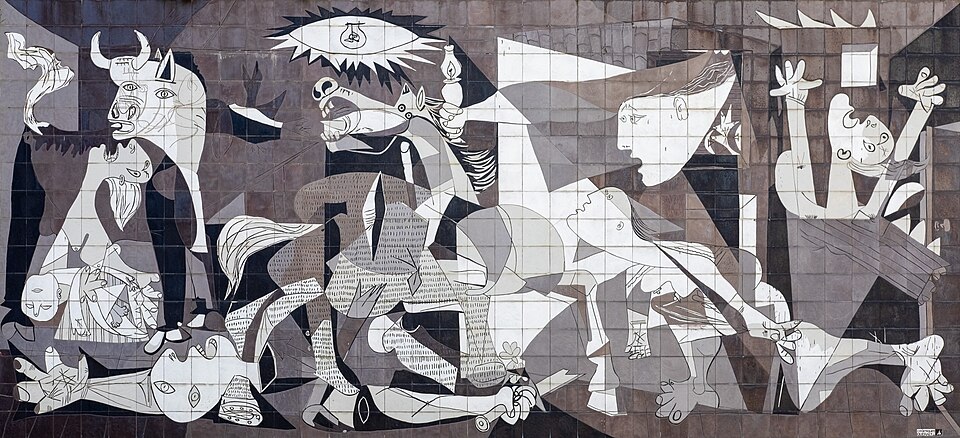
In January 1937, Pablo Picasso was living quietly on Rue des Grands Augustins in Paris when the Spanish Republican government asked him for something monumental: a mural for the Spanish pavilion at that year's Paris International Exposition. For months he sketched half-heartedly, circling his old obsession — an artist's studio. Nothing about it demanded urgency.
Then, on 26 April 1937, everything changed. German aircraft of the Condor Legion, sent by Hitler to aid General Franco, descended on the small Basque town of Guernica and bombed it for nearly two hours. It was market day; most men were away fighting, so the dead and wounded were overwhelmingly women and children. Estimates of the toll range from 250 to 1,600 killed. The nearby war factory, ironically, survived untouched — proof to observers that this had been an act of terror against civilians, not a military strike.
The poet Juan Larrea rushed to Picasso's home urging him to make this atrocity his subject. Days later, on 1 May, Picasso read journalist George Steer's eyewitness account, first published in The Times and The New York Times, describing bombers unloading bombs and incendiaries for three hours and fifteen minutes while fighters machine-gunned fleeing civilians. Picasso abandoned his studio sketches and began the preliminary drawings for what would become Guernica.
He worked fast — reportedly completing the vast mural within about fifteen days. The finished canvas, 3.49 meters tall and 7.76 meters wide, rendered entirely in black, white and grey, evokes newspaper photographs of the time and denies its subject any comforting color. Picasso deliberately avoided abstraction for its own sake; every distorted form carries weight.
Within the painting's single, chaotic room: a bull with wide eyes stands over a woman wailing over her dead child. At the center, a horse pierced by a spear collapses in agony, its teeth shaped disturbingly like a human skull. Beneath it lies a dismembered soldier gripping a broken sword from which a flower grows. Above the horse, a bare bulb shaped like an eye glares down. A woman thrusts a lamp through a window, bearing witness; another staggers toward the center, gazing blankly at the light. Tongues shaped like daggers stand in for screams. At the far right, a man raises his arms amid flames, trapped between a black wall and an open door.
More from Art

The Painting With No Foreground
A single robed figure stares out at an empty grey sea — and the emptiness itself became a scandal. When it was unveiled in Berlin in 1810, no one knew quite what to do with it.

The Painter Who Chased the Light
For a few purple minutes each evening, an American exile knelt in an English garden and raced the dying sun to paint two little girls lighting lanterns. It took him two years to finish.

When a President Became a God
Look straight up inside the U.S. Capitol dome and you will find George Washington enthroned among the clouds, surrounded by goddesses — the founding father transformed into myth.

Marble Brought Back to Life
A corpse asleep, a wing barely brushing her skin — and marble somehow learns to breathe. This is the moment Antonio Canova dared to carve.

The World Turned Upside Down
Look closely at a sixteenth-century Flemish village and you'll find a man biting a pillar, another carrying daylight in a basket, and a wife slipping a blue cloak over her husband's shoulders. Every gesture is a joke — if you know the language.

The Girl in the Glass Case
She stood two-thirds life size, dressed in a real tutu and human hair — and the critics who saw her in 1881 recoiled as if she were something obscene.